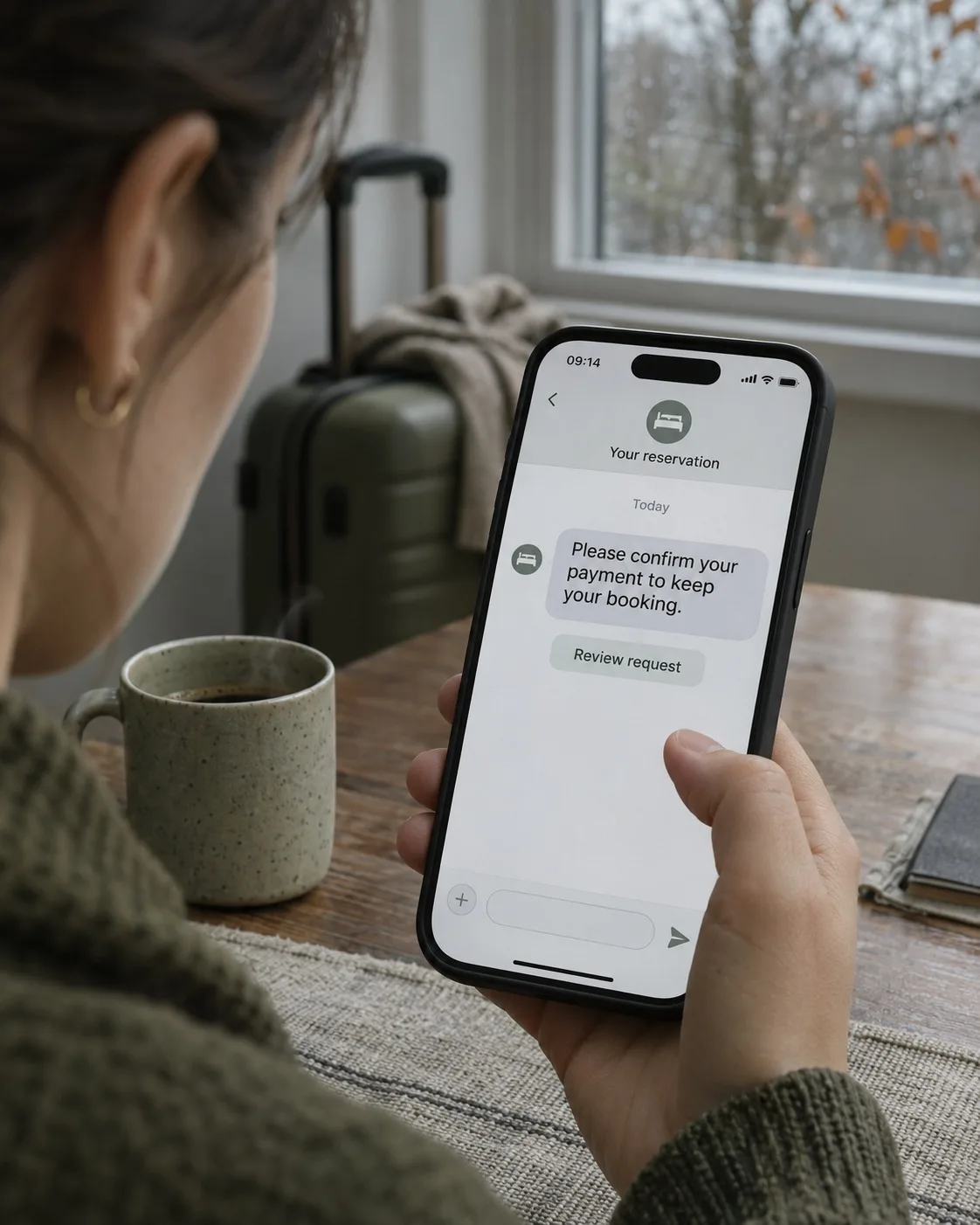
Is a WhatsApp message asking me to verify my card for a booking a scam?
Yes. A hotel, a host or a platform such as Booking.com, Airbnb or Vrbo does not ask a guest to re-enter a card through a link sent by WhatsApp, SMS or email. Researchers Martin Chlumecký and Luis Corrons of Gen Digital described the method on 25 March 2026 and named it the reservation hijack scam: criminals who hold real reservation details pose as the property or the platform, quote the guest's name, the place and the dates, and send a link to a fake payment page. The deadline is part of the method, usually 24 to 48 hours.
The wording changes little from country to country. Guests of Australian hotels and holiday parks were told that their card had been blocked and that the reservation would be canceled unless they verified it, ABC News reported on 29 October. Italy's Polizia Postale warned earlier this year about messages that appear to come from the booking site, show the amount already paid and demand a new payment at once, often by instant bank transfer, Telefonino.net reported on 23 February.
Which booking systems were breached in 2026?
Sardinia Blog found 11 incidents with a public source between 14 October and 26 November 2026. They fall into three groups, and the difference matters. Each line gives the date, what the company confirmed and what it says did not happen.
Unauthorized access confirmed (9)
- 14 October, Welcome Hotels (Germany). Its notice, updated that day, reports an incident at a subprocessor of its booking-engine supplier, which it does not name. Names, email addresses, phone numbers and travel dates were affected. The supplier says card data was not visible.
- 19 October, Misterbooking (France, hotel software). The French hotel trade body GHR wrote on 23 October that, according to the publisher, an outsider reached an application server and extracted a large part of the stored data: identity and contact details of guests and their companions, booking information and documents attached to guest files. GHR added, in the conditional, that full card data appears not to be involved.
- 26 October, Visit Group (Sweden, booking platform). The Swedish Tourist Association says a breach at its booking provider was stopped on 26 October and touched 1,392 of its bookings: names, addresses, phone numbers, email addresses and booking details. Card details are not stored in that system.
- 29 October, RMS (Australia, booking platform). RMS told ABC News that guest names, contact details and booking information were taken and that card and payment details were not. ABC put the system at more than 6,000 properties.
- 4 and 5 November, Guestline (United Kingdom, hotel software). Hotel Wiehberg in Germany says a weakness in a guest-facing Guestline service was exploited on those two days, giving read-only access to guest records: name, email address, arrival and departure dates. Payment data was not identified as affected.
- 6 November, LekkeSlaap (South Africa, booking platform). It confirmed to ITWeb unauthorized activity in its calendar-syncing system, with names, email addresses, phone numbers and booking references exposed. It said no payment information, identity numbers or passwords were accessed.
- 12 November, Kempinski (hotels). A login used by a third-party technology partner was misused to reach names, stay dates, hotel, itinerary numbers, mobile numbers and email addresses. The group says it can neither confirm nor exclude that passport or visa numbers were seen, and that "No payment card information was involved."
- 20 November, Seekom (New Zealand, booking and property software). It says it identified unauthorized access to its iBex platform on 20 November. The data may include names, addresses, email addresses, phone numbers, dates of birth and masked payment details, and for a small proportion of guests free-text notes that can hold ID numbers or card details. It is still confirming who is affected.
- 26 November, Flight Centre (Australia). The travel group told the Australian stock exchange of "unusual activity" in a third-party accommodation booking system used by Flight Centre, Travel Associates, Cruiseabout and some independent agents. A significant number of customer records may have been accessed: names and basic travel information, and for a very small percentage limited passport details, email addresses, phone numbers and birth dates. It says flights, corporate bookings and, so far, payment card data are not affected. It has not named the supplier.
Access confirmed, contents not confirmed (1)
- 12 November, Expedia Group (owner of Vrbo and Hotels.com). It told Skift that attackers reached its systems through a compromised third-party data platform provider. It has not confirmed the supplier, the scale or the data. An extortion group claims nearly a billion records; that is the attackers' figure and nobody has verified it.
Data collected without a break-in, by the company's account (1)
- 19 to 22 November, OwnerRez (United States, vacation-rental software). Chief executive Paul Waldschmidt wrote on 23 November that booking links were gathered at scale through public pages, calendar feeds and rental agreement pages. About four in ten accounts had at least one booking involved: name, often phone number, email address, address, property and stay dates. "Nobody broke into OwnerRez," he wrote. No passwords or cards were exposed, and the route was closed within about five hours of the company learning of it.
Two more were reported and are not in the count. ITWeb wrote that NightsBridge, another South African booking system, disclosed unauthorized access in the same week as LekkeSlaap; we found no notice from the company. In Denmark, AK Techotel reported a leak of hotel bookings on 7 November, and its managing director said the data might have come from somewhere else. Earlier in the year, Booking.com told customers that unauthorized third parties had accessed reservation data including booking details and names, Skift reported on 13 April.
What data was taken, and were card numbers stolen?
Mostly who the guest is and when they travel. No company has confirmed that full card numbers were taken. Names were named in 10 of the 11 incidents, an email address or phone number in 9 plus a small share of records in a tenth, and stay dates or booking details in 9. Passport or ID numbers appear in 3, each time for part of the records or as something the company cannot rule out. Card data appears once, at Seekom, as a possibility in free-text notes.
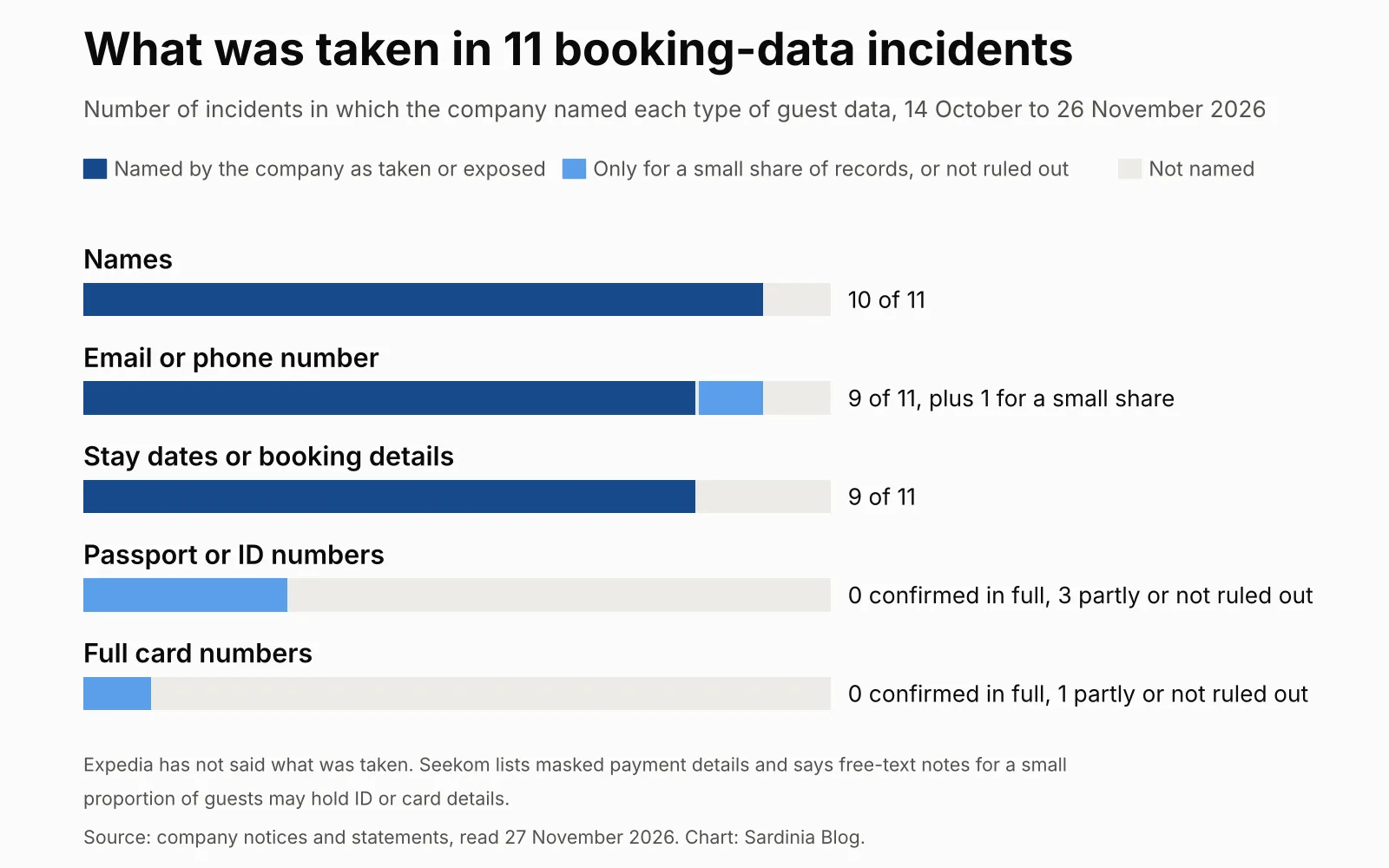
This explains the scam. With a name, a phone number and the dates of a stay, a stranger can write a message that reads as if it came from the host. The one thing the stranger lacks is the card, so the message asks for it.
Does a host in Italy need my ID, and is the tourist tax real?
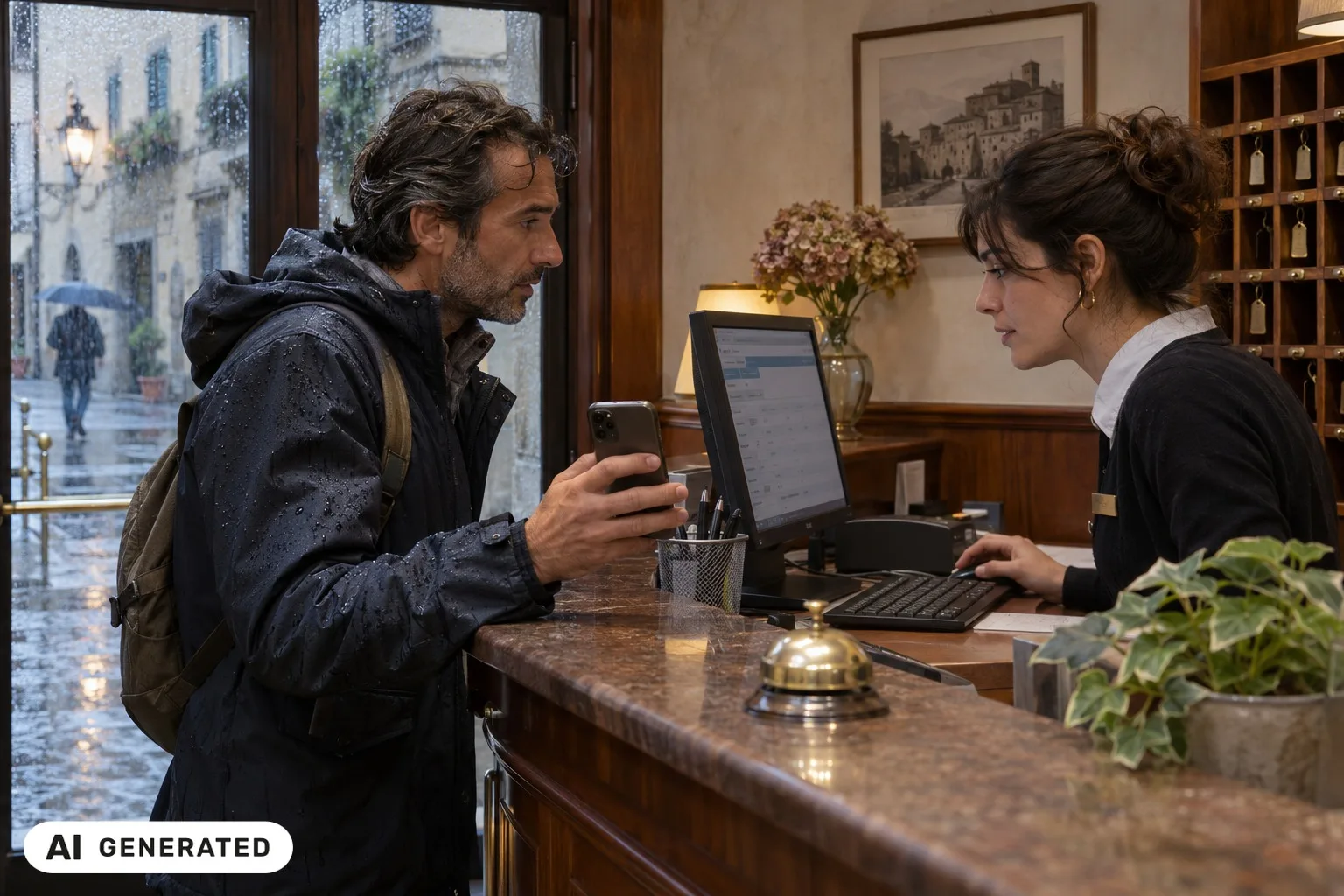
Yes to both, and scammers copy both. Article 109 of Italy's public-security law, the TULPS, lets hotels, holiday homes and short lets lodge only guests who show an identity document, and obliges the operator to send the guests' details to the Questura, the provincial police headquarters, within 24 hours of arrival. In practice this goes through Alloggiati Web, a portal of the Polizia di Stato. Olbia also charges a tourist tax of €3.50 per person per night in most B&Bs and private holiday homes, or 5% of the price when a booking portal collects it, for at most seven nights, with children under 16 exempt.
| Request | Where it arrives | What it asks for | Deadline or threat |
|---|---|---|---|
| Guest ID check (art. 109 TULPS) | From your host, in the platform's message thread, by the host's known email or at the door | Name and identity document of each guest | None for the guest. The host has 24 hours after arrival to report |
| Tourist tax in Olbia | At check-in, or through the portal you booked on | €3.50 per person per night in most holiday homes, or 5% of the price through a portal | None |
| Scam message | WhatsApp, SMS or email from a number or address you have never dealt with | Card number, a "verification" or a bank transfer, through a link | Pay within hours or the booking is canceled |
A genuine ID check never asks for a card number, and a genuine tax is a small sum set by the town, not by the sender of a message.
What should I do if I already entered my card?
Call the bank or card issuer first, have the card blocked and dispute any charge. Then:
- Tell the host and the platform through the app or website where the booking was made, not through the message that asked for the card.
- Keep screenshots of the message, the number and the page, then report and block the sender in WhatsApp.
- In Italy, report it to the Polizia Postale through its portal, commissariatodips.it. Elsewhere, report it to the police at home.
Anyone who clicked the link and entered nothing has lost nothing. Block the sender and tell the host, who may need to warn other guests.
Why this matters for a Sardinia trip in 2027
Summer stays for 2027 are being booked now, so a guest's name, phone number and dates will sit in a booking system for six months or more before arrival. Hotels and holiday homes in Sardinia use the same kinds of software as those in the list above. The scam messages do not have to arrive the week of the breach; they can come when the trip is close and a payment request seems plausible. Anyone still choosing where to stay on the island can ask the host one question before paying: how, and through which channel, will you ask me for money or documents?
We asked an Olbia rental company how it protects its guests
Rental12, a holiday-rental company in Olbia, shares an owner with Sardinia Blog, so read these answers as a company's own account.
Sardinia Blog put five questions to Rental12 on 27 November. Floriana Panvini Rosati, its chief executive and co-founder, answered.
What do you tell a guest right after they book, and why at that moment?
"Every guest gets a short security note from us right after booking, on whichever channel they booked. It says what we will never ask for and where our real requests come from. We send it straight away because a scam message can arrive any time after a booking exists, and a guest who knows the rules does not have to guess."
How does a guest recognize a real message from Rental12? Where do your requests for ID and payment arrive?
"We write in the conversation on the platform you booked on, and by email for direct bookings. Your ID is requested only in Vikey, our online check-in, and the link comes from us in that same conversation. Payments go only through the platform you booked on or through our own booking and check-in systems. We never ask for a bank transfer or cash. Booking.com guests also pay the tourist tax in Vikey, by card."
What should a guest do if a message asks them to verify a card or pay again?
"Our note puts it in two sentences: 'We will never ask you to verify your credit card or confirm your reservation details by message, email, or WhatsApp. If you get such a request, it is a scam: don't click anything and tell us.' If you are unsure about any message, ask us first in the booking conversation."
Your site describes a €10,000 Payment Integrity Guarantee. What does it cover, and what does it not cover?
"It is our own guarantee, backed by reserves the owners hold in the company. It is not an insurance policy. It stands behind three things: every home we list is one we own and have verified, so there are no fake listings; cancellations are refunded on the terms we state; and if a payment goes wrong in processing, we fix it within 24 hours. It cannot cover money sent to someone pretending to be us, and that is the reason we warn guests on the first day."
Have guests told you they received such messages? What did they do?
"Yes. On 27 November a guest replied to our note within minutes. She had received scam messages on WhatsApp about a booking she made on Airbnb with another host. She did not click the link, she reported the number to WhatsApp and blocked it, and her host reported it to Airbnb. She told us how easy it is to answer in a rush when a message says the booking will be canceled unless you reply in time."
The guest is not named because she has not agreed to be published. Rental12's trust page, read on 27 November, lists the same three points for the guarantee.
A note on the numbers
We counted an incident only when one of four sources confirmed it: the company's own notice, a notice from a customer that names it, a stock-exchange statement, or a news report quoting the company. That gives 11 between 14 October and 26 November 2026: nine with confirmed unauthorized access, one where access is confirmed and the contents are not, and one where the company says data was collected without a break-in. The dates are a mix of when an incident happened, when it was found and when a notice was updated, because the companies do not all give the same one. Misterbooking rests on a single relayed source, the trade body GHR, which does not say whether the attached documents include identity papers. Welcome Hotels and Flight Centre do not name the supplier involved, so two of the 11 could be the same system as another on the list. The count is a floor: a provider that told its customers privately and published nothing is not in it. The chart counts what each company named, not how many guests were affected, a figure most of them have not given.
Sources: the notices and reports linked above, and ABC News, 26 November 2026, for Flight Centre. Also used, not linked: ABC News, 29 October 2026 (RMS) · ITWeb, 6 November 2026 (LekkeSlaap, NightsBridge) · GHR, 23 October 2026 (Misterbooking) · Welcome Hotels data-breach notice, updated 14 October 2026 · VSec, 7 November 2026 (AK Techotel) · Skift, 13 April 2026 (Booking.com) · Gen Digital, "The Reservation Hijack Scam", 25 March 2026 · Telefonino.net, 23 February 2026 (Polizia Postale) · LeggeInChiaro on article 109 TULPS.
Related reading
Elsewhere on Sardinia Blog: the 2027 travel lists that put Sardinia in front of new visitors; the EU plan to limit short-term rentals; and the 21.9 million overnight stays Sardinia counted in 2025.
Rental12, a holiday-rental company in Olbia that shares an owner with Sardinia Blog, answered our questions in the section above; its press archive holds company statements, not independent evidence.