
What CGIA counted
The Mestre association of artisans and small firms published its analysis on 24 October 2026, using INPS pension records and ISTAT employment data for 2025. Nationally it counts 23,181,898 pensions against 24,117,235 people in work, 96 pensions for every 100 workers. In the 1980s, it notes, there were three workers for every pension. All eight southern regions are in deficit, and so are Liguria, the Marche and Umbria.
Sardinia's balance is minus 66,443, the fifth largest after Puglia, Calabria, Sicily and Campania, and its ratio of 111 pensions per 100 workers is also fifth. The 2024 edition gave 655,506 pensions and 591,938 employed, a gap of 63,568. Jobs grew, as the CRENoS 2026 report on the island economy also finds. Pensions grew faster.
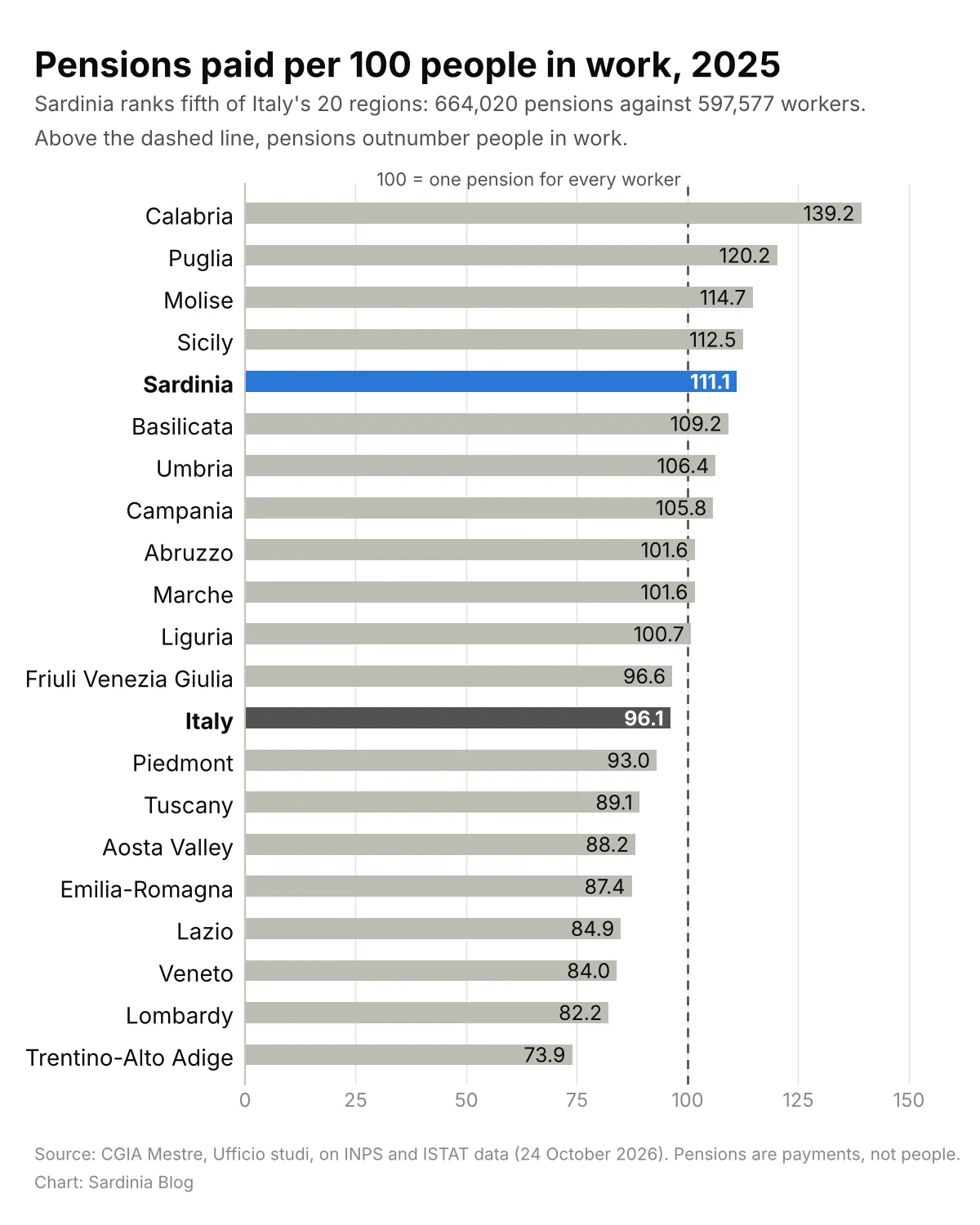
CGIA did not publish Sardinian provinces for 2025, because INPS now reports eight provinces and ISTAT five. Provincial figures circulating online come from the 2024 edition, in which Cagliari was the only province with more workers than pensions.
Who replaces them
CGIA's replacement table draws on Excelsior, the forecasting system run by Unioncamere and the Labor Ministry. Sardinia will need 80,000 replacement workers in 2025 to 2029, of whom 30,800 are private-sector employees. That is one in eight of everyone in work today.
ISTAT's 2024 census shows how thin the pool is. Births fell to a record low of 7,052, deaths exceeded births by 11,467, and the island has 282.5 people over 65 for every 100 under 15, against 207.7 for Italy. Foreign residents rose by 2,050 to 54,091 and slowed the decline.
Age is unevenly spread. The belt comuni around the main towns are the youngest, and Olbia's old-age index of 165.1 is the fifth lowest on the island. Peripheral inland comuni score 314.2 and lose residents to other comuni. The Region is now paying workers under 40 up to €30,000 to move to the island, and each of them needs a home near the job.
Where the homes are, and why many stay closed
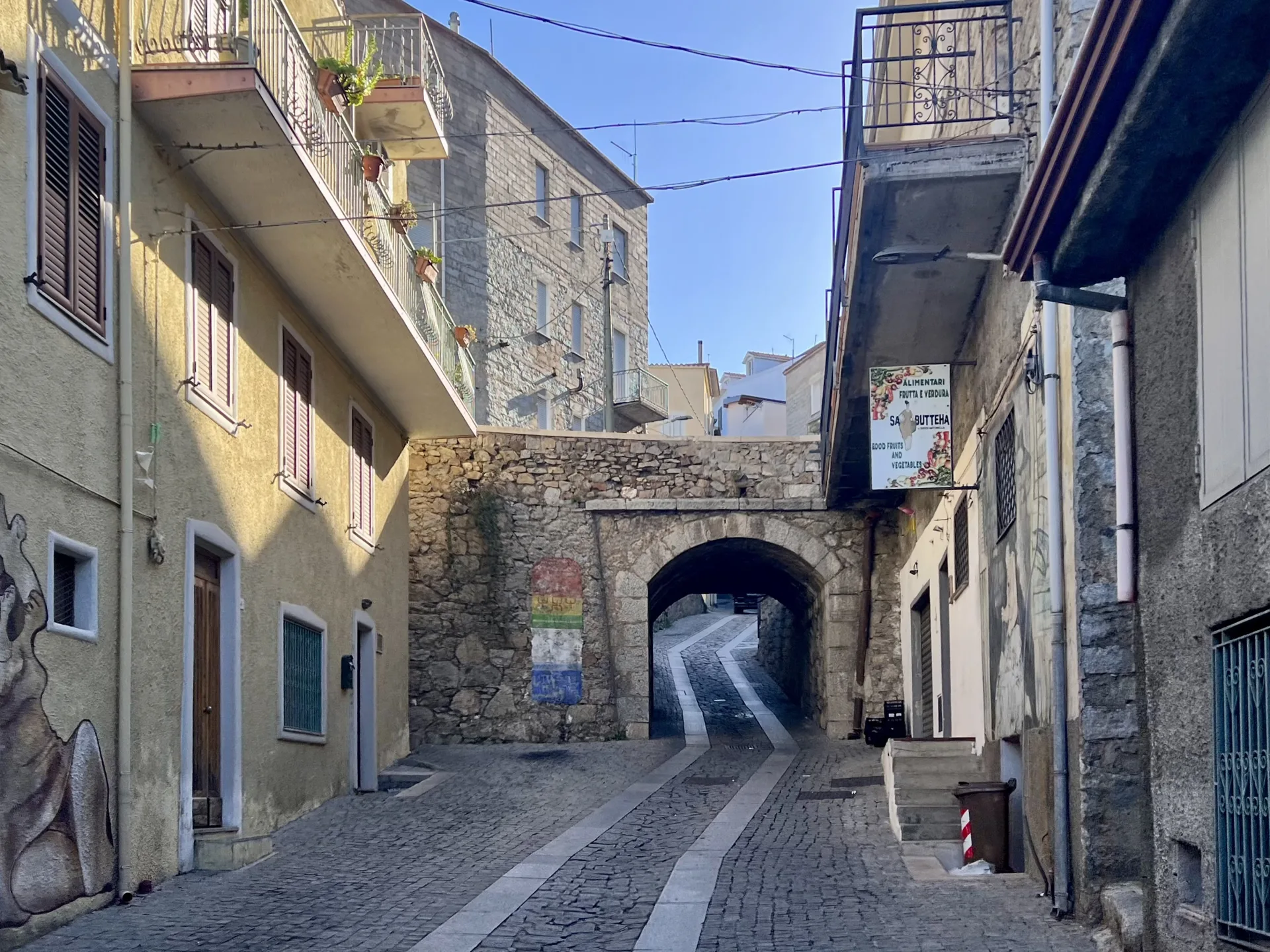
Sardinia has about 1,049,263 homes, and 319,211 of them, 30.4%, have no permanent resident, a total published by AIGAB in April and by Nomisma in October. In inland areas the share passes half. The category covers second homes in use as well as houses that are empty or unfit to live in.
Short lets are a smaller block. The Bank of Italy's June 2026 report counts 47,217 dwellings used for short-term letting at the start of the second quarter, 4.5% of the stock. Even if every one of them sat inside the no-resident total, they would make up about one in seven of it.
The law keeps part of the rest off the long-term market. Under Law 431 of 1998 a standard residential lease runs four years and renews automatically for four more, and the owner can refuse the first renewal only for the reasons listed in article 3, such as needing the home for family or selling it. The alternatives are the three-plus-two agreed-rent contract and transitional leases of up to 18 months.
Recovering a home from a tenant who stops paying takes time. Italy issued 37,122 eviction orders in 2025, 26,632 of them for arrears, and bailiffs carried out 18,292 evictions, according to Interior Ministry data reported by Il Fatto Quotidiano. At a Senate presentation of reform bills in April, their sponsors put the average procedure at 15 to 24 months. A government bill to speed it up, A.S. 1896, was presented on 12 May 2026 and is still before the Senate Justice Committee.
What cuts the other way
The same Bank of Italy report finds 38% of homes without resident occupants in tourist comuni against 26% elsewhere, and about three tourist units per hundred inhabitants, the highest ratio in southern Italy. It finds a positive association between private tourist accommodation and the ratio of house prices to income, without measuring a causal effect, and notes that this ratio fell in almost all Sardinian comuni between 2015 and 2024. In the coastal comuni where tourist lets cluster, they are part of the picture. An aging population also frees homes over time, so the pension figures do not by themselves prove a shortage. They show who is leaving work and how many must replace them.
The figures side by side
| Measure | Figure | Source |
|---|---|---|
| Pensions paid in Sardinia, 2025 | 664,020 | CGIA Mestre on INPS data |
| People in work in Sardinia, 2025 | 597,577 | CGIA Mestre on ISTAT data |
| Pensions per 100 people in work | 111 (Italy 96) | CGIA Mestre |
| Replacement workers needed, 2025 to 2029 | 80,000 | CGIA Mestre on Excelsior forecasts |
| Residents at the end of 2024 | 1,562,381 (8,072 fewer than a year earlier) | ISTAT census |
| Average age | 49.2 (Italy 46.9) | ISTAT census |
| Homes on the island | 1,049,263 | AIGAB, Nomisma |
| Homes with no permanent resident | 319,211 (30.4%) | AIGAB, Nomisma |
| Homes used for short-term letting, spring 2026 | 47,217 (4.5%) | Bank of Italy |
| Eviction orders in Italy, 2025 | 37,122 (26,632 for arrears) | Interior Ministry, via Il Fatto Quotidiano |
Our view
This section is the opinion of Sardinia Blog's publisher, not reporting.
The pension figures explain Sardinia's housing problem better than the short-let debate does. The island is losing working-age people, needs 80,000 replacements in five years and has a third of its homes without a resident, many of them in villages the jobs have left. In the towns where the jobs are, owners who could let a flat for years choose a few months, a few weeks or a closed door, because an eight-year lease and an eviction that can take two years make long letting the riskiest option they have. Short lets are visible, and in some streets they matter. They are about one home in 22.
It is time to change the story. A debate that starts from these numbers asks why a third of the island's homes have no resident, and what would persuade their owners to offer them to the people Sardinia needs, before it asks how to restrict the 4.5% let to visitors. Sardinia Blog is published within an ecosystem that lets homes short term in Olbia and Golfo Aranci, so read this as an interested view.
A note on the numbers
CGIA counts pensions, not pensioners. Its total covers old-age, welfare, survivors', disability and compensation benefits, and one person can draw several, so Sardinia has fewer pensioners than 664,020. The employed total is ISTAT's labor-force figure and includes people over 64; CRENoS gives 572,118 for ages 15 to 64. Excelsior's 80,000 is a forecast of replacement demand, not a count of vacancies. The 319,211 homes figure has no published reference year, and short-let counts differ with the definition used. Eviction figures are national, because we could not retrieve the Ministry's Sardinian breakdown. The 15 to 24 months is the reform sponsors' estimate, not an official statistic.
Sources: CGIA Mestre, Abbiamo una pensione per ogni occupato, 24 October 2026 (PDF) · ISTAT, Censimento popolazione 2024, Sardegna, 30 April 2026 (PDF) · Banca d'Italia, L'economia della Sardegna, June 2026 (PDF) · CRENoS, Economia della Sardegna, 33rd report, 2026 (PDF) · Law 431 of 9 December 1998, Normattiva · Senato, A.S. 1896, Disposizioni in materia di rilascio di immobili · Il Fatto Quotidiano, 2025 eviction data, 7 October 2026 · Sky TG24, Senate housing bills, 14 April 2026
Related reading
Elsewhere on Sardinia Blog: how Gallura's sales and rents moved, and its leases shortened, since 2016; the EU proposal that would let comuni cap short lets after proving harm; and the industry's own valuation of Italian short-term rentals.
Sardinia Blog is published within the Rental12 ecosystem, an owner-operator letting homes it owns in Olbia and Golfo Aranci rather than a property manager acting for other owners. Its own case that Italy's four-plus-four lease keeps homes closed, its reading of an owner survey on arrears and evictions and its press archive are company statements, not independent evidence.