
What was decided on 29 October
The management committee of the Autorità di sistema portuale del Mare di Sardegna (AdSP) adopted an adeguamento tecnico funzionale, a technical amendment to Olbia's port master plan, covering the two vasche di colmata, sediment containment basins, planned in the water in front of the former Palmera plant on the port's northern shore, Shipping Italy and Olbia.it reported.
Once filled, the basins are to connect to the land behind them, already used for nautical boatbuilding.
The 2022 amendment had not specified what the basins would become, the gap the court pointed to in March.
The project now has to go back through the valutazione di impatto ambientale (VIA), the environmental impact assessment.
The first dredging lot is in the authority's 2027 works programme, approved at the same meeting. Shipping Italy puts 2027 investment for all nine ports in the system at over €114 million.
AdSP president Domenico Bagalà said the amendment aims to «dare una destinazione certa a un'area dismessa e rafforzare un polo della cantieristica già consolidato» (give a disused area a definite purpose and strengthen an established boatbuilding hub).
The project
The dredging plan submitted for environmental assessment in 2024, as described by Shipping Italy at the time:
Access channel from the mouth of the gulf to Isola Bianca and Porto Cocciani deepened to 11 metres, and the other areas to 10 metres
About 700,000 cubic metres of sediment, of which about 630,000 classed as suitable for disposal at sea in an area identified with ISPRA, the national environmental research institute
Quay 9 extended to absorb quay 8, giving a quay about 350 metres long with a 316-metre berth for ro-ro ferries and cruise ships, and a new 40 by 40 metre mooring spur
Four basins: two small ones for the quay works and two larger ones by the former Palmera pier for sediment that cannot legally go to sea
Cost about €94.3 million, 525 days of works
The stated aim is to keep the port open to larger ro-pax ferries and cruise ships and to make mooring safer. In June 2025 the then AdSP president, Massimo Deiana, warned that without the dredging Olbia would lose cruise calls and could, in future, lose larger modern ferries, Shipping Italy reported.
Why it was stopped
June 2025: the environment ministry (MASE) concluded the VIA with a positive opinion, with conditions, on most of the project, but adopted the culture ministry's refusal of the two large basins. The culture ministry said they would add about five hectares of fill on «uno dei rari tratti di morfologia costiera naturale risparmiato dai banchinamenti», one of the rare stretches of natural coastline spared by quays, protected by a 1965 decree declaring the Olbia coast of considerable public interest.
March 2026: the TAR Sardegna rejected the AdSP's appeal. As reported by La Nuova Sardegna and Shipping Italy, the court found that the project «non motiva la finalità» of the basins, which seemed only to store leftover sediment; that it «non ha fornito alcuna localizzazione alternativa»; that its socio-economic and environmental benefits were not demonstrated; and that the solution was not realistically reversible or mitigable.
The AdSP had argued that the basins are needed for sediment that cannot legally go to sea, and that the site is state maritime land inside the industrial area, outside the 1965 protection. The court did not accept that.
What the new amendment does and does not fix
Giving the basins a final use answers the court's point about their purpose. On our reading of the reports, it does not by itself answer the other grounds: the lack of alternative sites, the five hectares of fill on a protected stretch of shore, and the missing cost-benefit case. Those will be tested again in the new VIA.
There is a possible way round the basins. A ministerial decree of 16 December 2025, published on 30 January 2026, updated the rules for disposing of dredged sediment at sea, and the AdSP commissioned offshore surveys to find new disposal sites, which could let it shrink or drop the basins, La Nuova Sardegna reported in February. The 29 October decision keeps the basins in the plan.
The port today
In May the AdSP levelled the access channel with the crane ship Hebo Lift II to restore depth for the 2026 cruise season. Bagalà said the seabed now allowed the port to work «con la massima capacità operativa», at full operating capacity, Shipping Italy reported. That was maintenance; the deepening itself has not started.
A note on the numbers
The volume meant for the basins varies by source and project version: about 65,000 cubic metres in Shipping Italy's 2024 description, which also gives the two large basins a capacity of about 200,000; about 250,000 in its June 2025 report, and 200,000 to 250,000 in La Nuova Sardegna's February 2026 report. The €94.3 million cost and the depths are from the 2024 project; no updated cost has been published. We have not seen the adopted amendment, the MASE decree or the TAR judgment themselves, only the authority's statement and press reports of them.
Disclosure: Sardinia Blog is part of the Rental12 ecosystem, which lets homes in Olbia and Golfo Aranci. Any commercial or tourism benefit of the dredging would affect businesses connected to us; this report relies on official decisions and independent coverage.
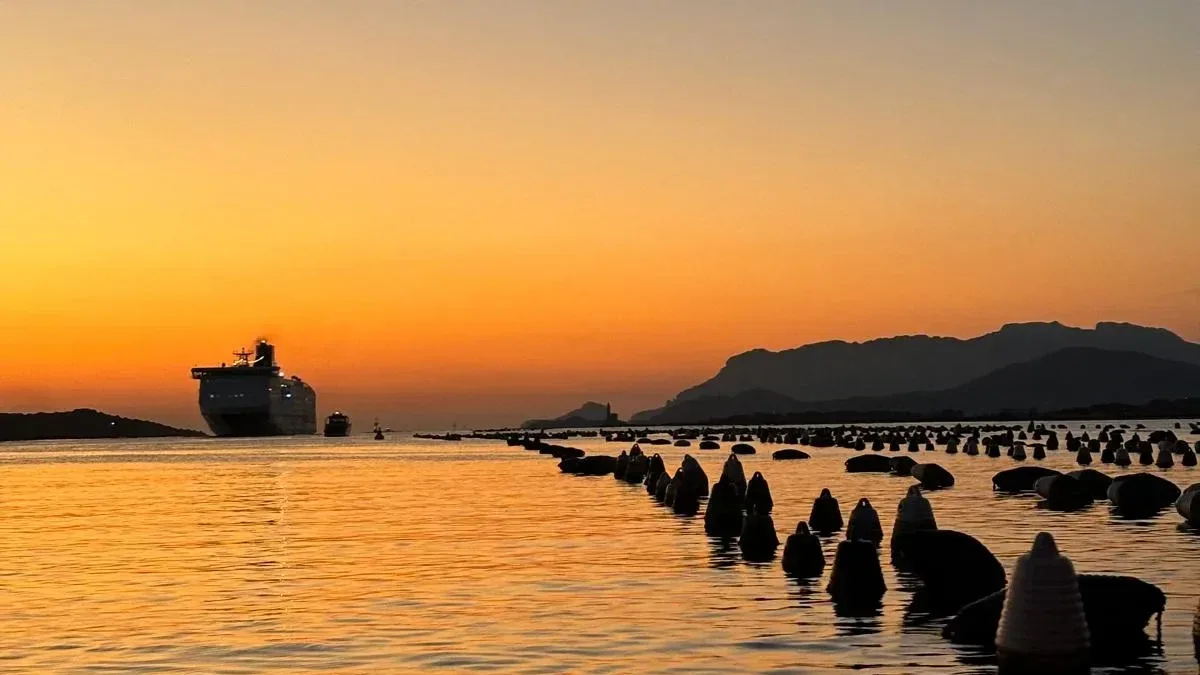
Photo: a ferry in the Gulf of Olbia at sunset, behind the oyster-farm buoys. Photo: Sardinia Blog.
Sources: Shipping Italy, 29 October 2026 · Olbia.it, 30 October 2026 · Shipping Italy, 13 March 2026 · La Nuova Sardegna, 13 March 2026 · Gallura Oggi, 14 March 2026 · La Nuova Sardegna, 22 February 2026 · Shipping Italy, 17 June 2025 · Shipping Italy, 29 February 2024 · Shipping Italy, 18 May 2026
Related reading
Elsewhere on Sardinia Blog: how the Cala Finanza beach club plan was dropped on the Tavolara shore; the study to protect Luras's ancient wild olives; and Aeroitalia's cut to three daily Olbia–Rome flights.
Sardinia Blog is published within the Rental12 ecosystem, an owner-operator letting homes it owns in Olbia and Golfo Aranci. Its own article on ferry fares to Sardinia and its press archive are company statements, not independent evidence.