
What the project provides
ARES Sardegna, the agency that runs shared services for the island's health service, presented the project on 26 October. It is promoted by the Region's directorates for health and for social policy, and ARES is the implementing body. Over 18 months it is meant to bring care into the homes of 1,410 people over 80 through the Regional Telemedicine Infrastructure (IRT), aimed at three risk factors:
Cognitive decline: cognitive and motor stimulation at home, with simplified adaptive technology
Poor adherence to medication: digital dispensers that track whether pills are taken, coordinated with local pharmacies
Social isolation: home monitoring systems and links with comuni's social services and the third sector
ARES says acute problems are handled by linking the home service with hospital care, with the aim of fewer admissions and fewer unnecessary emergency visits.
Who runs it, and where
The island is split into three poles, each with a multidisciplinary team:
North: ASL Sassari and ASL Gallura
Centre: ASL Nuoro, ASL Oristano and ASL Ogliastra
South: ASL Cagliari, ASL Medio Campidano and ASL Sulcis Iglesiente
Delivery is led by the local health authorities through their districts, community health centres (Case di Comunità), territorial operations centres (COT) and family doctors. Partners include the comuni's social services and PLUS areas, pharmacies, the universities of Cagliari and Sassari and voluntary organisations, according to ARES's June announcement.
Where the money comes from
The €3,470,000 comes from Mission 6 (health) of Italy's National Recovery and Resilience Plan, through the "Grandi Anziani" call run by Agenas, the national agency for regional health services. Sardinia's bid ranked first in southern Italy and third nationally; the delegation presented it at Agenas in Rome on 26 June. Nationally, the call selected 58 projects out of 146, with €150 million and about 60,000 people over 80, Tecnica Ospedaliera reported in July. Pintor said in June that the aim is «una risposta ordinaria e permanente per il Servizio Sanitario Regionale», an ordinary, permanent service of the regional health system.
What was said
Alessandra Todde, President of the Region and acting health assessor, said the project «rappresenta la nostra visione di sanità di prossimità» (represents our vision of healthcare close to home). Giuseppe Pintor, director general of ARES, spoke of «garantire la piena operatività dell'Infrastruttura Regionale di Telemedicina» (ensuring the Regional Telemedicine Infrastructure is fully operational). Ivano Leta of Agenas said it was «ponendo le basi per percorsi di continuità assistenziale davvero vicini ai bisogni dei cittadini» (laying the foundations for continuity-of-care pathways truly close to people's needs).
What is still missing
The published material leaves practical questions open:
How patients are selected and enrolled. The national call targeted people over 80 with at least one chronic condition who are not already in integrated home care (ADI), Tecnica Ospedaliera reported; Sardinia Post gives the same profile for the Sardinian project.
How the 1,410 places are divided between the three poles and the eight ASLs
Who watches the alerts from home devices, and how fast someone responds
How data from devices in people's homes is protected
Which results will be measured and published
ANSA's headline spoke of over-80s "with acute conditions", but the ARES text describes a prevention and monitoring project with links to hospital care, not treatment of acute illness at home.
Why it matters here
27% of Sardinians are over 65, ANSA and ARES report, and many live in small, scattered villages far from a hospital. «La Sardegna è una delle regioni più longeve del mondo» (Sardinia is one of the longest-lived regions in the world), Todde said in a regional release in July. A separate regional pilot in the Isili district, with ASL Cagliari and the University of Cagliari's geriatrics school, is screening residents over 70 for frailty from September to December 2026, according to the Region.
What families can do
There is no public application form. Families with a relative over 80 living at home can ask the family doctor or the local health district whether the relative could be included, and which pole covers their area. In Gallura that is the northern pole, with ASL Sassari.
A note on the numbers
The 1,410 patients, €3,470,000 and 18 months are ARES figures. An earlier Region release speaks of about 1,500 people aged 80 to 90; ARES's June note says "1,410 grandi anziani" mostly aged 80 to 90. The national totals are from Tecnica Ospedaliera's report of Agenas's ranking. ARES dates the presentation 26 October; Sardinia Post reported on 27 October that the project starts that day. Neither says how many people are enrolled so far, so the 1,410 is a target, not a count of patients already receiving the service.
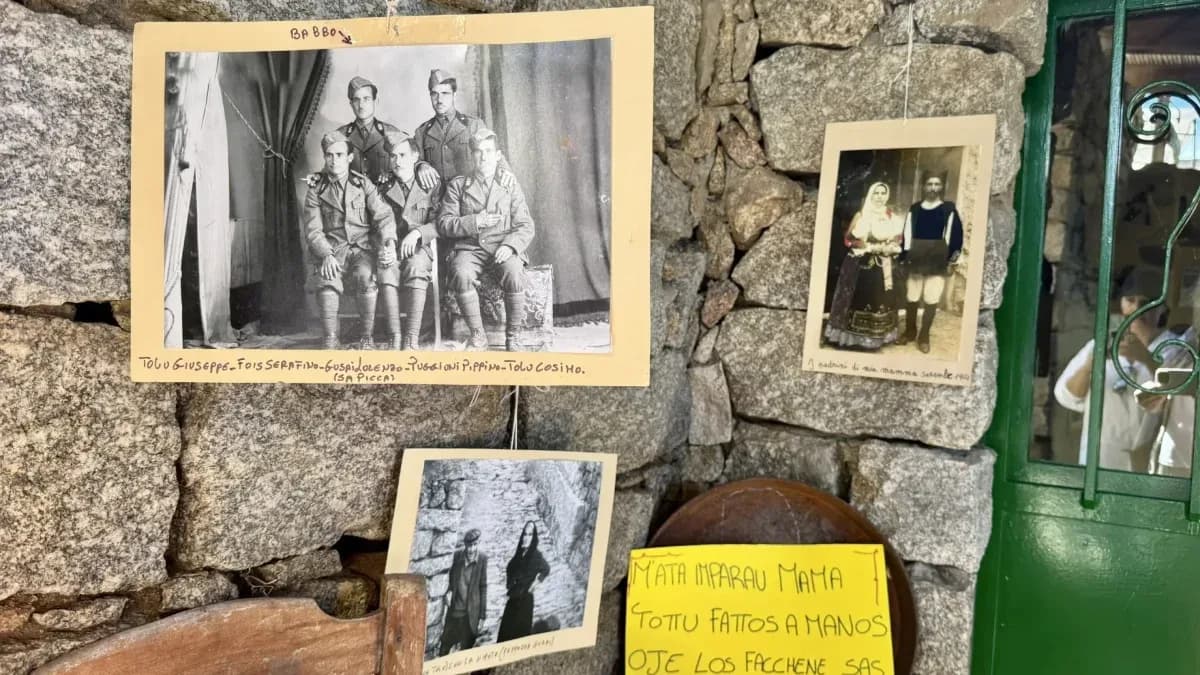
Photo: old family photographs on a house wall in Lollove, in the Barbagia. Photo: Sardinia Blog.
Sources: ARES Sardegna, 26 October 2026 · ARES Sardegna, June 2026 · ANSA, 26 October 2026 · Sardinia Post, 27 October 2026 · Tecnica Ospedaliera, 21 July 2026 · Regione Sardegna
Related reading
Elsewhere on Sardinia Blog: the €600 baby bonus rule that a Gallura family took to court; the 319,000 homes in Sardinia with no permanent resident; and a 70-year-old cooperative that keeps inland Gallura farming.
Sardinia Blog is published within the Rental12 ecosystem, an owner-operator letting homes it owns in Olbia and Golfo Aranci. Its press archive holds company statements, not independent evidence.