
What Capo Testa actually is
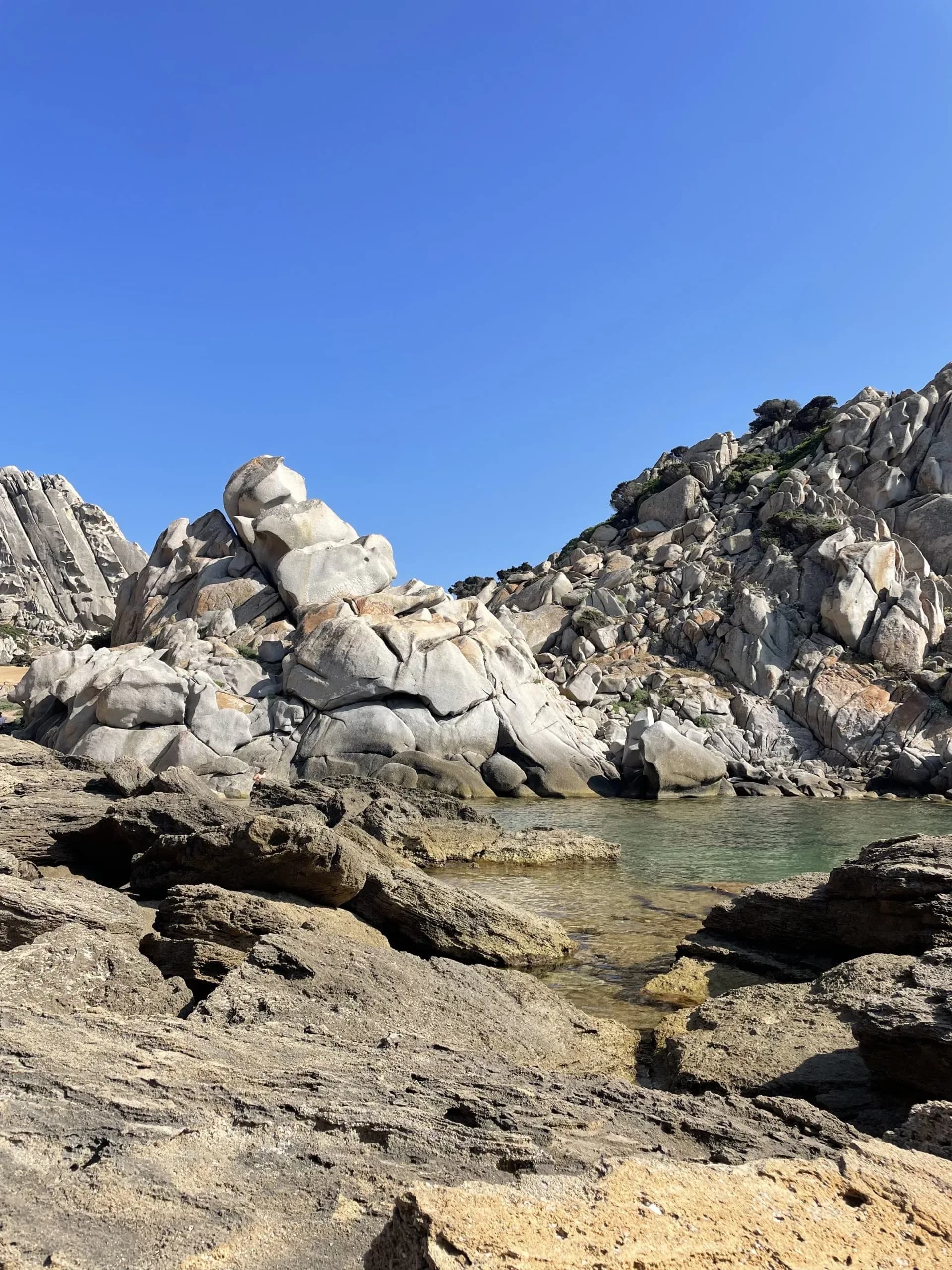
Capo Testa is a narrow granite headland at the northern tip of Sardinia, just west of Santa Teresa Gallura. It is not a beach in the conventional sense, not a single trail, and not a village. It is a place defined by its rock: pale, weathered granite worn into rounded boulders, arches and hollows, with the Strait of Bonifacio opening out to the north and Corsica visible across the water. If you are drawn to dramatic coastal geology, wide horizons and the sensation of being at the edge of something, this headland delivers all three.
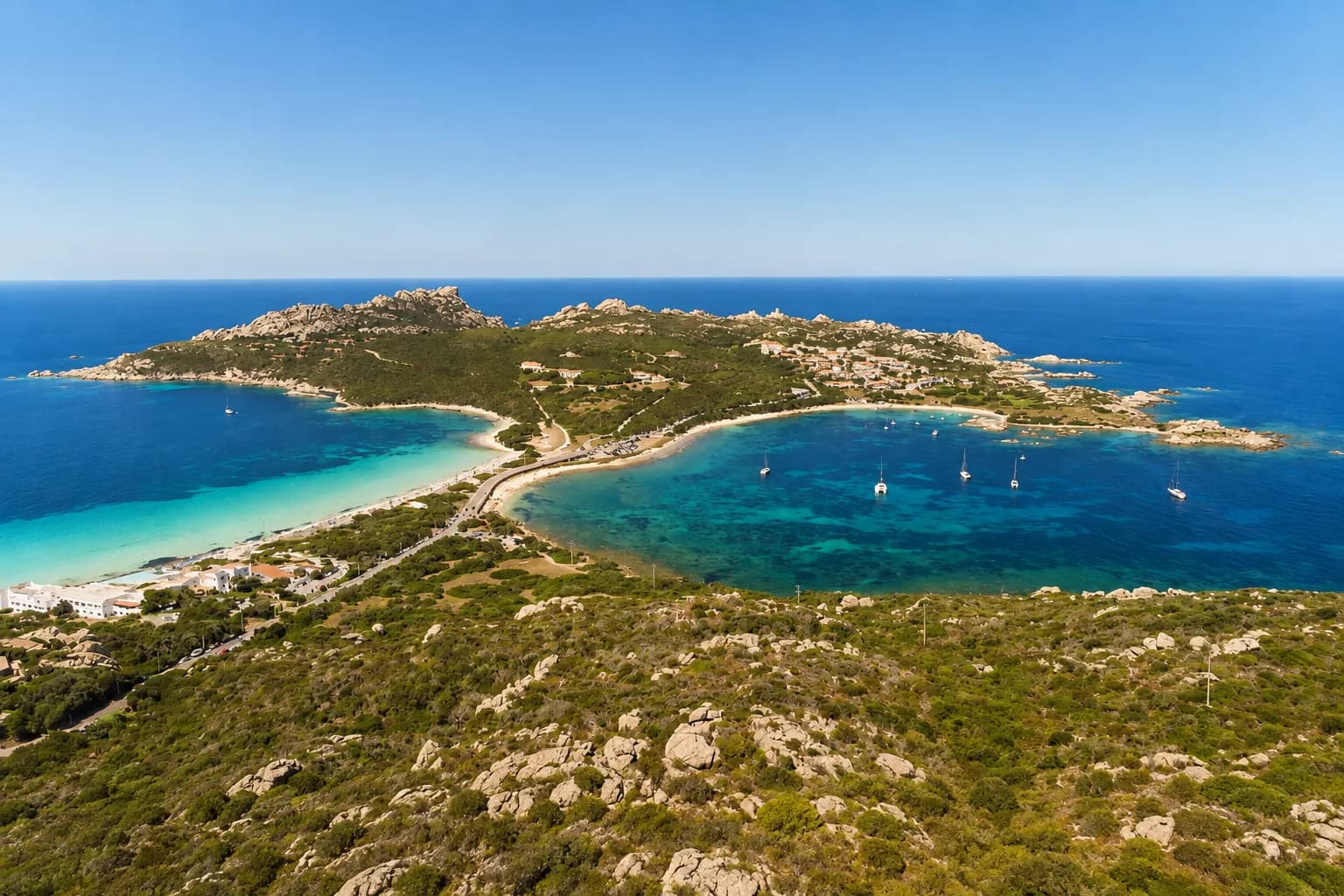
The drive out already sets the tone. A thin isthmus connects Capo Testa to the mainland, and as you approach you have sea on both sides of the road before the headland opens out ahead of you. That narrow neck of land is also one of the most useful features of the whole place, for reasons explained below.
Understanding the layout
Knowing how Capo Testa is arranged saves a lot of confusion on the ground. The headland is not one unified walk — it is several distinct corners, each with a different character, and the wind often determines which one makes sense on a given day.
The two sides of the isthmus
The isthmus has a bay on each side. This is the single most useful piece of information for anyone visiting: because the Mistral governs this headland, there is almost always one sheltered bay available whatever the wind is doing. The Mistral — Sardinia's dominant north-westerly wind — can make the exposed northern and western faces rough and uncomfortable, while the lee side stays calm. If conditions look hostile from the car park, that is the cue to choose accordingly.
For a fuller understanding of how the Mistral shapes conditions across this part of Sardinia, our guide to Sardinia's winds covers it in detail.
Valle della Luna and Cala Grande
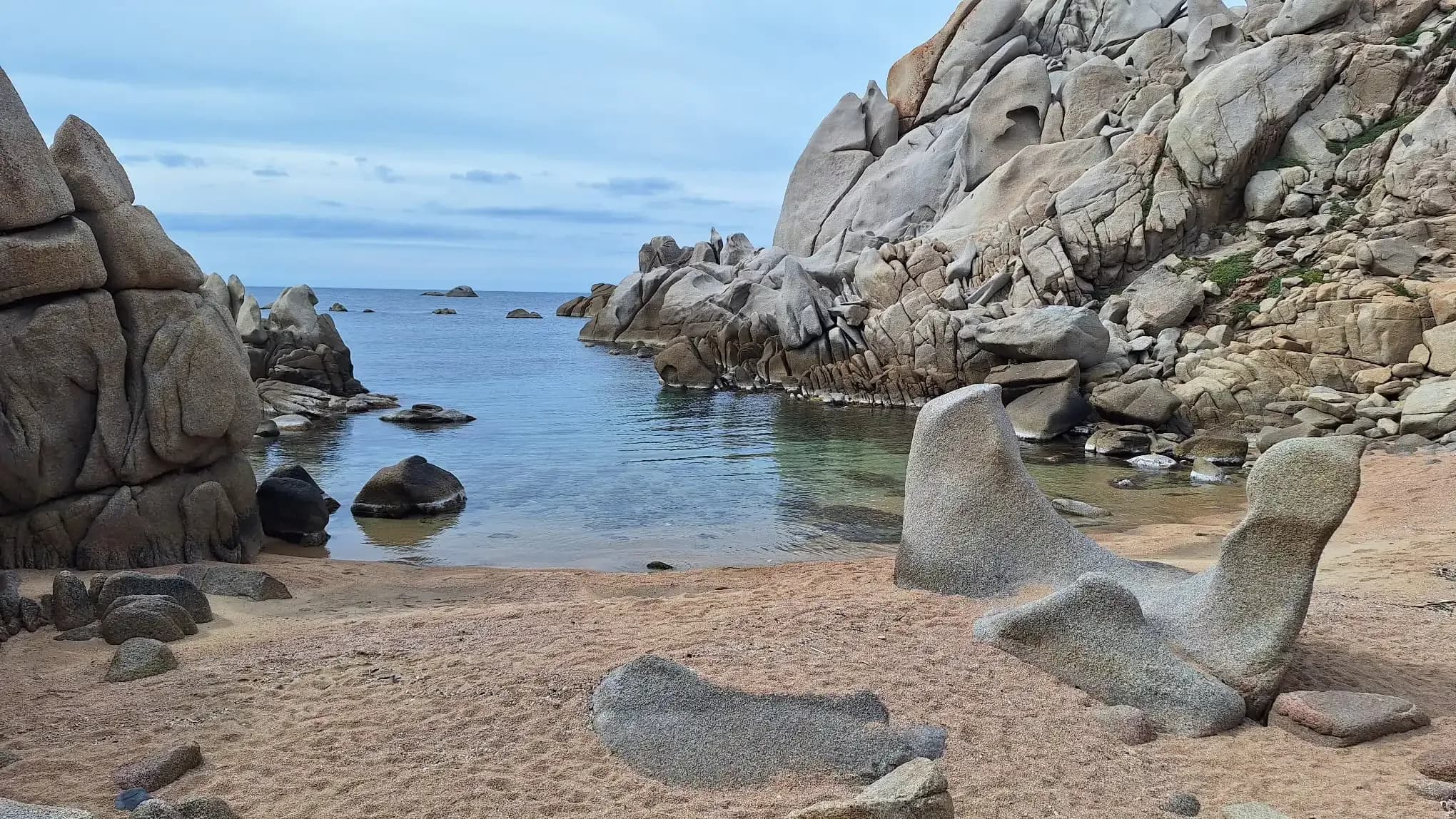
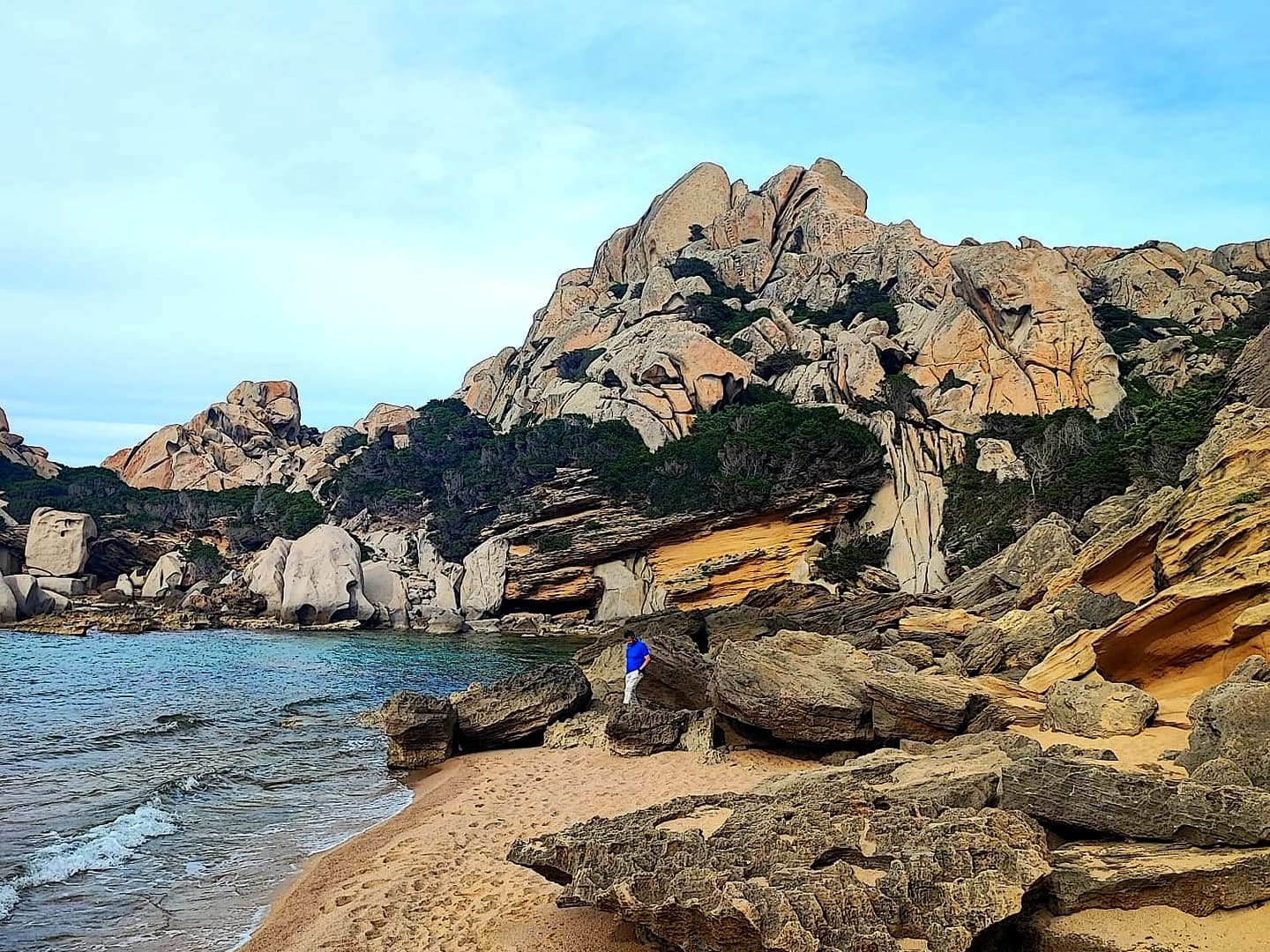
On the western side of the headland, past the isthmus, lies Valle della Luna: a small valley of granite leading down to a sheltered cove called Cala Grande. This is the most atmospheric walk on the headland, winding through a landscape of enormous boulders worn into near-sculptural forms. We have a full dedicated guide to this corner — the Valle della Luna walk and Cala Grande swim — and it is worth reading before you set out rather than trying to navigate it from scratch.
The lighthouse side and Cala Spinosa
On the northern and eastern side sit Cala Spinosa and the lighthouse, reached by short uneven paths over the rock. The approach is rougher underfoot than the valley route, and sea entries here are rocky rather than sandy, but the views across the strait are exceptional. If you want a meal or a sheltered spot on this side, we have a dedicated piece on a day at Sea Lounge, Cala Spinosa, which covers lunch and the lighthouse path in detail.
Getting there and parking
Capo Testa is roughly a ten to fifteen minute drive from Santa Teresa Gallura. The road follows the isthmus out to the headland and is straightforward to find. Parking is not free: it is run by Silene Multiservizi, the council's own company, and charged by the hour through the summer season, which in 2026 resumed on 1 June. It is the most expensive parking in the municipality, and on the most recent tariff the council has published, covering the 2025 season, the rate was 2 EUR an hour between 09:00 and 20:00. Spaces are limited and informal, closer to pull-offs near the trailheads than to an organised car park, and in July and August they fill early, so arriving in the morning before the heat builds is both the practical and the comfortable choice. Do not block entrances or narrow shoulders, and read the local signs when you pull in.
You do not have to drive. A seasonal beach bus runs out to the headland from town between 1 June and 30 September, operated by Just Sardinia, stopping at the isthmus, Zia Colomba beach and the Capo Testa hamlet before finishing at the lighthouse. Tickets are bought on board: 3 EUR one way, 5 EUR return, with weekly and seasonal passes for longer stays. Seven runs a day go each way, the first leaving town at 9:00 and the last leaving the lighthouse at 19:00, with a long gap in the early afternoon when nothing runs between 12:15 and 15:00. Given how quickly the parking fills in August, it is a genuinely useful alternative. Those fares and times come from the tourist office's 2026 timetable, which prints them as indicative, and the parking rate from the council's own schedule; both were checked in August 2026 and both change from season to season, so confirm before you travel.
There are no shops out here, and nothing at all at the trailheads or along the paths themselves. There is a bar and restaurant above Cala Spinosa on the lighthouse side, and a few more places in the Capo Testa hamlet you pass on the way out, but once you are walking on the granite you are on your own. Shade is scarce to non-existent, so bring water, a hat, and sun protection regardless of how cool the morning feels.
What to do at Capo Testa
Rather than thinking of Capo Testa as a single itinerary, it helps to think of it as a set of choices. The right one depends on your group, the conditions and how much time you have.
A short wander for the views
Ten to fifteen minutes from any pull-off gets you wide horizons, the strangest of the rock shapes and a clear view north towards Corsica. This is viable even in heat or wind, and it suits anyone who wants a sense of the place without committing to a longer walk. Many people do exactly this — stretch their legs, take in the granite and the sea, and head back.
The valley walk and a swim
Continuing through the granite to Cala Grande is the most rewarding option for those who want more. The route through Valle della Luna is unlike anywhere else in Sardinia — granite walls close in, light shifts, and the cove at the end is worth the walk. See our full Valle della Luna guide for the route detail rather than repeating it here.
The lighthouse path and Cala Spinosa
Short paths over uneven rock lead from the eastern side of the headland to Cala Spinosa and the lighthouse. The sea entries are rocky, and the paths require attention, but it is a manageable outing for anyone with reasonable footwear and a steady step. Our Cala Spinosa guide covers this route alongside options for lunch on the water.
Sunset
The light on the granite in the last hour before sunset is the reason many people come specifically in the evening. The pale rock takes on warmth it lacks in the midday glare, and the view across the Strait of Bonifacio shifts in colour through the hour. It is a worthwhile reason to return if you visited in the morning too.
Conditions and safety
A few practical points that are easy to overlook before you arrive. Granite dust is slippery on slopes, and noticeably worse after rain. Shoes with grip are not optional — sandals on the steeper sections are a genuine slip hazard. The paths are informal with no waymarking, so pay attention to where you came from and how the ground changes.
Sea entries are rocky across most of the headland, and currents shift with the wind. When the Mistral is running strongly, the sensible call is to take in the views and leave the swim for another day or another bay. The drop-offs at the water's edge are abrupt in places and worth noting if you have children with you.
In summer, shade is scarce across the whole headland. Walking before 11:00 or after 17:00 keeps the heat manageable and, as a side benefit, the light is better for photography at both ends of the day.
Who Capo Testa suits
Walkers, photographers and anyone who responds to raw coastal landscape over a groomed beach experience will feel at home here. Active children who are steady on uneven ground can manage most of the headland, though the drop-offs require an attentive adult. It is not, however, a sand-and-sunlounger day: the terrain is rocky, shade is minimal, and the only food on the headland is the bar and restaurant above Cala Spinosa. If your group wants that kind of day, Spiaggia Rena Bianca in Santa Teresa Gallura is the right call instead — sandy, accessible and much easier for young children.
If you are planning a broader trip around the northern coast and want to manage logistics across multiple days — from boat trips and beach clubs to longer drives — the Rental12 platform brings together the rental options you might need, from cars to boats, in one place.
How long to allow
A short stop for views and rock-watching takes under half an hour. A walk to Valle della Luna and a swim at Cala Grande adds an hour or two depending on pace. Combining both sides of the headland — valley, lighthouse path and a sunset return — makes for a full half-day. Most visitors find that the place rewards more time than they initially planned to give it.