What the figure measures
The report, "Le retribuzioni in Sardegna: una crescita che non colma i divari", is dated 26 November and comes from the Centro Studi of Confindustria Sardegna, the employers' association. It rests on INPS data for 392,076 employees observed in Sardinia in 2025. The report does not say which employees those data cover; every sector it lists is private. With the 4.3% rise Sardinia moved from 17th to 16th of Italy's 20 regions.
Working patterns differ sharply from the rest of the country. Sardinian employees were paid for 230.5 days on average. In the year, 40.5% had at least one part-time contract, against 32.9% in Italy. Among people paid for all 52 weeks with no part-time contract, Sardinians earned €31,871 and Italians €38,223, a gap of 16.6%. So the like-for-like gap is smaller than the headline one, and it does not disappear.
Where the gap sits
Permanent contracts cover 60.4% of Sardinian employees and 73.5% of Italian ones. The report calls the island's share of seasonal work a national record. Pay inside each type of contract tells a different story from the average.
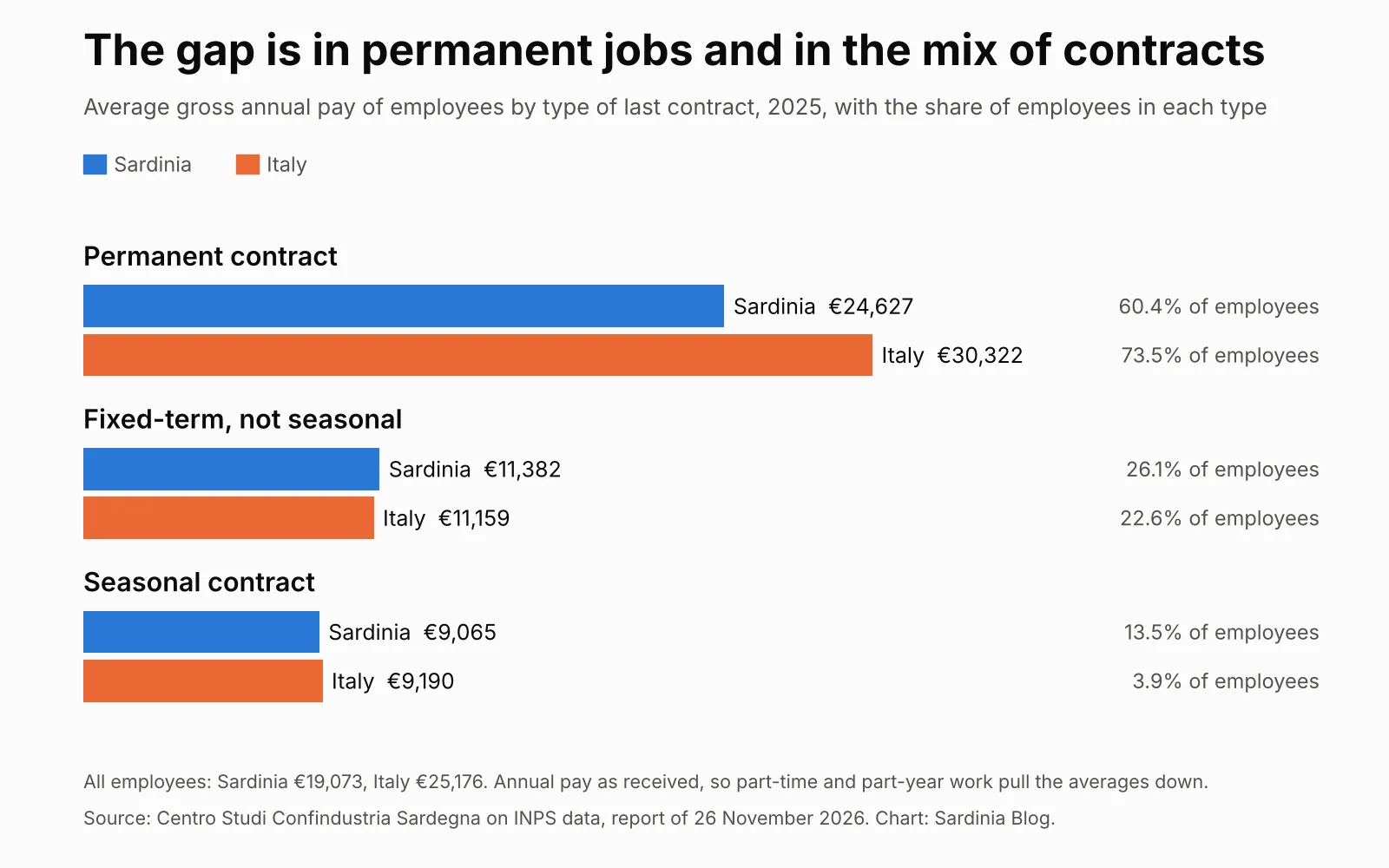
If Sardinia had Italy's mix of permanent, fixed-term and seasonal contracts, at Sardinian pay for each, its average would be about €21,000 by our calculation. That closes about a third of the gap. Weighted the other way, with Italian pay and the Sardinian mix, the mix accounts for 44%. Either way more than half of the gap is inside permanent jobs.
Sectors point the same way. Accommodation and food service employ 20.0% of Sardinian employees, against 11.6% in Italy, and pay the least of the sectors in the report: €11,162 a year here, €11,728 nationally. In manufacturing the figures are €24,035 and €33,365, a gap of 28.0%.
Pay rose, purchasing power did not
From 2008 to 2025 average pay in Sardinia rose 23.4%, from €15,459, while consumer prices rose 37.6% on the national harmonized index. Pay therefore buys 10.3% less than in 2008; in Italy the loss is 8.5%. Against 2019 Sardinia is 1.5% down and Italy 4.8%. Andrea Porcu, who directs the Centro Studi, said that in a healthy economy «il potere d'acquisto delle retribuzioni aumenta, non diminuisce» (our translation: the purchasing power of wages rises, it does not fall), ANSA reported.
The Bank of Italy reached a similar conclusion in June on a different measure. Using Istat's territorial accounts for private-sector employees, it found real pay per employee 15.2% lower in 2023 than in 2008 in Sardinia, against 6.2% lower in Italy. The two studies agree on the direction. They do not check each other's numbers.
Can one salary pay for a home?
For municipalities the report switches source, to finance ministry tax returns for 2024. These count taxable income from employment per earner, public employees included, and give a higher regional average of €20,628. We downloaded the ministry's file and reproduced the report's figures: 335 of 377 municipalities are below that average, and Cagliari, at €26,119, is the only one above the Italian average of €24,251. The report does not print the other cities. The file does: Sassari €22,342, Alghero €21,182 and Olbia €20,680, 40th of 377 and 20.8% below Cagliari.
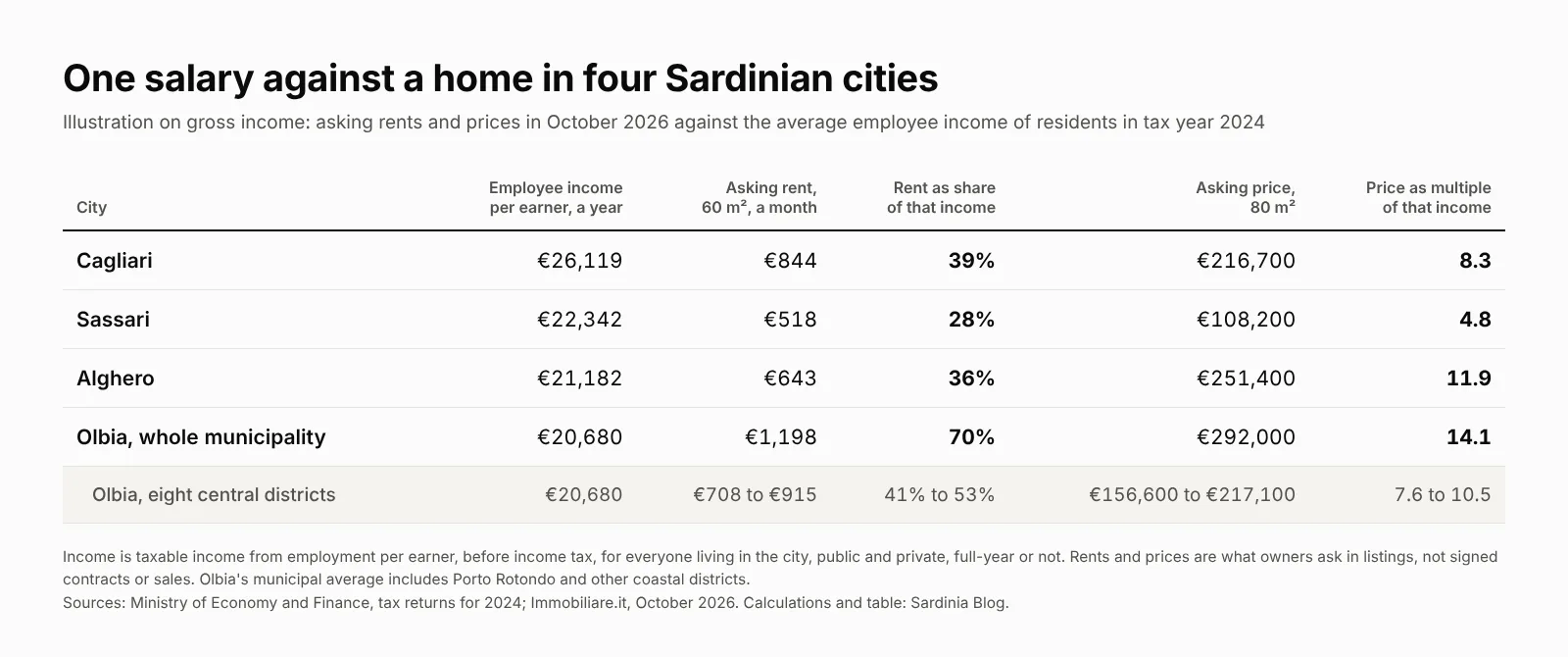
Olbia pairs the lowest income of the four with the highest asking prices. Its municipal average includes Porto Rotondo and other coastal districts, so we also show eight central districts, where a 60 m² flat is advertised at €708 to €915 a month. An 80 m² flat is advertised at 4.8 times the average employee income in Sassari, 8.3 times in Cagliari, 11.9 in Alghero and 14.1 in Olbia, or 7.6 to 10.5 in central Olbia. The Bank of Italy's own price-to-income indicator averages 9.8 in tourist municipalities and 5.3 elsewhere.
The limits matter. Listings show what owners ask, not what tenants and buyers pay: a study reported by L'Unione Sarda on 27 October put the tax agency's reference values for Olbia's main urban areas at about €1,400 to €1,925 per m², while listings often ask €2,300 to €3,000. The incomes are before income tax and two years older than the prices. Many households have two incomes. The multiple is not the number of years needed to save for a home.

The €2 billion
Confindustria puts the gap at €1.75 billion to €2.45 billion a year. The higher figure is what it would take to bring average pay up to that of the rest of Italy; 392,076 employees times €6,103 gives €2.39 billion by our arithmetic. The lower one compares each size class of Sardinian municipality with the same class elsewhere. Both are modelled comparisons, not wages owed to anyone. The report's first stated objective is more continuity of work, followed by activities and skills that pay better and opportunities beyond the strongest centers.
A note on the numbers
Three datasets appear here and they are not interchangeable: INPS pay for 2025 (€19,073), finance ministry taxable income for 2024 (€20,628, municipal figures) and Istat accounts to 2023 (the Bank of Italy). The €6,103 is 24.2% of the Italian figure; put the other way, Italian pay is 32.0% above Sardinian pay. The report itself gives the difference as about €6,102, from unrounded figures. Our contract-mix calculation uses the report's three contract types and their shares, which rebuild both published averages to within €10; it cannot separate part-time work inside permanent contracts. The rent shares are a gross-income illustration for one earner, not a measure of household affordability. Immobiliare.it does not say whether its rent averages include seasonal listings.
Our view
This section is the publisher's opinion.
As long as the season stays short, this gap will stay. A seasonal contract paid €9,065 in 2025. The cheapest rent in the table above, in Sassari, would take 69% of it. The numbers also show the limit of the argument: a longer season will not lift pay in permanent jobs, where most of the gap is. But it is the part Sardinia can move by itself. In 2025, 78.9% of the island's tourist nights fell between June and September, and the same figures show the season starting to stretch, with April up 39.9% and September ahead of June. Every extra month of work turns a seasonal wage into something closer to a year's pay, for the same people, in the same towns. That is worth more to Sardinia than another record August. A longer season would also be good for our publisher's own rental business, so weigh this view with that in mind.
Sources: ANSA, 28 November 2026 · Ministry of Economy and Finance, tax returns by municipality, tax year 2024 · Bank of Italy, The economy of Sardinia, June 2026 · Immobiliare.it, asking prices, October 2026. The Confindustria Sardegna report is linked at the top. Also used, not linked: La Nuova Sardegna and L'Unione Sarda, 28 November 2026; L'Unione Sarda, 27 October 2026; Regione Sardegna tourism observatory, 2025.
Related reading
Elsewhere on Sardinia Blog: why 111 pensions per 100 workers is also a housing story; the tech jobs Sardinian firms cannot fill; the 319,000 island homes with no permanent resident; and the €20,000 grant for under-40 workers who move here.
Rental12, a holiday-rental company in Olbia that shares an owner with Sardinia Blog, earns its income from tourism and property, the subjects of this item; its press archive holds company statements, not independent evidence.