
What the agency compared
The analysis comes from Brili-Brilas, the Olbia agency Brili Servizi Immobiliari and its high-end division Brilas, and was reported on 27 October by L'Unione Sarda, GalluraOggi and Sardiniapost. It sets OMI central values for the first half of 2026 against listings on Immobiliare.it and Idealista in September 2026. L'Unione Sarda's account of the study puts the risk this way: «Resta però concreto il rischio di scambiare il prezzo desiderato per quello che il mercato è disposto a pagare» (the risk of mistaking the desired price for what the market is willing to pay remains real). The same account says not all of the difference should be read as overvaluation, that older homes in need of energy upgrades cannot be valued like new ones without proper checks, and that agents who give over-optimistic valuations to win mandates leave homes unsold. The agency sketches an indicative scenario, not a forecast, of 1 to 3% nominal growth in Olbia in 2027.
We could not find the study itself published, and the "up to 50%" figure appears only in L'Unione Sarda's headline. The ranges it reports give different answers depending on which ends are compared: 2,300 against 1,925 euro is 19% higher, 3,000 against 1,925 is 56% and 3,000 against 1,400 is 114%. L'Unione Sarda has also carried sponsored articles for Brili and Brilas, labelled as promotional; the 27 October article is not labelled that way.
How OMI values are made
OMI quotations are the Revenue Agency's half-yearly price ranges for each zone of each comune. According to the OMI manual (2025 edition), about 75% of the survey records for sales in 2024 came from signed deeds, about 20% from property offers and 5% from other sources. Asking prices that enter the sample can be adjusted by a provincial coefficient of up to 20%. A local committee of agents and notaries gives an opinion, and an internal commission validates the result.
The Agency is explicit about what the values are. Its 2026 consultation guide says they «non possono intendersi sostitutivi della “stima” puntuale del valore del singolo immobile» (cannot be taken as a substitute for a valuation of the individual property) and that they refer to «lo stato conservativo prevalente nella zona», the condition most common in the zone. The manual describes a range in which the average value of ordinary properties most probably falls, excluding homes of particular quality or in poor condition.
Timing matters too. The survey for the first half closes on 30 June, values are validated by 31 July and published on 15 October; second-half values follow on 15 March. In a 2020 paper, two of the Agency's own analysts wrote that «va scontata la poca tempestività... Si tratta di una criticità non superabile» (the lack of timeliness has to be accepted; it is a limitation that cannot be overcome), and that ranges can be slow to register small, gradual changes, although persistent trends do move them.
Two series, two speeds
Olbia's OMI central values for ordinary homes in normal condition, from the Agency's database, against Idealista asking prices:
B1 Centro storico, Stazione, San Simplicio: 1,450 euro in the second half of 2021, 1,775 in the first half of 2026 (+22%)
C1 Olbia Nord, Viale Aldo Moro: 1,550 to 1,925 euro (+24%); the "excellent condition" range in 2026 is 2,000 to 2,750
C2 Olbia Sud, Bandinu, Poltu Quadu: 1,500 to 1,750 euro (+17%)
D2 Olbia Ovest inside the ring road: 1,600 to 1,900 euro (+19%); "excellent" 1,800 to 2,700
D3 Periferia Ovest: 1,400 euro, unchanged since at least 2016
Idealista, Olbia town centre (Centro Città): 1,878 euro in September 2021, 2,625 in September 2026 (+40%), a record for the series
Idealista, whole comune including the coast: 2,202 euro in September 2016, 3,779 in September 2026 (+72%)
On these figures, Olbia's asking prices have risen about twice as fast as the OMI ranges since 2021. A listing at 2,300 euro in Viale Aldo Moro sits exactly at the top of OMI's normal-condition range; one at 3,000 is above the top of its excellent-condition range of 2,750. Immobiliare.it's own September averages for the town zones are mostly between about 2,000 and 2,700 euro, from 2,035 in San Simplicio to 2,661 in Viale Aldo Moro, with Tannaule near 3,000, its Olbia page shows.
What buyers actually pay
The best national measure of the gap between asking and closing prices is the quarterly survey of estate agents run by the Bank of Italy with Tecnoborsa and the OMI itself. In the second quarter of 2026 the average discount on the initial asking price was 7% nationally, «più elevato nel Sud e Isole (9 per cento)», close to the lowest since the survey began. Outside large cities in the South and Islands the discount was 9.7% and homes took 5.9 months to sell. There, 12.6% of agencies reported sales closing 20 to 30% below the ask, almost none more than 30% below, and 13.6% at or above it.
Applied to a listing 50% above OMI, a 10% discount still leaves the sale about 35% above it. The discount explains about a fifth of the gap. The rest plausibly reflects condition, how floor area is measured, the mix of homes listed and OMI's delay, which the published data cannot separate.
Is the market turning?
Not on the official evidence, though growth is slowing. Olbia's comune recorded 1,231 normalised home sales in 2022, 1,141 in 2023, 1,154 in 2024 and 1,239 in 2025, the OMI's regional statistics show, most recently the 2026 edition, with 2.8% of the comune's 43,982 homes, coast included, changing hands: stable rather than rising. The Bank of Italy's June report on Sardinia gives island-wide sales up 6.2% and prices up 4.6% in 2025, and finds the price-to-income ratio fell between 2015 and 2024 in almost all Sardinian comuni, most in tourist ones, alongside faster income growth. Nationally, Istat recorded house prices up 4.0% year on year in the second quarter of 2026, with the South and Islands slowest at 2.6%, down from 3.7% in the first quarter. In the Bank of Italy survey, agents' expectations for prices had turned slightly negative. Even the agency's own scenario for 2027 is a modest rise.
What the gap measures
A headline that puts listings up to 50% above OMI invites the reading that Olbia's sellers are asking the wrong price. The data do not support that reading on their own. OMI, by construction, follows the market with a delay: it averages condition, works in ranges and arrives months after the deeds it is built on. Since 2021 Olbia's asking prices have risen about twice as fast as its OMI ranges, while sales have held steady and official indices still show prices rising. In that setting a wide gap says at least as much about the speed of the statistic as about the market. The agency's practical point stands: a home in average condition priced at the top of its zone will take longer to sell, and an inflated valuation to win a mandate helps nobody.
A note on the numbers
OMI values for Olbia are per square metre of gross floor area, which may not match the surface used in listings. OMI zones and Idealista's "Centro Città" do not have identical boundaries. Idealista changed its methodology in July 2026, so the September record and the five-year comparisons straddle that change, and its whole-comune average is lifted by coastal zones such as Porto Rotondo - Rudalza - Cugnana (5,181 euro) and Pittulongu - Moriscu (4,044 euro). Immobiliare.it gives 3,658 euro for the whole comune in September, up 3.19% in a year. The Bank of Italy discount is a survey of agents for the South and Islands, not an Olbia figure. OMI publishes no average deed price for the town, and its sales counts are normalised transactions (NTN), adjusted for shares of ownership.
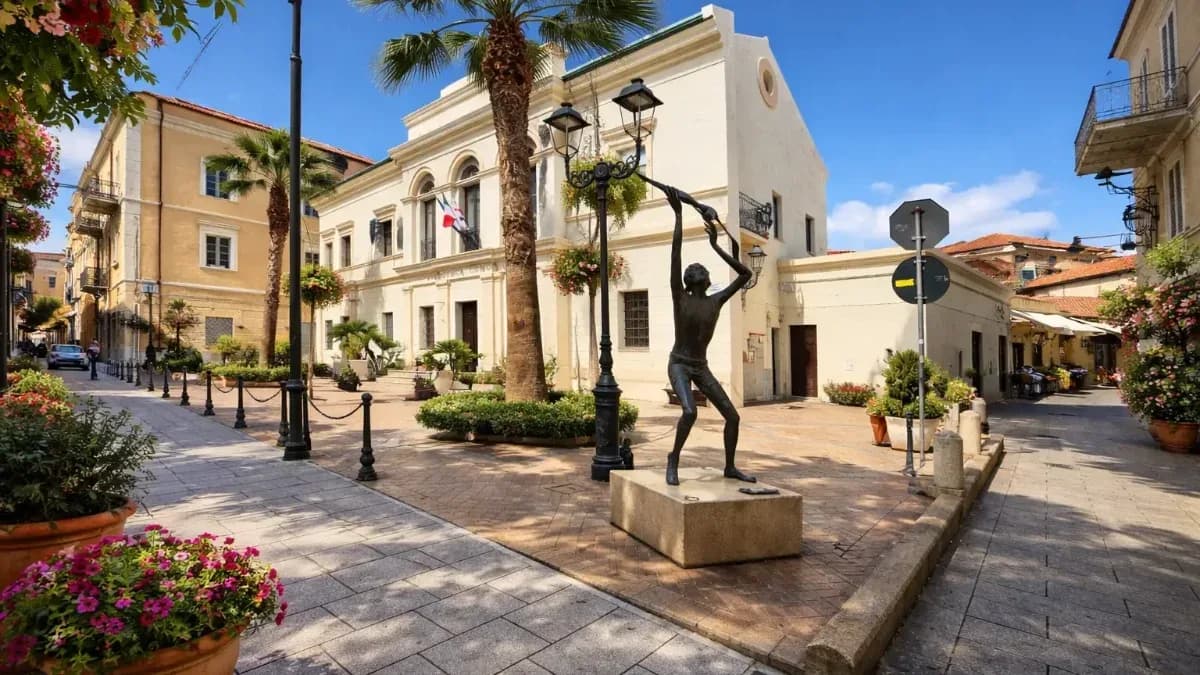
Image: Corso Umberto I in Olbia's town centre. Photo: Sardinia Blog.
Sources: L'Unione Sarda, 27 October 2026 · English version · Agenzia delle Entrate, OMI quotations, Olbia · OMI manual 2025 · OMI consultation guide 2026 · Ghiraldo and Papa, Agenzia delle Entrate, 2020 · OMI Statistiche regionali Sardegna 2026 · Idealista, Olbia price history · Idealista, Olbia town centre · Immobiliare.it, Olbia · Banca d'Italia, housing survey Q2 2026 · Banca d'Italia, L'economia della Sardegna 2026 · Istat, house prices Q2 2026
Related reading
Elsewhere on Sardinia Blog: what Olbia's asking prices would mean under the EU's housing-stress test; why the count of Sardinian homes without residents is broader than it sounds; and how the short-term rental industry values its own market.
Sardinia Blog is published within the Rental12 ecosystem, an owner-operator letting homes it owns in Olbia and Golfo Aranci rather than a property manager acting for other owners. Its own analysis of vacant homes and holiday lets in Olbia and its press archive are company statements, not independent evidence.