What the 2026-27 rules say
The season is set by decree no. 20 of 7 August 2026 of the Region's environment assessora, Rosanna Laconi. Boar may be hunted from 1 October 2026 to 31 January 2027, the same dates the regional wildlife committee (Comitato Regionale Faunistico) set for the previous season. Hunting is allowed on Sundays, Thursdays and weekday public holidays; the decree notes that Sardinia allows hunting on only two fixed days a week.
Method: drives (battute), or roaming hunting with a dog.
Bag limit: no more than 5 boar per 5 guns, or fraction of 5, and no more than 40 per group in a day. A drive must stop once the limit is reached; animals shot over the limit by mistake go to charity under the province's direction.
Weapons: a rifled barrel may be used only for boar and fox, including in drives. Fully jacketed bullets are banned in rifled guns.
Safety: hunters and beaters in a boar or fox drive must wear high-visibility clothing.
Meat and disease: boar meat may not be eaten or given away until a diaphragm sample of at least 60 grams has tested negative for Trichinella, under a 2013 regional decree. Hunters are asked to report any boar carcass they find to the local health authority's vets, as part of surveillance for African swine fever.
Where the rifle rule comes from
Rifles in boar drives are not new. On 19 January 2011 the Regional Council amended article 41 of the 1998 hunting law to allow a rifled barrel ("o a canna rigata") as well as a smooth bore; the change is Regional Law no. 5 of 21 January 2011. The same law gave the environment assessore power to adopt derogations of up to one month, for reasons including public safety and the prevention of serious damage to crops and livestock, after advice from a regional wildlife institute or, until one exists, a committee of three experts. The national government challenged that clause, and the Constitutional Court rejected the challenge in judgment no. 16 of 2012.
Longer seasons: asked for, mostly refused
In January 2023 the regional government of the time asked the environment and agriculture ministries to add four Sundays of boar hunting in February. On 3 February 2023 the then environment councillor, Marco Porcu, said the request could not go ahead because ISPRA, the national environmental research institute, and the environment ministry had given negative opinions.
For the 2025-26 season the Region added a single day, Saturday 31 January 2026, by decree of 23 January 2026. The Gruppo d'Intervento Giuridico (GRIG) and the Lega per l'Abolizione della Caccia (LAC) called the extension absurd. They argue that unselective hunting, releases of animals for hunting, crossbreeding with domestic pigs and rubbish left near towns are what spread boar and increase the damage.
On 29 October 2025 Fratelli d'Italia presented a bill, first signed by councillor Emanuele Cera, to rewrite the 1998 law. It would run boar hunting into the first ten days of February, add fallow deer, starling, collared dove and feral pigeon to the huntable species, and provide for extraordinary boar control and compensation for farmers. We found no record of a committee vote since.
Roads, towns and islands
On 28 November 2025 the Region reported 6,995 road accidents caused by wild animals from 2020 to that date, against 2,991 in the previous five-year period, with boar the species most often involved. It shared 324,000 euro equally among Alghero, Arzachena, Sassari and Olbia, the towns with the most boar collisions, and gave 136,000 euro to Sarroch and Castiadas for accidents with Sardinian deer. Laconi called wildlife "un fenomeno in costante crescita, difficile da contenere" (our translation: a phenomenon that keeps growing and is hard to contain). On 9 November 2025 L'Unione Sarda reported that a doctor from Bitti had been killed when his car hit a boar on the Sassari-Olbia road; local mayors asked for barriers to keep boar "and other stray animals" off the road, and for targeted culling.
In Olbia, boar have been reported since at least spring 2024 in Poltu Cuadu, Olbia Mare and around the airport. A protocol between the city, the Region, the province, the forestry agency Forestas, the health authority and the forestry corps, approved by the city's extraordinary commissioner on 14 November 2024, provides for cage traps and for fines on anyone who feeds boar. After a petition with more than 1,000 signatures, the assessora authorised the containment plan by decree no. 36/7812 of 17 December 2025, published in the regional bulletin on 2 January 2026. On 3 March 2026 Olbia.it reported a group of 11 boar at the CAM waste collection point and no captures yet. On 27 July 2026 Mayor Settimo Nizzi told the city council that captures would start shortly ("Inizieranno a breve la cattura dei cinghiali"; our translation: the boar captures will begin shortly), after a meeting with Forestas and the province, and on 31 July L'Unione Sarda reported the plan still not in operation. We have been told locally that trapping began in October, after the summer season; we found no public confirmation from the city or the province, and no figure for animals caught.
Off the south-west coast, the Region approved on 27 January 2026 a plan to eradicate boar from the island of San Pietro between 2025 and 2029 (decree no. 4/476), carried out by the Province of Sulcis Iglesiente.
What changes for visitors
Until 31 January, expect hunting parties in the countryside on Thursdays, Sundays and public holidays. Everyone taking part in a drive wears high-visibility clothing, and bright clothing makes sense for walkers too.
Boar cross rural roads mostly at dusk and at night. The Sassari-Olbia road and the edges of Olbia are among the places named in recent reports.
In Olbia, do not feed boar and keep rubbish closed: the 2024 protocol names easy food as what draws them into town.
A note on the numbers
The accident totals are the Region's figures for all wild animals, not boar alone; the release does not name its data source, and "to date" means 28 November 2025, so the recent period is almost six years against five; per year the count still roughly doubled (our calculation: about 1,180 against about 600). The Region gives 324,000 euro for the four towns and says it is shared equally, which is 81,000 euro each. There is no official count of boar in Sardinia: Coldiretti, the farmers' union, estimated about 100,000 in July 2024, and La Nuova Sardegna repeated that figure on 3 October 2026 without naming a source. Bag limits apply per group and per day. We read decree no. 20 in the copy published by the hunters' association ANLC, whose annexes carry the decree number and date.
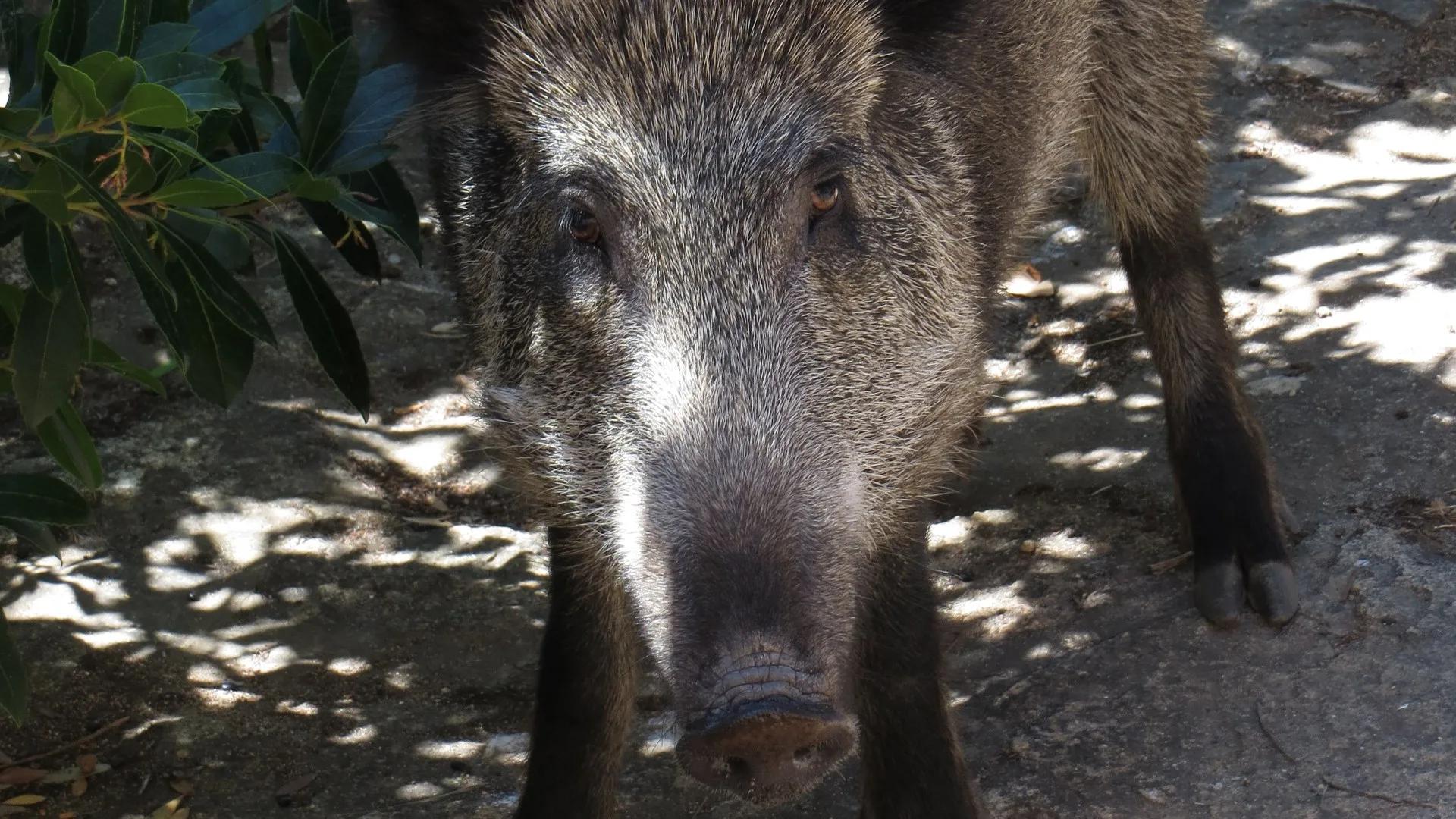
A Sardinian wild boar in Gallura, August 2014. Photo: Francesco Bellamoli, CC BY-SA 4.0, via Wikimedia Commons, cropped.
Sources: Regione Sardegna, hunting calendar decree no. 20 of 7 August 2026 (ANLC copy) · Regione Sardegna, 28 November 2025 · Corte costituzionale, judgment 16/2012 · Caccia Passione, 20 January 2011 · L'Unione Sarda, 3 February 2023 · L'Unione Sarda, 28 January 2026 · L'Unione Sarda, 29 October 2025 · L'Unione Sarda, 9 November 2025 · Olbia.it, 21 November 2024 · Gallura Oggi, 28 March 2025 · Olbia.it, 3 March 2026 · L'Unione Sarda, 31 July 2026 · Federcaccia, 9 February 2026 · L'Unione Sarda, 30 July 2024 · La Nuova Sardegna, 3 October 2026 · Caccia Passione, 25 October 2023 · Gallura Oggi, 27 July 2026 · L'Unione Sarda, 20 May 2023
Our view
This section is the opinion of Sardinia Blog's publisher, not news reporting. Our owner lets holiday homes in Olbia and Golfo Aranci, so boar in Olbia's streets and on Gallura's roads affect its guests directly.
Keeping wild boar numbers in check is the right policy, and Sardinia should do it more firmly. Boar damage crops, pasture and fences, and farmers and livestock keepers pay for it every season. They also carry disease: Sardinia lived with African swine fever for decades, and only in October 2023 did the European Commission recognise the island's strain of the virus as eradicated in wild boar. A large, unmanaged population is the easiest way for it to return. On the roads, the Region's own figures show more than twice as many accidents with wild animals since 2020 as in the five years before.
The hunting season is one tool, and its rules are sensible: drives on fixed days, rifles for accuracy, a cap per group and high-visibility clothing. Near towns, the answer is trapping and targeted culling by trained operators, and for Olbia that is already authorised. The plan authorised in December 2025 was still not running at the end of July. If trapping did begin in October, as we have been told, the city and the province should say so and publish how many animals have been caught, and where.
The same goes for cattle and pigs left to roam. A cow wandering across the four-lane Sassari-Olbia road near Monti made the news in May 2023 as a curiosity; on an unlit road at night it is a crash waiting to happen, and the mayors who asked for barriers in November 2025 named stray animals alongside boar. Owners should be made to keep livestock fenced, and the rules on free-ranging pigs should be enforced: in October 2023 unregistered pigs were the reason twelve municipalities in central-eastern Sardinia were still kept under the strictest swine fever zone.
The critics are right about one thing: shooting more proves nothing unless someone counts. The Region should publish an estimate of boar numbers, the season's bag totals, which its new hunting app could record for boar too, and accident data road by road, so every extra day or cull is judged on results. And residents have a part to play: feeding boar or leaving rubbish out undoes any plan.
Related reading
Elsewhere on Sardinia Blog: the three-year sea urchin ban that waits on Brussels; the study for a protected area around Luras's ancient wild olive; and the 2,500-a-day cap already in force in La Maddalena's park.
Sardinia Blog is published within the Rental12 ecosystem, a business that lets homes it owns in Olbia and Golfo Aranci. Its own advice on rural roads and driving after dark and its press archive are company statements, not independent evidence.