
Last updated: November 17, 2026.
Some wines are aged in oak, some in steel, some in clay. Akènta Sub is aged at the bottom of the sea. Off the coast of Alghero, at about 40 metres down, cages full of sparkling Vermentino rest on the seabed for months, watched over by divers, before they are lifted back to the surface by balloons and carried home by helicopter. When the bottles reach your table, they still wear the sea on their glass. We first tasted it at sunset on the bastions of Alghero, and it is one of the most memorable wine experiences Sardinia has to offer.
What is Akènta Sub?
Akènta Sub is a sparkling wine made from Vermentino di Sardegna DOC grapes, in an Extra Dry style. It is produced by Cantina Santa Maria La Palma, a winery in the countryside of Alghero. According to La Nuova Sardegna, it is a cooperative with about 300 members, and the winery itself tells the story of families who were given uncultivated plots near Alghero fifty years ago and turned them into vineyards.
The bubbles are made with the Charmat method, in pressure tanks rather than in the bottle. What makes Akènta Sub unique is what happens next: instead of resting in a cellar, the finished bottles go into the sea.
How the wine is aged under the sea
The bottles are packed into stainless steel cages and lowered onto the seabed in the Capo Caccia–Isola Piana Marine Protected Area, next to the Porto Conte nature park. In 2018, for example, La Nuova Sardegna reported that 924 bottles were lowered to 40 metres below Punta Giglio, in the bay of Porto Conte.
Down there, the conditions are unlike any cellar on land. According to the Vinitaly magazine:
There is no light and almost no oxygen.
The water temperature stays constant, so the wine matures slowly and evenly.
The bottles stay down for about eight months. Other sources give a range of six to twelve months.
A diver checks the cages roughly every 20 days for rust and for the marine life that settles on the glass.
The capsules are sealed with wax to protect the corks.
When the time comes, divers attach lifting balloons to the cages and bring them up, and a helicopter flies them back to the winery. The project is run with the Porto Conte Park, the Marine Protected Area and local diving teams, and according to the Concours Mondial de Bruxelles, it was reportedly the first wine to receive the mark of the Sardinia Parks Network.
Where the idea came from
The inspiration was a shipwreck. Around 2010, divers in the Baltic Sea found a mid-19th-century wreck carrying bottles of Champagne that were still in good condition after more than 150 years under water. If the sea could preserve wine that well by accident, the reasoning went, it could be used on purpose. The winery began its first experiments in 2011, and Akènta Sub grew from there.
Akènta Day: when the wine comes up
Every July since 2016, the return of the cages has become a celebration called Akènta Day. Boats gather off the coast of Alghero to watch the divers and the helicopter at work, then the party moves on. In 2023, L'Unione Sarda reported that about 1,000 bottles were raised near Capo Galera, with more than eight official boats carrying around 450 passengers and over 60 private boats following, before the cruise continued to Cala Burantino for a party on the water. Guests came from the United States, the United Kingdom, the Netherlands, Switzerland, Germany and Slovakia, as well as from across Italy.
If you are planning a summer trip to Alghero, keep an eye on the winery's channels in spring for the date and how to join.
How Akènta Sub tastes
The winery's tasting notes describe:
Colour: bright pale straw with greenish highlights and fine, persistent bubbles.
Nose: intense white and yellow flowers, good fruit and a light note of bread crust.
Palate: medium-bodied, fresh and soft, with a pleasant savoury finish.
Serving: 6 to 7°C, with aperitivo, fish, seafood and shellfish.
At the world's first underwater-aged wine tasting, held by the Italian Sommeliers' Association at Vinitaly in 2019, sommelier Valentino Tesi called it "a delightful-to-drink wine, truly a wine of exceptional quality", according to the winery. In 2023 it became the first Sardinian wine chosen as Official Wine of Vinitaly and the City.
What it costs and where to buy it
Akènta Sub is made in limited numbers each year. On the winery's online shop, a 75 cl bottle of the 2023 vintage was listed at €63 (checked November 2026). You can also find it in a few restaurants and wine shops in Alghero, and the winery offers tours and tastings at its cellar near the town.
Where to drink it: sunset on the bastions
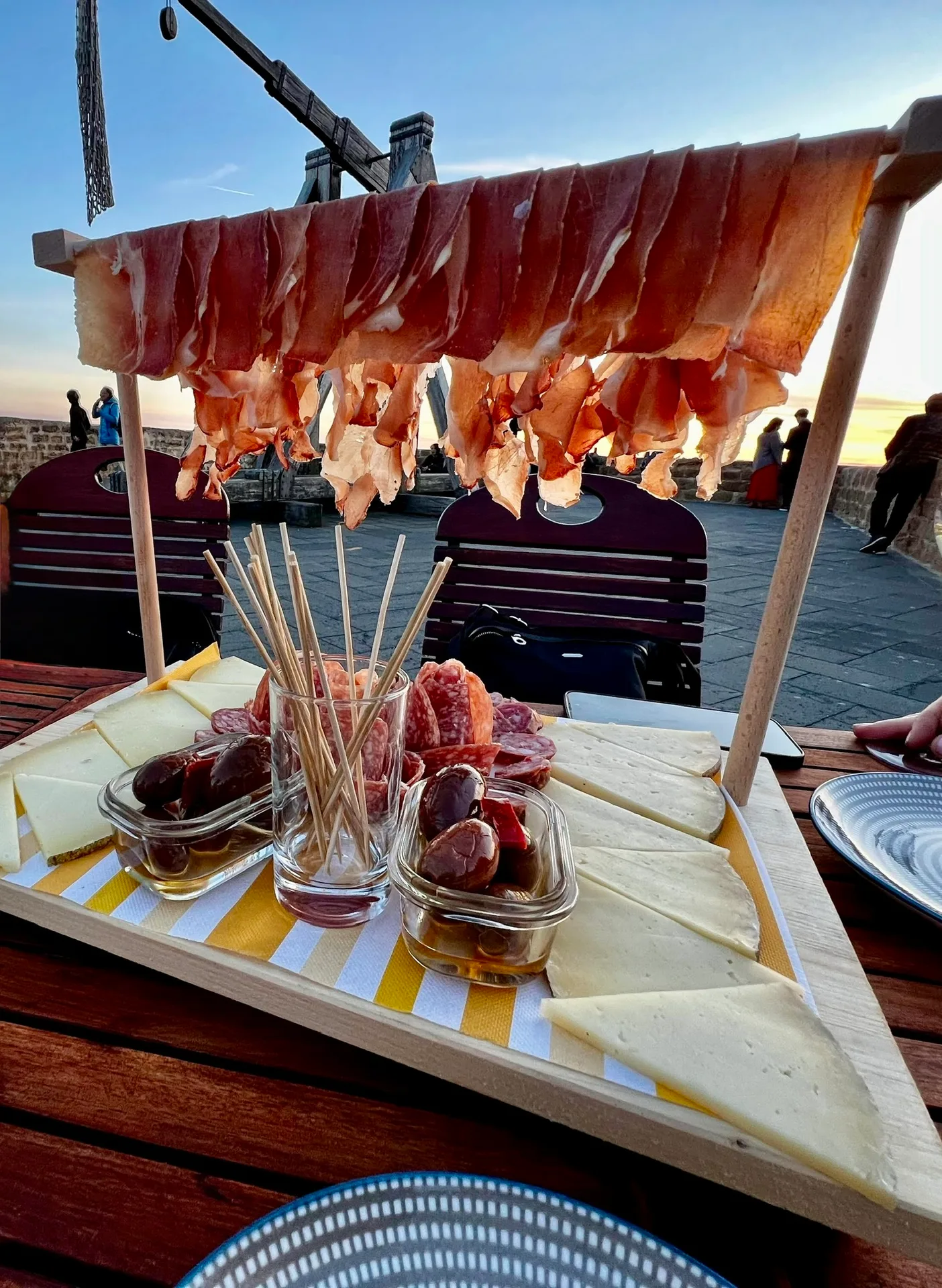
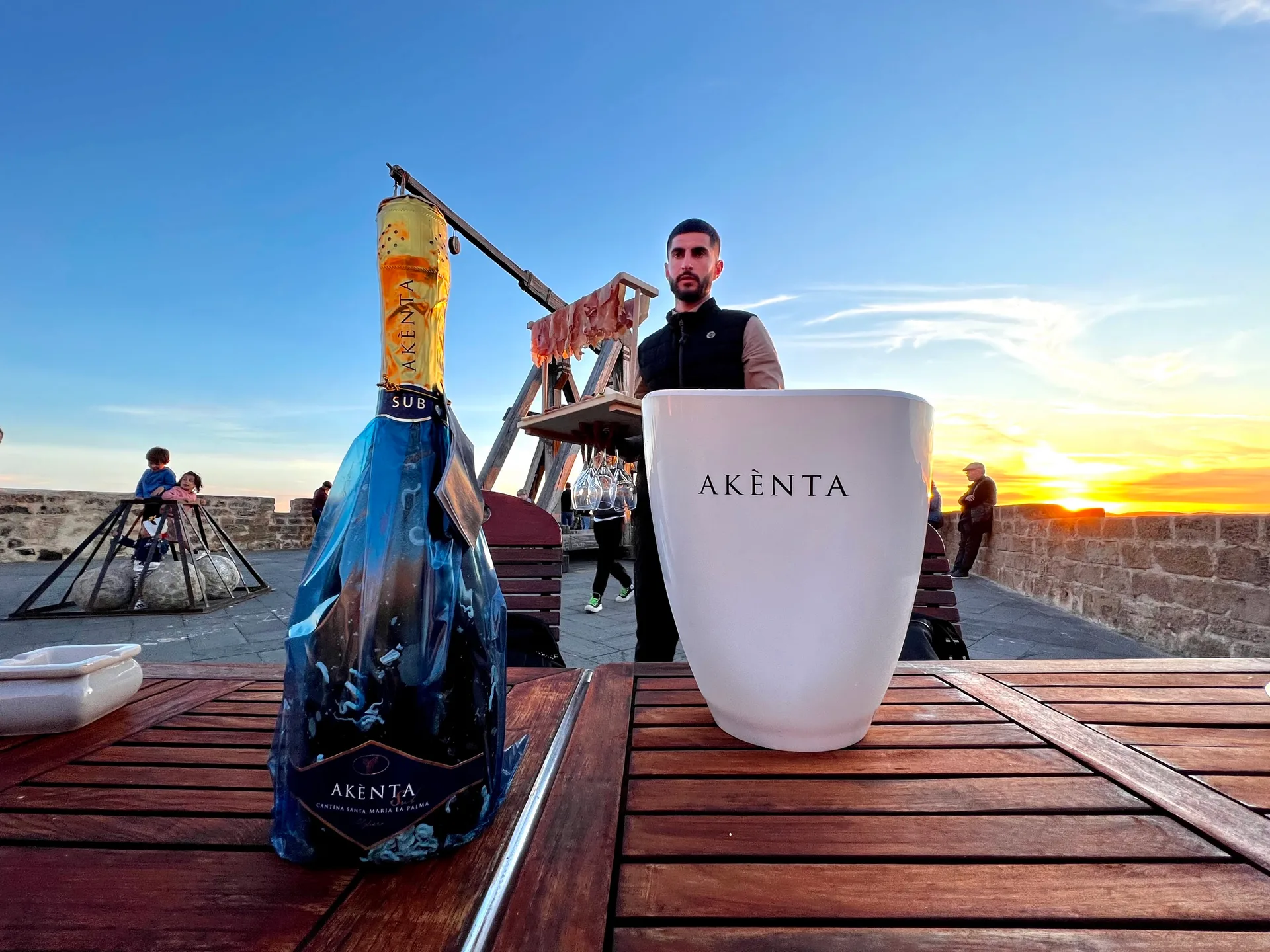
The most beautiful way we know to taste Akènta Sub is where we first tried it: at La Terrazza Sibul, on the Bastioni Marco Polo in Alghero's old town. The restaurant invited us to come for the sunset, and the bottle arrived still crusted with marine deposits, presented at the table like a small treasure. It came with a wooden stand draped with thin slices of prosciutto, cheese, olives and breadsticks, and the whole terrace turned gold as the sun dropped into the sea. Sibul also sells the wine, so you can take a bottle home.
Drinking a wine that spent months under the same sea you are looking at is a story you will tell for a long time. Book a terrace table, ask what time to arrive for the sunset, and order the Akènta.
Plan your trip around Alghero
The sea where Akènta Sub ages is one of the most beautiful stretches of the Sardinian coast. Our Alghero travel guide covers the old town, the beaches and Capo Caccia, and our guide to Neptune's Grotto explains how to reach the famous sea cave below the cliffs, by boat or down 654 steps. For a sunset walk before dinner, follow our Alghero bastions walk. And if you love Vermentino, compare Akènta with the wines of Gallura in our visit to Capichera.
Sources: Vinitaly magazine; Cantina Santa Maria La Palma; La Nuova Sardegna (May 2018); L'Unione Sarda (July 2023); Concours Mondial de Bruxelles. Experience and photos: Sardinia Blog, November 2026.
Rental12, a holiday-rental company in Olbia that shares an owner with Sardinia Blog, lets its own homes in Olbia and Golfo Aranci.