
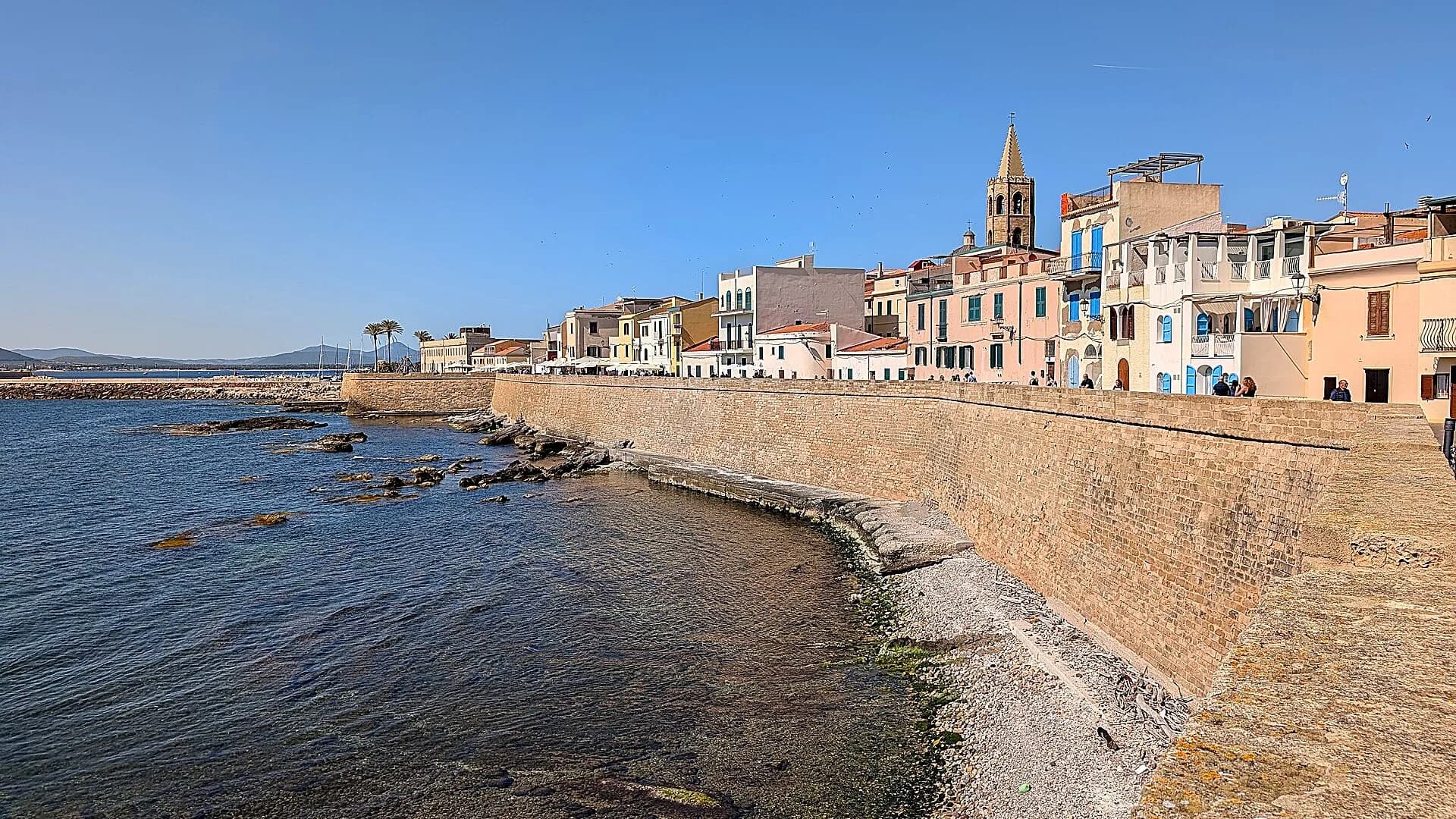

Alghero is a walled port town of about 44,000 people on Sardinia's north-west coast, where a form of Catalan is still spoken and protected by law. It combines a walled old town on the sea, the 654-step stairway down to Neptune's Grotto at Capo Caccia, a string of sandy beaches and its own airport, which handled 1,770,493 passengers in 2025.
Alghero quick facts
- Where: the far north-west of Sardinia, about 30 km from Sassari, on the stretch of shore called the Riviera del Corallo (Coral Riviera), about 90 km long.
- Language: Italian, plus Algherese Catalan, named in Sardinia's regional language law 22 of 2018.
- Big sight: Neptune's Grotto, reached by boat from the port or by the 654-step Escala del Cabirol.
- Old town: sea walls and eight 16th-century town towers survive; walking the bastions is free.
- Airport: Alghero-Fertilia (AHO), traffic up 12.3% in January to August 2026.
The Catalan old town, walls and towers
The Doria family founded Alghero between 1102 and 1112. The Aragonese took the town in 1353, and the following year the Sardinian and Genoese inhabitants were expelled and replaced with settlers from Catalonia. That is why Alghero is the only place in Italy where the everyday dialect is mainly Catalan. Italian Law 482 of 1999 protects the language of Catalan-speaking populations, and Sardinia's regional law 22 of 2018 names "il catalano di Alghero" alongside Sardinian, Gallurese, Sassarese and Tabarchino.
According to SardegnaTurismo's page on the walls and bastions, the sea-facing walls and eight 16th-century town towers survive, with 11 more towers along the coast. The bastions are named after navigators: Colombo, Pigafetta, Magellano and Marco Polo. Look out for these:
- Torre di Porta Terra: the old land gate, the way in for anyone arriving from Sassari.
- Torre di Sulis: scene of a night battle on 5 and 6 May 1412, later a prison.
- Torre della Maddalena: also called Garibaldi's tower, as he landed here in 1855.
- Torre di San Giovanni: the "middle" tower of the land walls.
Our bastions walk with history and viewpoints follows the full seafront circuit.
The Cathedral of Santa Maria is the old town's landmark. Building began in 1530 and the church was consecrated in 1593, still unfinished. Its base is Catalan Gothic, modelled on Barcelona's cathedral of Santa Eulalia, and its octagonal bell tower ends in a spire of coloured majolica tiles, according to SardegnaTurismo's cathedral page. The neoclassical portico on Piazza Duomo dates from 1820. For a shaded break between churches, the Giardini Giuseppe Manno public garden is close by.
Capo Caccia and Neptune's Grotto
Neptune's Grotto (Grotta di Nettuno) sits at sea level in the cliffs of Capo Caccia, west of Alghero. Guided visits start every hour and last about 30 minutes, past stalactites and the saltwater Lago La Marmora. There are two ways in.
By land: the Escala del Cabirol has 654 steps, according to the official Grotta di Nettuno site. You walk down and then climb back up. The site says the stairway is not recommended for people with certain heart or breathing conditions, and the cave is not accessible to wheelchair users. From June to October you park at Casa Gioiosa and take a paid shuttle, arriving an hour before your slot; from November to May you drive to the forecourt and arrive at least 40 minutes early. ARST bus 9321 runs from Alghero all year.
By sea: boats leave from the Banchina Dogana in Alghero port and from the Cala Dragunara pier in Porto Conte. The crossing takes about 40 minutes, and boats run from April to November. The boat ticket does not include cave entry.
Tickets and hours: the official ticket page lists €18 full price and €10 reduced (ages 6 to 17, students up to 26, Alghero residents, and Sardinian residents from 1 November to 31 March), with under-6s free. That price list is still labelled 2025 on the official site in October 2026. Land visits always need a booked time slot. The Alghero Experience ticket page gives 09:00 to 17:00 from 1 to 24 October 2026 and 10:00 to 15:00 from 25 October. The official site's own timetable still showed 09:00 to 17:00, so check before you go. The cave closes on 24 and 25 December and whenever the sea is rough.
Porto Conte regional park
Capo Caccia is part of the Porto Conte regional park, created by regional law 4 of 26 February 1999. It covers about 5,000 hectares, with 60 km of coastline, and since 2002 has included the Capo Caccia-Isola Piana marine protected area. The forest of Le Prigionette is home to white donkeys, Giara horses and fallow deer, and griffon vultures nest on the highest cliffs. The park authority's site sells tickets for its ecomuseum sites, including the Grotta Verde, limited to 30 people per booked visit.
Alghero beaches: which one for which day
- Lido di San Giovanni: the 3 km town beach, a short walk from the centre, with a sandy seabed that shelves gently.
- Maria Pia: sand dunes with centuries-old junipers, just outside town.
- Le Bombarde: almost 1 km of fine sand, 10 km north of Alghero. The official SardegnaTurismo description says the seabed drops quickly, so the water is deep a few metres from shore.
- Lazzaretto: a sandy arc of just over 300 metres, about 10 km from town; the west side is the first to fall into shade in the afternoon.
- Mugoni: 2 km of sand inside the bay of Porto Conte, 16 km from Alghero, sheltered, calm, accessible and suited to families.
- Porto Ferro: a 2 km arc of amber sand about 20 km north, with Lake Baratz, Sardinia's only natural lake, behind the dunes.
Nuraghe Palmavera and the Anghelu Ruju necropolis
Nuraghe Palmavera stands at km 45 of the SS 127 bis near Fertilia. Its main tower dates from the 15th to 14th century BC. Fewer than 50 huts survive from a village once estimated at 150 to 200. Anghelu Ruju, found by chance in 1903, has 38 rock-cut tombs (domus de janas) from about 3200 to 2800 BC and is one of the 17 sites inscribed by UNESCO in 2025.
Both cost €7 full and €5 reduced, open daily 10:00 to 18:00 in October and 10:00 to 14:00 from November to February, per the Palmavera page on Alghero Experience. The Alghero Ticket pass covers 13 sites, including the grotto, Palmavera and Anghelu Ruju, with no expiry date. For older stonework, see our guide to the Monte Baranta megalithic complex.
Catalan food, red coral and Alghero wine
A classic Alghero dish is aragosta alla catalana, boiled spiny lobster dressed with tomato, sliced onion, olive oil and lemon. Ask how it is priced before you order. Alghero's other emblem is red coral (Corallium rubrum): the Museo del Corallo, in the Liberty-style Villa Costantino built in 1927, explains the coral trade and the local craft of setting coral in gold.
Two large wineries are based in Alghero's countryside. Sella & Mosca began reclaiming its estate in 1899, founded by two men from Piedmont, the engineer Sella and the lawyer Mosca, and runs bookable tours and tastings. Cantina Santa Maria La Palma is a cooperative founded in 1959 by 100 growers; it now has 300 members farming more than 800 hectares.
Getting there and getting around
Alghero-Fertilia airport handled 1,770,493 passengers in 2025, according to Assaeroporti monthly traffic data, and January to August 2026 was 12.3% higher. Winter traffic is much thinner, so check routes before planning a November to March trip. Our news story on Ryanair's winter 2026 schedule for Alghero has the latest seat changes.
By car, Olbia to Alghero is about 137 km and 1 hour 47 minutes, and Cagliari to Alghero about 203 km and 2 hours 57 minutes, both toll-free. Heading south, the coast road from Alghero to Bosa is one of the island's best drives.
The old town is a camera-controlled ZTL (limited traffic zone). Under the comune's ZTL regulation, traffic and parking are banned all year from 00:00 to 08:00, 10:30 to 14:30 and 16:30 to 24:00. Guests of accommodation inside the zone may drive in to unload luggage if their host registers the number plate with the local police.
When to go
July and August are the busiest months, with more than 290,000 airport passengers in each in 2026. In 2025, May, June and September each had between about 168,000 and 222,000 passengers: quieter than high summer, but more than double any month from November to March. Boats to the grotto run from April, and the grotto's winter hours start on 25 October. Two events stand out: Cap d'Any, the New Year celebrations in the old town, and the Holy Week rites in the Spanish tradition.
Local tips: what most guides get wrong
- Le Bombarde is not a toddler beach. The seabed drops quickly. For small children, choose Mugoni or the Lido di San Giovanni.
- The grotto ticket is only the entry. Shuttle and boat fares are extra. In summer there is no ticket desk at Capo Caccia (in 2026 it reopened on 16 October), so buy online or at Casa Gioiosa or the port.
- Check the sea before you set out. The cave shuts in rough weather even for visitors on the stairs. Alghero Experience posts closures on its homepage, as it did for 25 and 26 October 2026.
- 654 steps is one way. Allow time and water for the climb back up, and wear proper shoes rather than flip-flops.
- Mind the ZTL lunch window. The old town is closed to traffic from 10:30 to 14:30, not just at night.
Sources: Grotta di Nettuno, getting there · Grotta di Nettuno, admission fees · Alghero Experience, Grotta di Nettuno · Alghero Experience, Palmavera · SardegnaTurismo, walls and bastions · SardegnaTurismo, Cathedral of Santa Maria · SardegnaTurismo, Le Bombarde · Parco di Porto Conte · Assaeroporti traffic data · Comune di Alghero, ZTL regulation
Photo credits: Alghero's sea walls run along the old town, with the bell tower of the Cathedral of Santa Maria rising behind the seafront houses (Basilicofresco, CC BY-SA 4.0, via Wikimedia Commons); The limestone cliffs of Capo Caccia seen from the sea, with the lighthouse on the headland above Neptune's Grotto (Holger Uwe Schmitt, CC BY-SA 4.0, via Wikimedia Commons); Stalactites and columns above the saltwater lake inside Neptune's Grotto at Capo Caccia (Falk2, CC BY-SA 4.0, via Wikimedia Commons); The Escala del Cabirol zigzags down the cliff face of Capo Caccia to the entrance of Neptune's Grotto (Falk2, CC BY-SA 4.0, via Wikimedia Commons); Golden hour over the sea and one of Alghero's bastions, a favourite evening walk in the old town (Mauriz-79, CC BY-SA 4.0, via Wikimedia Commons). Fact sheet and chart: Sardinia Blog, from the sources listed above.
Combining Alghero with Olbia on one trip? Rental12, a holiday-rental company based in Olbia, splits ten days between the two towns in 10 days in Sardinia: a two-base Olbia and Alghero itinerary. It is a company guide, not independent research.