
🏛️ The Megalithic Complex of Monte Baranta – A Hidden Prehistoric Gem in Sardinia
High above the plains of northwestern Sardinia, near the quiet town of Olmedo, the Megalithic Complex of Monte Baranta offers a rare, atmospheric journey into the Copper Age. Dating to roughly 2500–2200 BC, this clifftop stronghold predates the Nuragic era and reveals how Sardinia’s earliest communities lived, worked, and defended themselves amid sweeping views of the Nurra region.
Why the Megalithic Complex of Monte Baranta matters
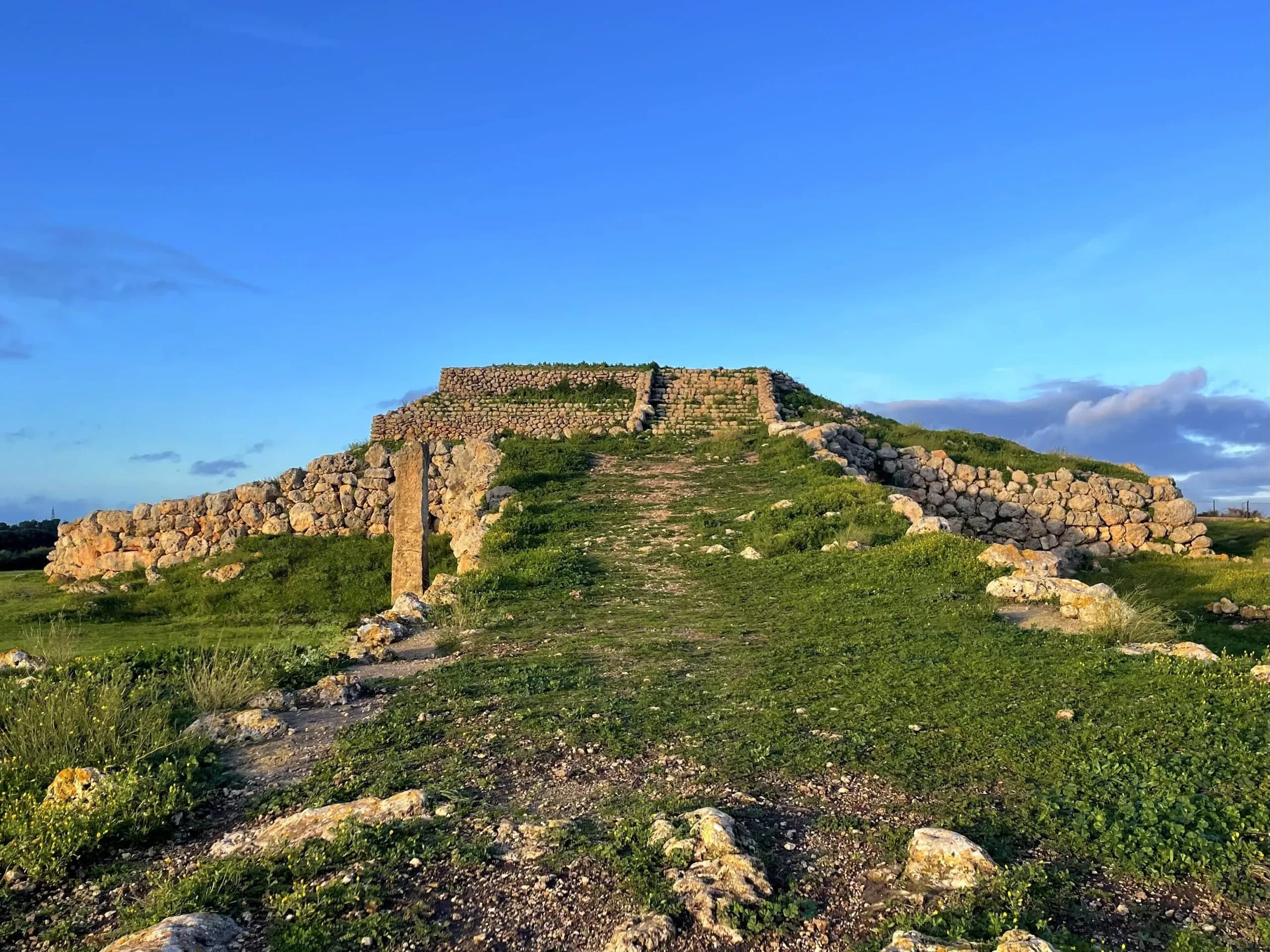
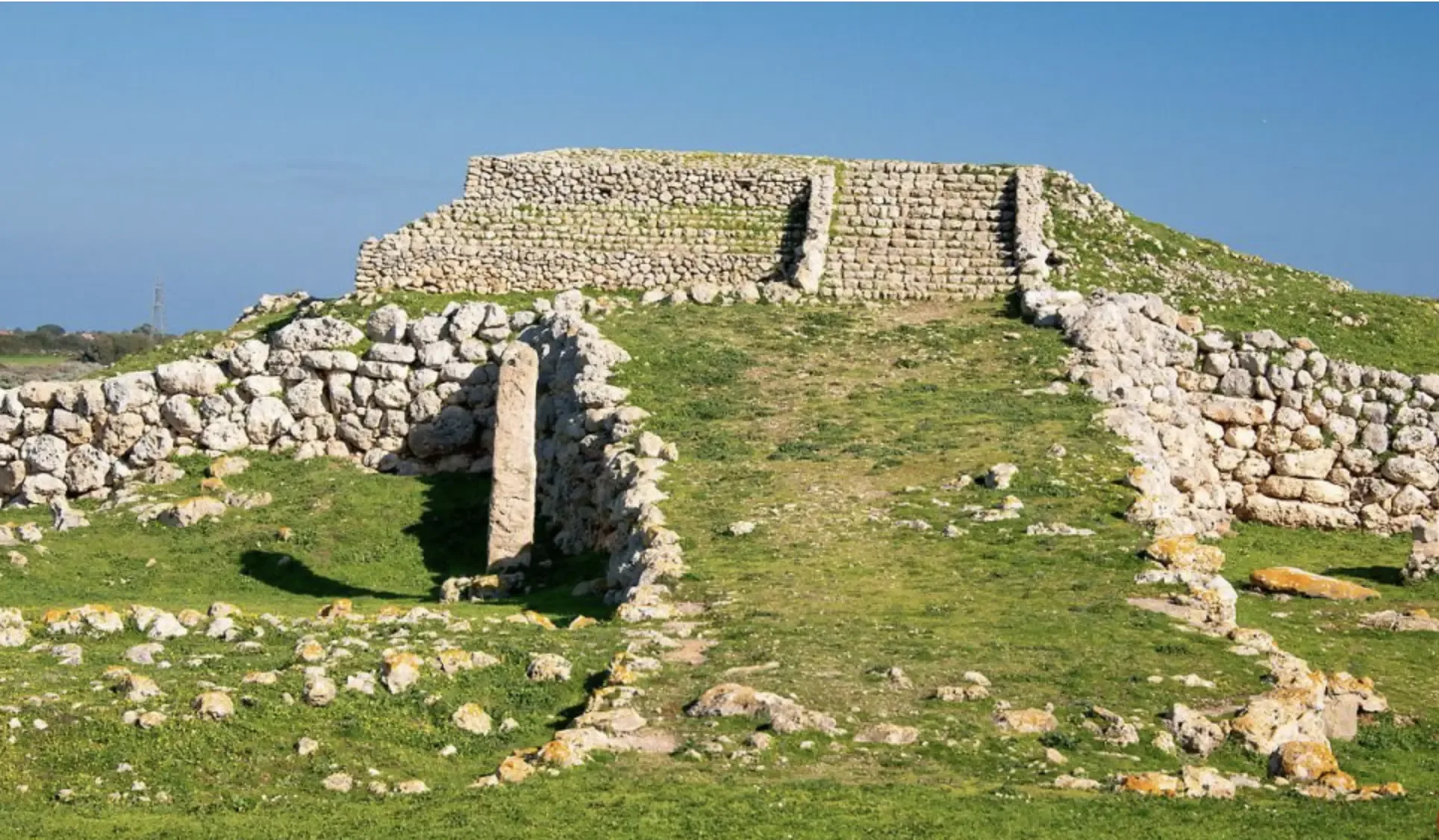
Built by the Monte Claro culture, the Megalithic Complex of Monte Baranta blends civil, defensive, and sacred spaces within one dramatic landscape. Archaeological studies date the fortifications and village to the late Chalcolithic period and highlight the site’s innovative engineering for the time, including a long megalithic curtain wall and a horseshoe-shaped tower enclosure. According to Sardegna Turismo, the wall stretches for about 97 meters and was designed to protect the plateau’s most exposed side, while the inner area shows traces of domestic and communal life from more than four millennia ago (Sardegna Turismo).
Beyond its age and scale, the Megalithic Complex of Monte Baranta captivates for its quiet beauty. The setting is a sun-warmed trachytic plateau with sheer drops on three sides, where wind and light change by the minute. You feel the past here in a very direct way.
📍 Where it is
The Megalithic Complex of Monte Baranta stands just outside Olmedo in the province of Sassari, a short drive from Alghero and its coastline. The plateau commands broad views across the Nurra plain, which once provided natural surveillance and strategic protection.
- From Alghero: approximately 20 minutes by car
- From Alghero Airport: around 15 minutes
- From Sassari: about 35 minutes
The location makes the Megalithic Complex of Monte Baranta an easy addition to any northern Sardinia itinerary, whether you are based in Alghero, Sassari, or along the Coral Riviera.
🧭 How to get there
Driving is the simplest way to reach the Megalithic Complex of Monte Baranta:
- From Olmedo, take the SP 19 toward Alghero for about 1.2 km
- Turn left at the brown sign for “Complesso Megalitico di Monte Baranta”
- Follow the dirt road for roughly 850 m to a small parking area
- Walk the final 700 m on a signposted footpath to the top of the plateau
Conditions are generally straightforward, but after heavy rain the track can become muddy. The site is open-air with no ticket office or facilities; visiting is typically free and unguided, as noted by local and regional tourism information (Comune di Olmedo).
Visitor tips 🧭
- Wear sturdy shoes and bring water, sun protection, and a light jacket outside summer
- Avoid visiting right after rain due to mud
- Offline maps help, as signage is minimal once you turn off the SP 19
- Surfaces are uneven; the walk is not ideal for those with limited mobility
What to see at the site
The Megalithic Complex of Monte Baranta is one of Sardinia’s best preserved pre-Nuragic fortified settlements. Allow 60 to 90 minutes for an unhurried visit.
Horseshoe tower enclosure 🧱
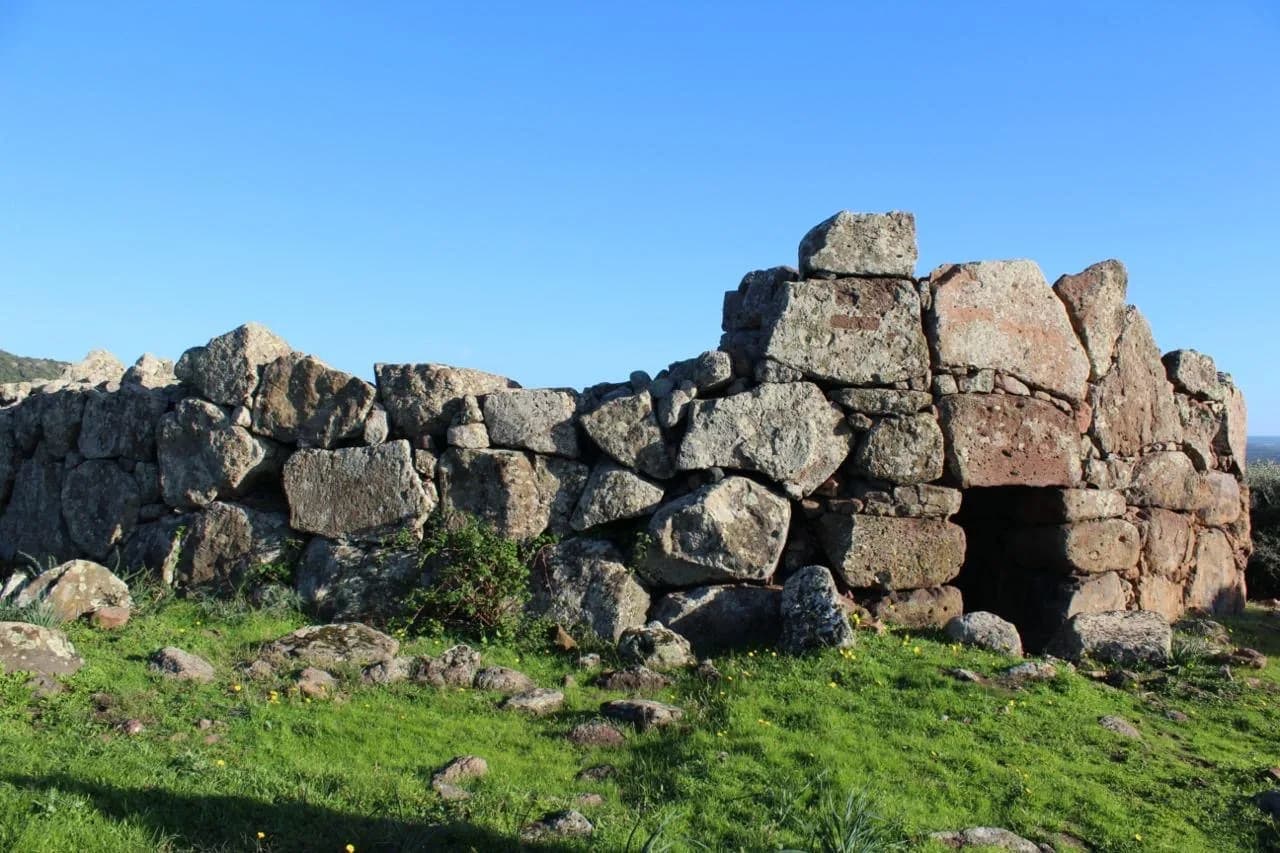
This striking structure is built in a horseshoe plan, formed by massive masonry that once stood several meters high. Two narrow passages, roofed with large stone slabs, served as controlled entrances into the interior. Their scale and design point to a community that understood defensive planning as well as monumentality.
The megalithic wall
On the plateau’s weakest side, you will find the famous fortification wall, about 97 meters long with an entrance framed by upright monoliths. Its construction, using large fitted blocks, showcases a sophisticated approach to defense and movement control for the Copper Age. According to Sardegna Turismo, the wall protected the only side not guarded by cliffs, forming a formidable barrier with a single, well-protected gateway (Sardegna Turismo).
Village remains
Inside the defenses lie traces of daily life: foundations of oval and rectangular huts, some with stone-paved floors. These remains suggest domestic spaces and communal areas where craftwork, storage, and social activities may have taken place. The combination of living quarters within a fortified perimeter is a hallmark of the Megalithic Complex of Monte Baranta and a window into early organized settlement in Sardinia.
Sacred area and menhir ✨
Just beyond the main wall sits a circular megalithic enclosure composed of some 80 slabs. The arrangement, along with a nearby fallen menhir nearly 4 meters long, is thought to have served ritual or ceremonial functions. The juxtaposition of sacred space outside the defended village adds another dimension to the Megalithic Complex of Monte Baranta, where the spiritual, civic, and military aspects of life coexisted within steps of one another.
🌄 Reasons you will love it
- Sense of place: the silence, wind, and vast horizon create an atmosphere that photographs beautifully 📷
- Archaeological depth: a rare pre-Nuragic stronghold with visible fortifications and living spaces
- Authenticity: typically low visitor numbers make it easy to explore at your own pace
- Easy logistics: close to Alghero yet far from crowds
For travelers who love culture, landscape, and a touch of mystery, the Megalithic Complex of Monte Baranta delivers all three.
Practical information
Best time to visit
- Spring and autumn: mild weather and clear light are perfect for walking and photos
- Summer: visit early morning or late afternoon to avoid heat; shade is minimal
- Winter: beautiful on clear days, but bring layers and check for muddy tracks after rain
On-site essentials 💡
- Entry: typically free; open-air site with no gates or ticket office
- Facilities: no toilets, café, or visitor center; bring water and snacks
- Footwear: sturdy shoes recommended for uneven ground
- Average visit: 60–90 minutes including the approach walk
- Respect the site: do not climb on walls or move stones
Understanding its history
The Megalithic Complex of Monte Baranta belongs to the Monte Claro culture, a key Copper Age horizon in Sardinia known for early fortifications, social stratification, and distinctive pottery. The plateau’s natural cliffs provided ready-made defenses on three sides, while the megalithic wall and tower enclosure secured the rest. This integration of topography with architecture is a defining trait of the Megalithic Complex of Monte Baranta and a reason archaeologists consider it unique in the island’s prehistoric landscape.
While the site predates the better-known Nuragic civilization, it provides crucial context for Sardinia’s later cycles of monumental building. It shows that by the 3rd millennium BC, communities here were already organizing collectively, investing in large-scale works, and establishing sacred environments alongside protected settlements.
Make a day of it
The Megalithic Complex of Monte Baranta combines well with other archaeological highlights in the area:
- Anghelu Ruju, the island’s largest pre-Nuragic necropolis, near Alghero
- NURAGHE Palmavera, a classic Nuragic complex a short drive from the coast
- Alghero’s old town for a relaxed lunch and stroll along the bastions
- Santu Antine in the Logudoro region if you are up for a longer inland drive
With thoughtful planning, you can experience a full arc of Sardinia’s prehistory in a single day, from Copper Age fortifications to Nuragic towers and rock-cut tombs.
Frequently asked questions
Is the Megalithic Complex of Monte Baranta suitable for children?
Yes, if they are comfortable walking on uneven trails. Keep a close eye near cliff edges and along the wall sections.
Can I visit with a guide?
Guided tours may be available through local operators in Alghero or Olmedo. Otherwise, it is easy to visit independently. For background, read up before you go or bring a concise site description on your phone.
Are drones allowed?
Open-air archaeological sites in Italy often restrict drone use. If you plan to fly, check current regulations and obtain necessary permissions in advance.
Final thoughts
If you are exploring northern Sardinia and crave a deeper connection to the island’s ancient roots, the Megalithic Complex of Monte Baranta is a compelling stop. Quiet, powerful, and close to the coast, it rewards curious travelers with vivid traces of a world that thrived here more than four thousand years ago. Step onto the plateau, feel the wind, and let the stones tell their story.