
Cabu Abbas is the rocky hill that rises just north-east of Olbia, between the town and the coast road to Golfo Aranci. On its top, at almost 250 metres, stands the Nuraghe Riu Mulinu, Olbia's most important Bronze Age monument: a tower inside a 220-metre wall that wraps the whole summit, with a view that runs across the Gulf of Olbia to Tavolara. The walk up from the Olbia 2 estate is short and steep, and the regional heritage office describes it as a panoramic path. There is no signed trail network, so this is a half-morning outing, not a mountain hike.
A note on this page: an earlier version called the hill "Monte Saccùri" and described springs along the way. No regional, municipal or archaeological source uses that name; the Regione's heritage portal places the complex on Monte Colbu, and the only water feature recorded at the site is a small well inside the nuraghe. We have rewritten the guide from primary sources.
Quick facts
Site: Cabu Abbas nuragic complex (Nuraghe Riu Mulinu), on the summit of Monte Colbu, almost 250 m above sea level (Sardegna Cultura, Sardegna Turismo).
Age: 1300 to 1200 BCE (Sardegna Turismo).
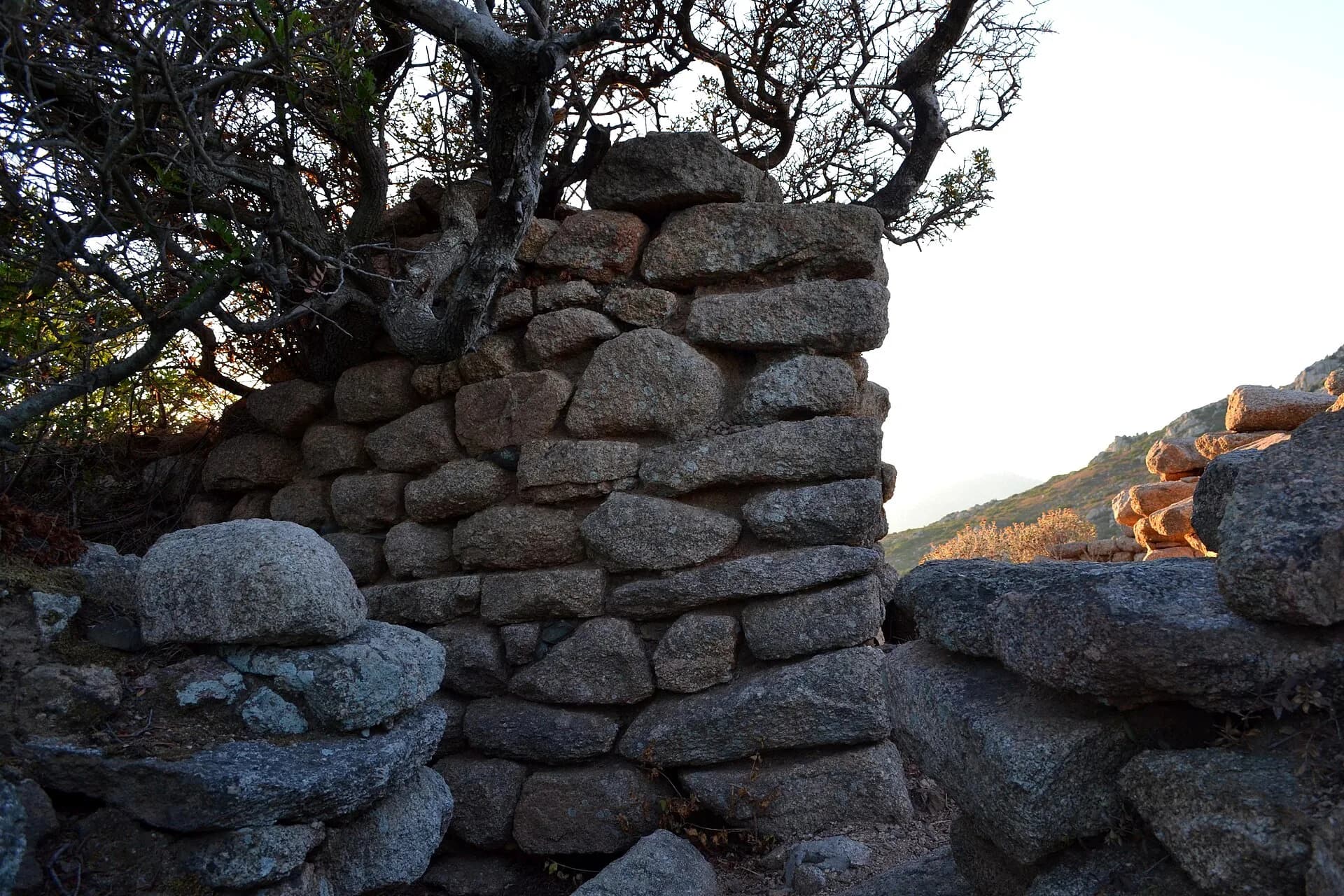
What you see: a tower about eight metres across on the highest point, enclosed by a wall 220 metres long and up to five metres thick and high in places, built around the natural granite outcrops; two gateways, south and north.
Inside the tower: a room about 3.5 by 3.65 metres with two niches and a well 2.60 metres deep lined with small stones; excavated in 1936 by Doro Levi, who found a small bronze of a woman carrying an amphora and read the building as a place of water worship (Sardegna Cultura).
Access: leave Olbia on the coast road towards Golfo Aranci, turn left at the second junction following the signs for the Olbia 2 estate, park beyond the houses and walk up the hill on the panoramic path (Sardegna Cultura).
Cost: open ground, no ticket, no services.
Why walk up
The nuraghe was a lookout. From its outlook on Cabu Abbas, Sardegna Turismo writes, it kept watch for enemy ships, with a view that reaches to Tavolara. That is still the reward: the Gulf of Olbia at your feet, the ferries sliding in and out of the port, Tavolara and Molara offshore, and the granite hills of Gallura behind you. On a clear day after the maestrale the island outlines are sharp. Granite, cistus and lentisk scrub, and the occasional kestrel are the company.
What you are looking at
The Cabu Abbas complex is unusual among Sardinian nuraghi for its wall. Rather than a settlement of huts, the summit is ringed by a cyclopean wall 220 metres long that uses the rock outcrops as part of its line, with widths and heights of up to five metres. Two gateways, one to the south and one to the north, lead inside. On the highest point stands the tower, roughly eight metres in diameter.
Inside, the chamber is slightly squashed in plan, about 3.50 by 3.65 metres, with two niches in the walls. Near the back wall a truncated-cone well 2.60 metres deep is lined with small stones laid in courses. Doro Levi, who dug here in 1936, found a small bronze figure of a woman with an amphora on her head, and concluded that the building was dedicated to the cult of water rather than to defence alone. Sardegna Turismo calls Riu Mulinu Olbia's most important nuragic site; the sacred well of sa Testa, the town's other famous Bronze Age monument, is a separate site on the edge of Olbia, not on this hill.
The walk
Leave Olbia on the coast road towards Pittulongu and Golfo Aranci and take the second turning on the left, signed for the Olbia 2 estate. Drive through the estate, park where the houses end and continue on foot up the hill. The Regione's heritage portal describes the climb as a panoramic path; it is not a numbered regional trail and there is no CAI route, so expect an informal track over granite, rough and slippery after rain. Allow about an hour up and down with time at the top; the hill is under 250 metres high, so the climb itself is short.
Download an offline map before you go and note where you parked, because signage is thin. Wear shoes with grip, carry water (there is none on the hill), and in summer go early or late: there is little shade. Keep dogs on a lead and leave the stones where they are. For anything serious the emergency number is 112.
Make a morning of it
Pair the walk with a swim at Pittulongu, ten minutes down the same coast road.
Continue to Golfo Aranci for lunch by the sea; see our Golfo Aranci guide.
Back in town, our Olbia guide covers the sacred well of sa Testa and the archaeological museum.
Sources: Sardegna Cultura, Olbia, Cabu Abbas Complex · Sardegna Turismo, Riu Mulinu · Monumenti Aperti, Nuraghe Riu Mulinu. Checked 31 October 2026.
Photo: AnetaMalinowska, CC BY-SA 4.0, via Wikimedia Commons.