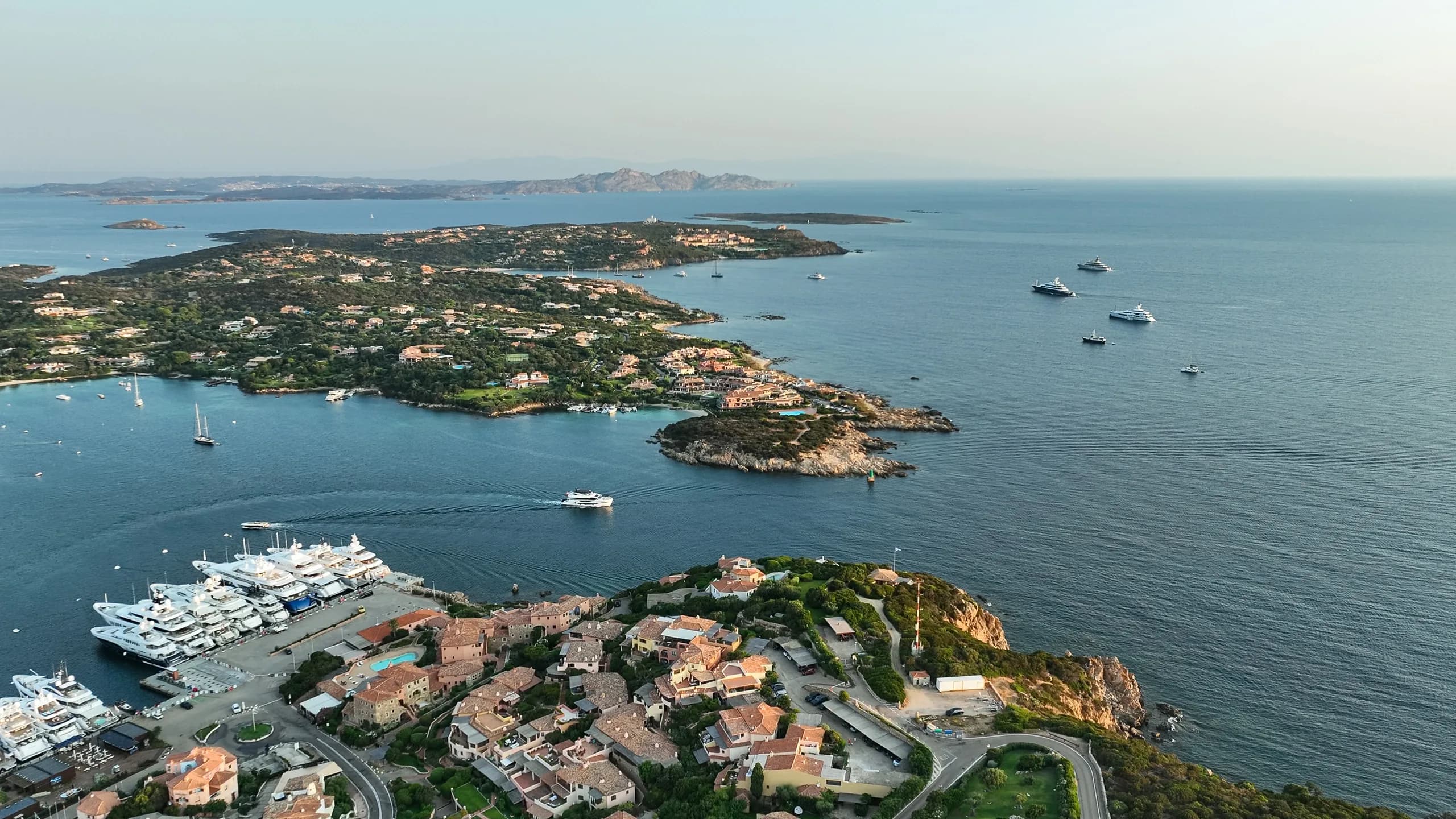
Costa Smeralda is the 55 km stretch of granite coast in north-east Sardinia that has been managed by the Consorzio Costa Smeralda since 14 March 1962, almost all of it in the municipality of Arzachena. Its main village, Porto Cervo, is 28 km from Olbia, and the reason to go is a string of small, sheltered sandy coves with clear, shallow water, best between June and September.
Costa Smeralda in brief
What it is: not a place name but the name of the land owned by members of the Consorzio Costa Smeralda, according to the Consorzio's own boundary page.
Size: 3,114 hectares, of which 117 hectares (3.7%) are built on, with 55 km of coastline.
Where: Gallura, mostly in Arzachena, with a small southern strip in the municipality of Olbia.
Edges: two granite boulders carved with the name mark the boundary, one after Portisco on the road from Olbia, the other just after Liscia di Vacca on the road to Baja Sardinia.
Distances: Porto Cervo is 28 km from Olbia and 17 km from Arzachena, the Consorzio says.
Season: the summer airport bus runs from 1 June to 30 September, and Arzachena's tourist tax applies over the same months.
Where Costa Smeralda starts and ends
This is the point most guides blur. "Costa Smeralda" is used loosely for the whole north-east coast, but the official area runs from Pitrizza and Capo Ferro in the north to the land behind Rena Bianca beach, near the Gulf of Cugnana, in the south.
That means Baja Sardinia and Poltu Quatu sit beyond the northern marker. Both are in Arzachena and on the same bus line, but they grew separately. Arzachena's tourism office says Baja Sardinia was started in the 1960s by the Gentili family, and that Poltu Quatu, a fjord-like inlet with about 500 berths, dates from 1987.
At the other end, Porto Rotondo lies before the southern marker on the road from Olbia, so it is outside the Consorzio too. It explains why building styles and rules change within a few kilometres.
A short history: 1962, the Aga Khan and the architects
Until the early 1960s this coast was known simply as Monti di Mola. The Consorzio's history page records a letter of intent in 1961 and the formal founding on 14 March 1962 in Olbia, at 193 Corso Umberto, before a notary from Tempio.
About 1,800 hectares changed hands at first. The six founding members were Prince Karim Aga Khan IV, Patrick Guinness, Felix Bigio, John Duncan Miller, André Ardoin and René Podbielski. The Consorzio was set up as a non-profit body to control building and stop speculation.
An architecture committee drew up the rules. Its members were Luigi Vietti, Jacques Couëlle, Michele Busiri Vici and Antonio Simon Mossa.
Hotel Cala di Volpe, designed by Couëlle, was among the first buildings.
Porto Cervo's old village, planned by Vietti, opened in 1964.
The Yacht Club Costa Smeralda was founded in 1967.
Stella Maris church, by Michele Busiri Vici, opened in 1968.
The Aga Khan also set up the airline Alisarda in Olbia on 29 March 1963 to fly visitors in. He died in Lisbon on 4 February 2025, aged 88, and Olbia's airport now carries his name in its official title.
Porto Cervo and the smaller villages
Porto Cervo is the village at the heart of the Consorzio. The old centre was built on higher ground above the harbour, and the newer marina, begun in the 1980s, has about 700 berths. Shops, bars and restaurants line the lanes from the Piazzetta down to the Sottopiazza. For the slower side of the village, read our piece on Porto Cervo's design and quiet luxury.
The other names you will see on bus stops, such as Abbiadori, Piccolo Pevero and Liscia di Vacca, are small clusters of homes rather than towns. Cala di Volpe is the bay south of Porto Cervo that gives its name to the Couëlle hotel. The municipal centre, Arzachena, is 17 km inland.
Costa Smeralda beaches, and which to pick on a windy day
The maestrale, Sardinia's cold north-westerly wind, is the main thing to plan a beach day around. The Consorzio's guide to wind-sheltered beaches names the east side of Capriccioli, Liscia Ruja, Petra Ruja, Spiaggia del Principe and Li Itriceddi as the places to go when it blows.
Capriccioli: a low granite headland with four small beaches, two on each side. The two east-facing beaches are well sheltered in a maestrale; the two west-facing ones look onto Cala di Volpe bay. Paid parking, a bar and a bus stop.
Liscia Ruja: the largest beach on the Costa Smeralda, with more than 500 m of white sand, paid beach clubs and wide free sections.
Petra Ruja: an arc of fine white sand just past Liscia Ruja, about 340 m long, with shallow water. You walk to it from Liscia Ruja.
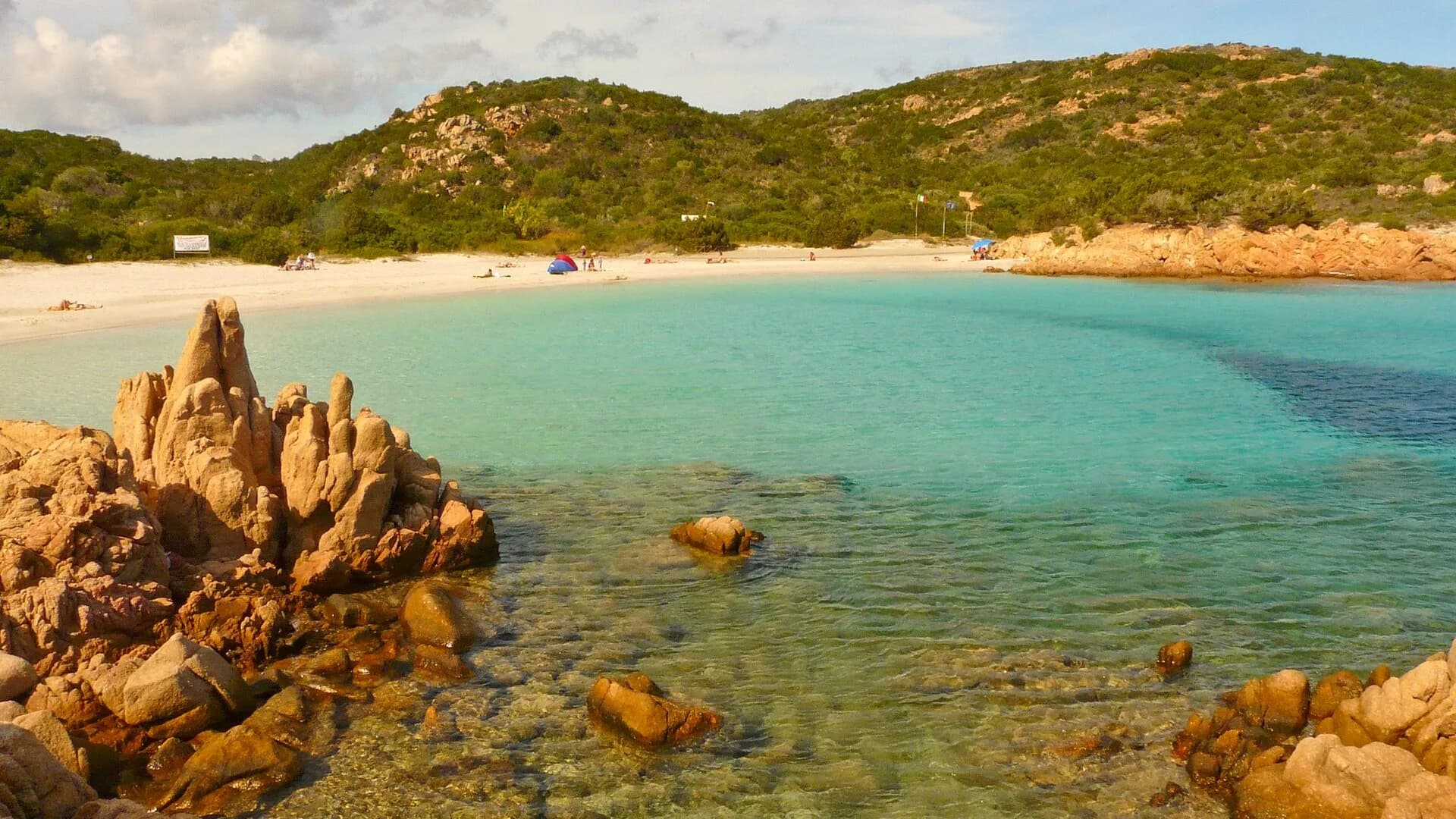
Spiaggia del Principe: its old name, Poltu di li Cogghj, means "port of the hides". It took the prince's name after the Aga Khan chose it for a villa that was never built. Arzachena's official beach page warns that the access path is a winding dirt track.
Romazzino: named after romassinu, Gallurese for rosemary, in a bay about 500 m wide. It is sheltered from the north and west, and the Romazzino hotel behind it dates from 1965. We have also written about coasteering and the zip line at Romazzino.
Dogs are not allowed on Capriccioli, Romazzino or Spiaggia del Principe. Taking sand, pebbles or shells off any Sardinian beach is banned by regional law, with fines of €500 to €3,000.
How to get to Costa Smeralda from Olbia airport
Olbia Costa Smeralda airport handled 4,128,015 passengers in 2025, according to its 2026 service charter. The airport operator puts the coast 34 km away; our Olbia airport guide covers arrivals and car hire.
Bus: Sun Lines line 20 runs every day from 1 June to 30 September 2026, four times each way. It leaves the airport at 10:00, 12:30, 16:00 and 19:00, stops at Olbia port, Porto Rotondo, Portisco, Capriccioli and Piccolo Pevero among others, and reaches Porto Cervo 1 hour 14 minutes later. It continues to Liscia di Vacca, Poltu Quatu and Baja Sardinia. The last bus back leaves Porto Cervo at 19:17.
Taxi: Olbia's tariff, published by the airport operator, is €3.50 to start, €2.60 a km for the first 5 km and €2.40 a km up to 45 km. Night and public holiday journeys add 20%, and luggage is €1 a piece up to €3. On our arithmetic, 34 km comes to about €86 by day before luggage. There is no fixed fare.
Car: Arzachena's 2026 parking table charges €2.50 an hour, capped at €12.50 a day, in its beach car parks from June to October, 09:00 to 20:00. Pay at the machines or with the EasyPark app.
When to go to Costa Smeralda
June and September give the best balance. The sea averages about 21.4°C in June and 24.1°C in September, against 25.8°C in August, based on ten-year averages for Olbia. Average daytime highs are around 29°C in June and 28°C in September, compared with about 32°C in July and August.
Crowds follow the planes. The airport's charter says June to September carries 68% of its yearly traffic, and July and August alone account for 40%, each passing 800,000 passengers. June and September share the rest of that peak, so they are calmer.
For sailing fans, the 36th Maxi Yacht Rolex Cup ran from 6 to 12 September 2026 off Porto Cervo, open to yachts of at least 60 feet. Our Maxi Yacht Rolex Cup guide has more on the event.
October is still mild, with the sea around 21.4°C and daytime highs near 23°C. If you want to understand the pressure July and August put on this coast, read our look at overtourism lessons from the Costa Smeralda.
What Costa Smeralda really costs
Costs range from a free towel on Liscia Ruja to a few hundred euro a day at a beach club.
Tourist tax (2026): Arzachena charges per person per night from 1 June to 30 September, for up to 7 nights. Five-star hotels pay €5.00, four-star €3.00, three-star and below €2.00, and homes in cadastral category A/7 or above €5.00. Children under 12 are exempt. The rules are filed with Arzachena's tourist tax office.
Parking: €2.50 an hour, €12.50 a day at most. In central Porto Cervo you can stay a maximum of 2 hours.
Beach clubs: the national average for an umbrella and loungers was €37.35 a day in 2026 (Federconsumatori). Sky TG24 reported in August 2025 that sets reach €120 in some Sardinian resorts, and that Nikki Beach Costa Smeralda asked €400 for two loungers and an umbrella, including €230 of food and drink credit.
Getting in: about €86 by taxi from the airport by day.
We found no official source for average hotel or villa rates on this coast, so we do not quote one.
Local tips
Check the wind forecast before choosing a beach. On a maestrale day, head for the east side of Capriccioli or Liscia Ruja.
Parking in Porto Cervo, Poltu Quatu and central Baja Sardinia is charged until 31 October, from 09:00 to midnight.
Liscia Ruja and Spiaggia del Principe both have free sand next to the paid clubs.
Sources: Consorzio Costa Smeralda, boundaries · Consorzio Costa Smeralda, history · Consorzio Costa Smeralda, beaches without wind · Arzachena Turismo, Spiaggia del Principe · Arzachena Turismo, parking 2026 · Sun Lines, line 20 timetable 2026 · ENAC, Olbia airport service charter 2026 · Ge.Se.Co. Arzachena, tourist tax · Yacht Club Costa Smeralda, Maxi Yacht Rolex Cup 2026 · Sky TG24, beach club prices 2025
Photo credits: Spiaggia del Principe, the crescent of white sand south of Porto Cervo that took its name from the Aga Khan (Ökologix, CC0 1.0, via Wikimedia Commons); Granite boulders and a lone juniper at Capriccioli, the headland whose east-facing coves stay calm when the maestrale blows (gpatgn, CC BY-SA 3.0, via Wikimedia Commons); Yachts moored in Porto Cervo's old harbour below the terracotta-roofed village, August 2018 (Klaus Bärwinkel, CC BY-SA 4.0, via Wikimedia Commons); Stella Maris church in Porto Cervo, designed by Michele Busiri Vici and opened in 1968 (Nivora, CC BY-SA 4.0, via Wikimedia Commons); Rented umbrellas and loungers on Capriccioli beach on the Costa Smeralda in September 2025 (Hidvégi Balázs, CC BY-SA 4.0, via Wikimedia Commons). Fact sheet and chart: Sardinia Blog, from the sources listed above.
Comparing a Costa Smeralda hotel with a holiday home? Rental12, which lets its own homes in Olbia and Golfo Aranci, priced the same August 2026 week both ways in Costa Smeralda hotels vs AZULIS: August 2026 pricing. It is a company comparison, not independent research.