
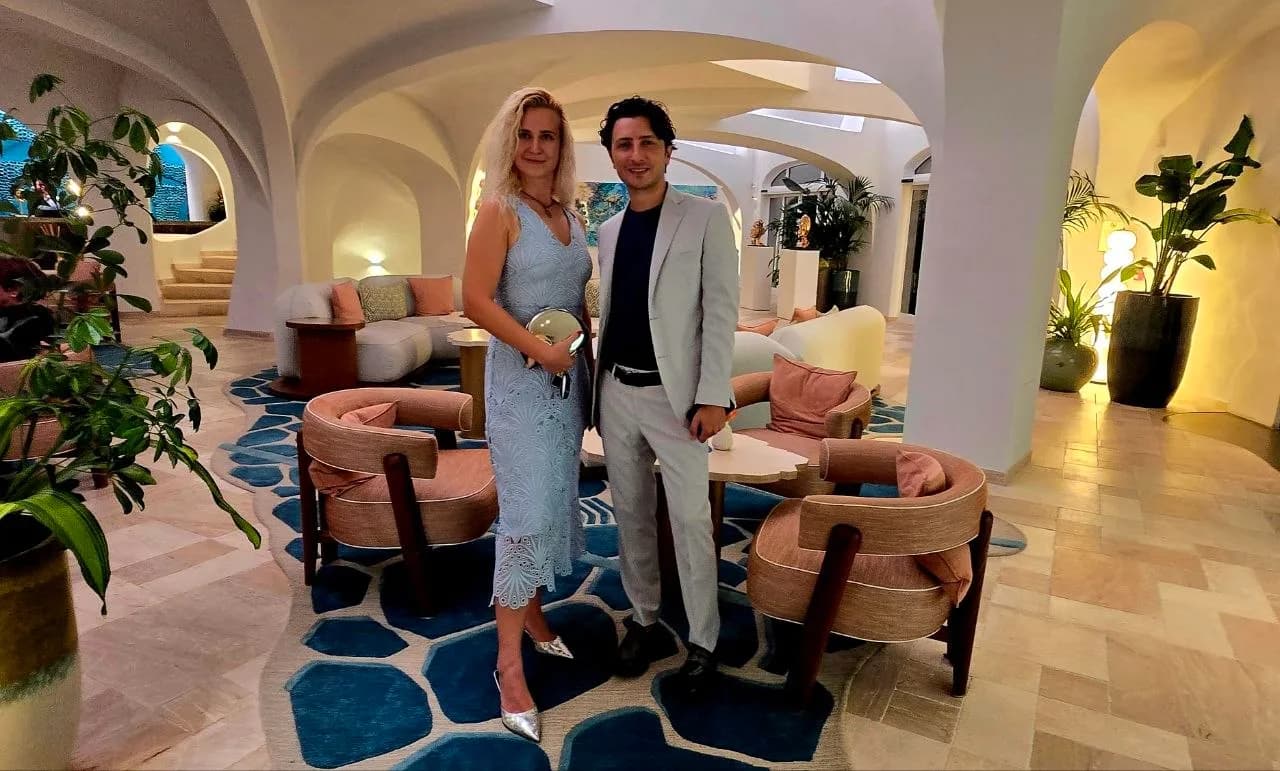
Contemporary art at W Sardinia does not sit inside a single exhibition room. Sculptures and paintings from the Liquid Art System project appear throughout the hotel, becoming part of the architecture, the atmosphere and the everyday rhythm of the space. Guests encounter the works while crossing the lobby, having a drink or simply moving between rooms, rather than by stepping into a gallery.
We spoke with curator Fabio Molinas about how the exhibition came together, what changes when art leaves the traditional gallery model, and what role he believes Sardinia could play in the future of the international contemporary art scene.
What inspired the concept behind the Liquid Art System exhibition at W Sardinia?
Molinas explains that the starting point was bringing Liquid Art System to Sardinia in a way that felt connected to the place, rather than simply reproducing the traditional gallery model. At W Sardinia, the artworks are not confined to a dedicated room. "You encounter them while walking through the lobby, having a drink or simply moving from one space to another," he says. For the curatorial team, it was also a chance to introduce Liquid Art System to Sardinia and build a new dialogue between contemporary art, hospitality and an international audience.
How did you select the artists and artworks for this exhibition? What connects them?
There isn't a single theme running through every piece, and Molinas sees that as deliberate. Liquid Art System represents artists with very different languages, generations and approaches, ranging from figurative sculpture and painting to more conceptual research. What connects the selection is the strength and individuality of each artistic voice. "We wanted the works to coexist without becoming uniform, creating unexpected relationships with one another and with the architecture of the W," he says, describing the result as closer to a diffused gallery than a conventional show.
Is there a particular artwork or artist whose story you would especially like visitors to discover?
Molinas points to Maicol Borghetti and his series Archaeology of the Future. At first glance, Borghetti's bronze figures can look like discoveries from a distant past. His idea is actually the opposite: he imagines them as relics belonging to a civilisation that has not existed yet. "They feel somehow familiar, but we don't really know who these figures are or where they come from," Molinas says, adding that this reversal is fascinating because visitors can be drawn in visually before the story changes how they look at the work entirely.
How does exhibiting art in a luxury hotel change the relationship between the artwork and its audience?
"In a gallery, people enter because they have already decided to look at art. In a hotel, the encounter is much more accidental," Molinas says. A guest might walk past a sculpture every morning for several days before becoming curious about it, which in some ways gives the artwork more time to build a relationship with the viewer. At the same time, he sees it as a challenge: art has to hold its own identity within a space that already has strong architecture, design and atmosphere. It should never slip into decoration.
What role do you think contemporary art plays in creating the identity of a luxury villa or hotel?
Coming from a design background himself, Molinas says this is one of the aspects he finds most interesting. He doesn't believe art should be chosen simply because it matches a sofa, a material or a colour palette; good interiors already have their own identity. Instead, art can introduce something unplanned, tension, irony or emotion, that transforms a beautiful space into one people actually remember. Travellers exploring Costa Smeralda's design scene more broadly might also enjoy the bespoke approach described in our Cloto interview, which touches on similar ideas about craft and identity within an interior.
What would you advise someone considering buying their first significant artwork?
"I would tell them to look first and buy second," Molinas says. He suggests spending time looking, asking questions and understanding the artist and the story behind the work, but ultimately waiting for something that keeps bringing you back to it. A significant artwork will likely live with you for years, while trends and interiors change. A good gallery, he adds, should then help with provenance, edition, value, installation and conservation without making the process intimidating.
How do you see Sardinia's role in the international contemporary art market?
Molinas notes that Sardinia has an extraordinary international audience, particularly in summer, but draws a distinction between having international wealth on the island and having an established contemporary art market. Costa Smeralda has attracted collectors and galleries for years, yet much of that world is built through relationships, trust and continuity. He sees real opportunity for Sardinia if contemporary art becomes increasingly tied to the island's architecture, hospitality, design and cultural identity, rather than remaining a seasonal luxury offering. Visitors curious about the area's quieter side of luxury can read more in our guide to Porto Cervo's quiet luxury, regattas and design.
What is next for Liquid Art System?
Liquid Art System, Molinas explains, has always combined an international outlook with strong Italian roots, and the network continues to grow through its galleries, exhibitions, artists and international art fairs. This first full season at W Sardinia has been valuable for understanding the territory and beginning to build relationships locally. Rather than treating the project as a single summer exhibition, he hopes to see stronger connections grow between Liquid Art System, Sardinia and the international community that returns to the island every year, including guests who book private villas through our Rental12 ecosystem for extended stays on the north-east coast.
Is there anything else you would like to add?
Molinas, who is Sardinian and comes from a design background, says the project carries particular meaning for him. "Sardinia has an incredibly strong identity of its own, and I think the most interesting projects are not those that simply bring something here for the summer, but those capable of creating a genuine relationship with the place over time," he says, reflecting on what the exhibition has meant for how he sees his own island.