
What Facile.it counted
The comparison site published its 2025 figures on 25 February 2026, based on consumption declared in more than one million electricity and gas supply requests. Costs are calculated for free-market contracts at indexed prices, using the monthly wholesale price plus a spread, with charges and taxes as in force at the time. Nationally, the average household spent just under €740 for electricity on 2,387 kWh. Sardinia came first at €826 for 2,751 kWh, ahead of Sicily (€768, 2,511 kWh) and Veneto (€767, 2,505 kWh). Basilicata had the lowest bill, €611 for 1,862 kWh.
A Sardinian breakdown, based on nearly 19,000 island households and reported by L'Unione Sarda on 10 March, covers the island's five provinces, named here after their main towns. Facile.it does not publish city figures, and Olbia is not listed separately. Divide each bill by the electricity used and the order turns around.
| Area | Average bill 2025 | Use (kWh a year) | Cents per kWh |
|---|---|---|---|
| Italy, national average | about €740 | 2,387 | about 31 |
| Sardinia, regional average | €826 | 2,751 | 30.0 |
| Oristano province | €953 | 3,274 | 29.1 |
| Cagliari province | €847 | 2,838 | 29.8 |
| Sud Sardegna province | €802 | 2,650 | 30.3 |
| Sassari province | €799 | 2,640 | 30.3 |
| Nuoro province | €768 | 2,513 | 30.6 |
| Basilicata, lowest bill in Italy | €611 | 1,862 | 32.8 |
Cents per kWh are our calculation from Facile.it's figures. The province with the highest bill pays the least per kWh, and Basilicata, with the lowest bill in Italy, pays more per kWh than any Sardinian province. Fixed charges spread over more kWh probably explain part of that. The headline "most expensive" describes the size of the bill, not the price of the electricity.
Why Sardinians use more
Sardinia has no gas pipeline from the mainland and no island-wide gas network. ARERA's 2022 demand scenario for the island called it the only Italian region not supplied with methane. Facile.it says the absence of city gas for heating in some areas, and the use of electric heating, may explain the higher consumption at least in part. A home that heats with an electric heat pump or heater moves its heating cost from a gas bill to the electricity bill, which pushes that bill up even when the price per kWh is the same.
The most efficient heating there is
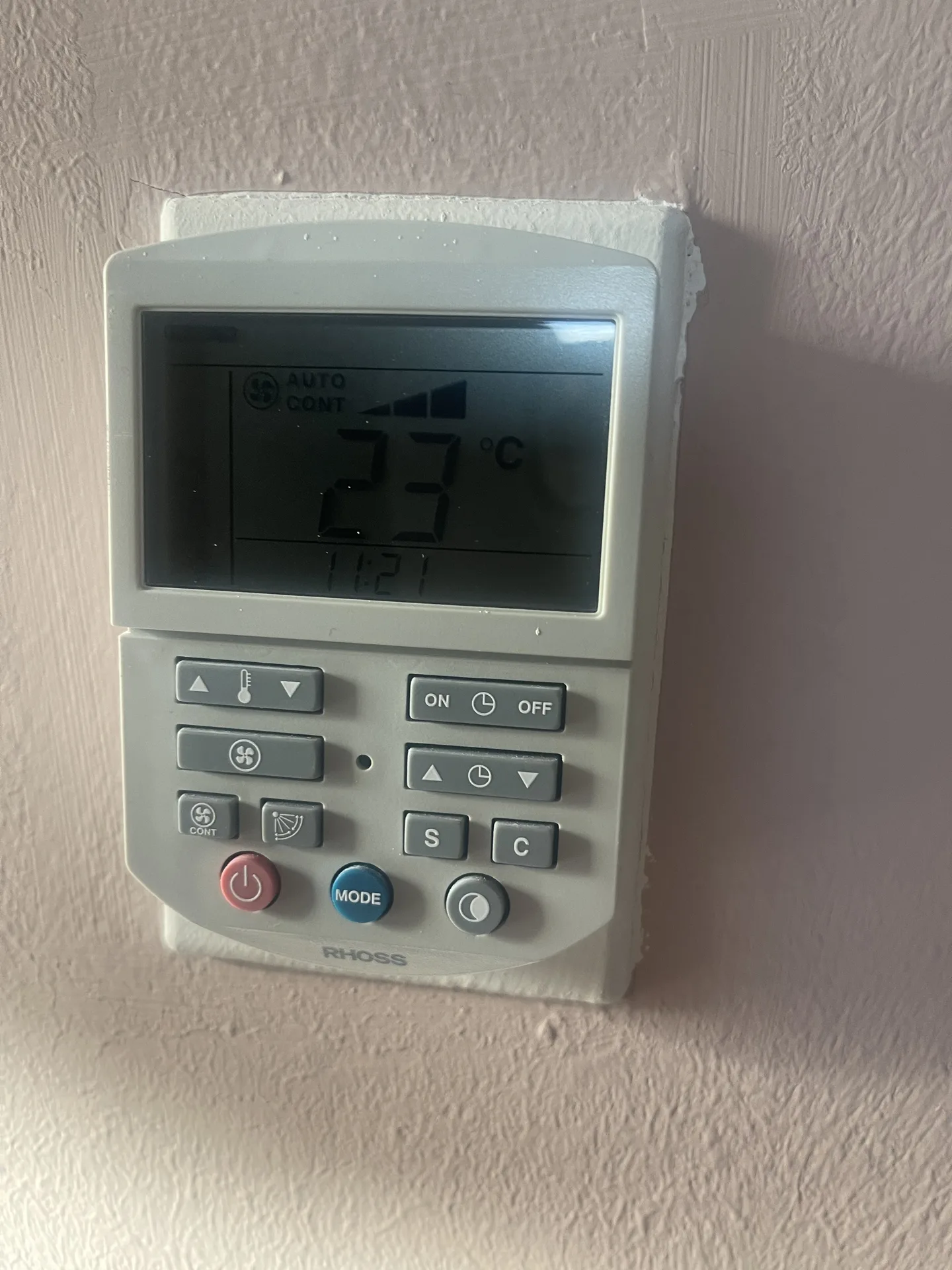
The split air-conditioner on a Sardinian wall is an air-to-air heat pump. It moves heat from outside air into the room rather than burning fuel to make it. The International Energy Agency's report The Future of Heat Pumps finds current models three to five times more energy efficient than natural gas boilers, with a typical household unit delivering about four units of heat for each unit of electricity. The European Commission estimates that switching from a gas boiler can cut a household's heating bill by 20% to over 60%, depending on prices and insulation.
Efficiency is not the same as cost, so we priced one kWh of heat with this autumn's official figures. The table assumes a conservative heat pump that gives three units of heat per unit of electricity, and a gas or oil boiler that turns 90% of its fuel into heat.
| Heating | Price used | Cost of 1 kWh of heat | Of which taxes |
|---|---|---|---|
| Air-to-air heat pump, 3 units of heat per unit of power | Electricity, 43.43 c/kWh (ARERA, Oct to Dec 2026) | 14.5 c | 1.4 c |
| Same heat pump at the IEA's typical 4 units | Same | 10.9 c | 1.0 c |
| Gas boiler | Gas, 176.80 c/m³ (ARERA, October 2026) | 18.4 c | 4.3 c |
| Heating-oil boiler | Heating oil, €2.008/liter (ministry average, September 2026) | 22.3 c | not itemized |
| Electric heater or fan heater | Electricity, 43.43 c/kWh | 43.4 c | 4.2 c |
On these numbers the heat pump wins twice. It is the cheapest way to heat a home, and it carries the least tax per kWh of heat. A plug-in electric heater costs three times as much. The gap between them is where a Sardinian household's bill is won or lost.
Where the taxes are
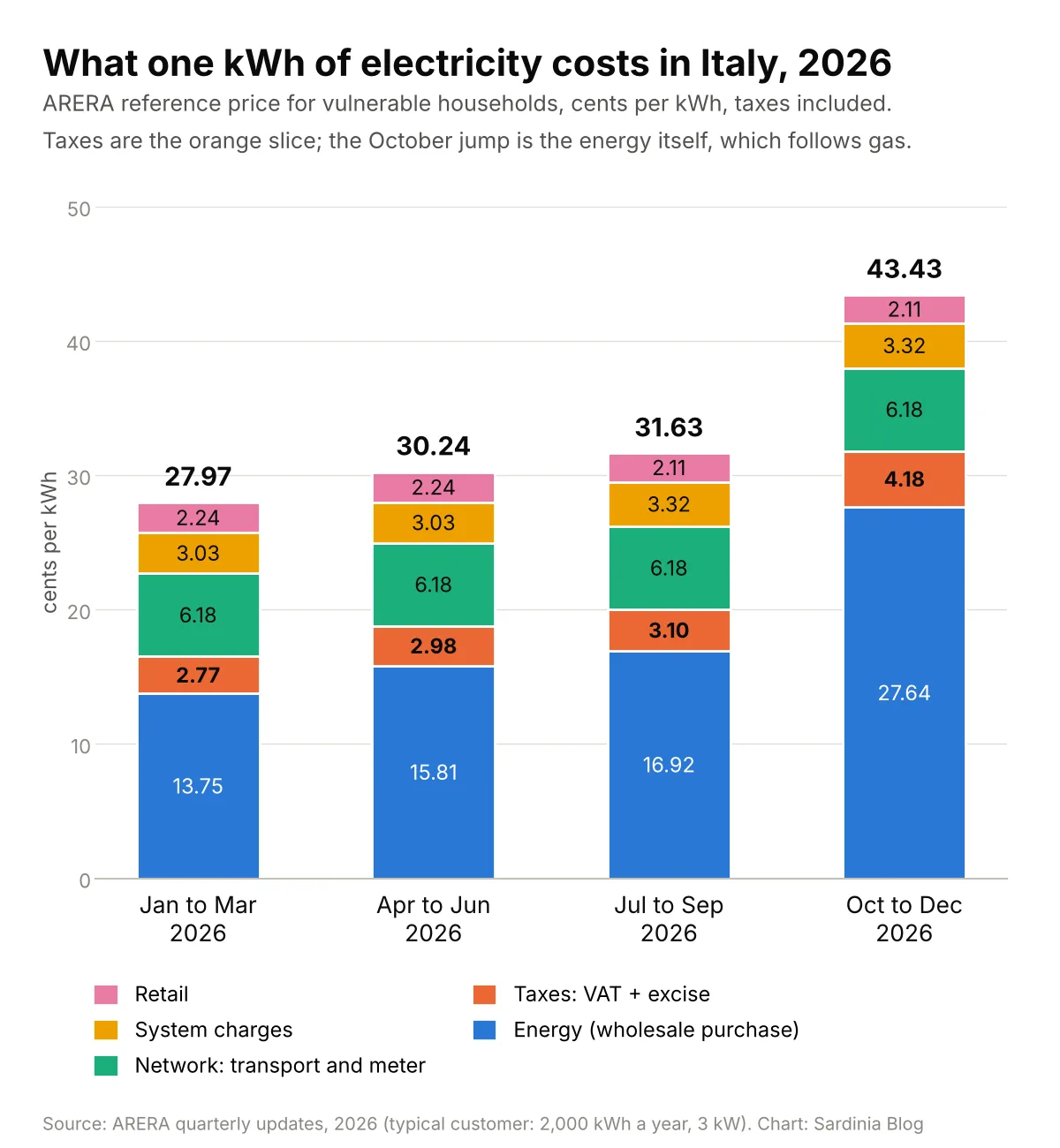
ARERA, the energy regulator, publishes a reference bill each quarter for vulnerable customers on regulated terms, based on 2,000 kWh a year and a 3 kW contract. From 1 October 2026 it is 43.43 cents per kWh, taxes included. That is 37.3% more than in the summer. Of that, 27.64 cents (63.7%) is the cost of buying energy, 6.18 cents (14.2%) transport and metering, 3.32 cents (7.6%) system charges, 4.18 cents (9.6%) taxes, VAT and excise together, and 2.11 cents (4.9%) retail. ARERA puts the rise down to wholesale prices, which it says remain closely tied to natural gas. Across 2026 the tax slice moved from 2.77 to 4.18 cents, while the energy slice doubled from 13.75 to 27.64.
Two taxes apply. Excise is €0.0227 per kWh. A main residence on a contract of up to 3 kW pays none on its first 150 kWh a month; on contracts above 1.5 kW that allowance holds while monthly use stays within 220 kWh, and above that it shrinks step by step. Contracts above 3 kW and second homes pay excise on every kWh. VAT on household supply is 10%, charged on the value of the supply with excise included, so part of the VAT is a tax on a tax. Even if every kWh were taxed, excise on the average Sardinian household's 2,751 kWh would come to about €62 a year, and the VAT inside an €826 bill is about €75, by our calculation.
What cuts the other way
Taxes are a smaller share of the electricity bill than of the gas bill. In ARERA's reference gas bill for October 2026, taxes were 41.68 cents of 176.80 per cubic meter, 23.57% of the total. Per kWh of heat, a heat pump pays less tax than a gas boiler, as the table shows. The largest part of what Sardinians pay for electricity is the energy itself, and that follows the price of gas, which the island cannot get through a pipe. Cutting the excise to zero would take about 2.5 cents off a kWh, counting the VAT charged on it; the October jump in the energy slice added more than 10.
Solar panels: what they cost, what they bring, what tax does
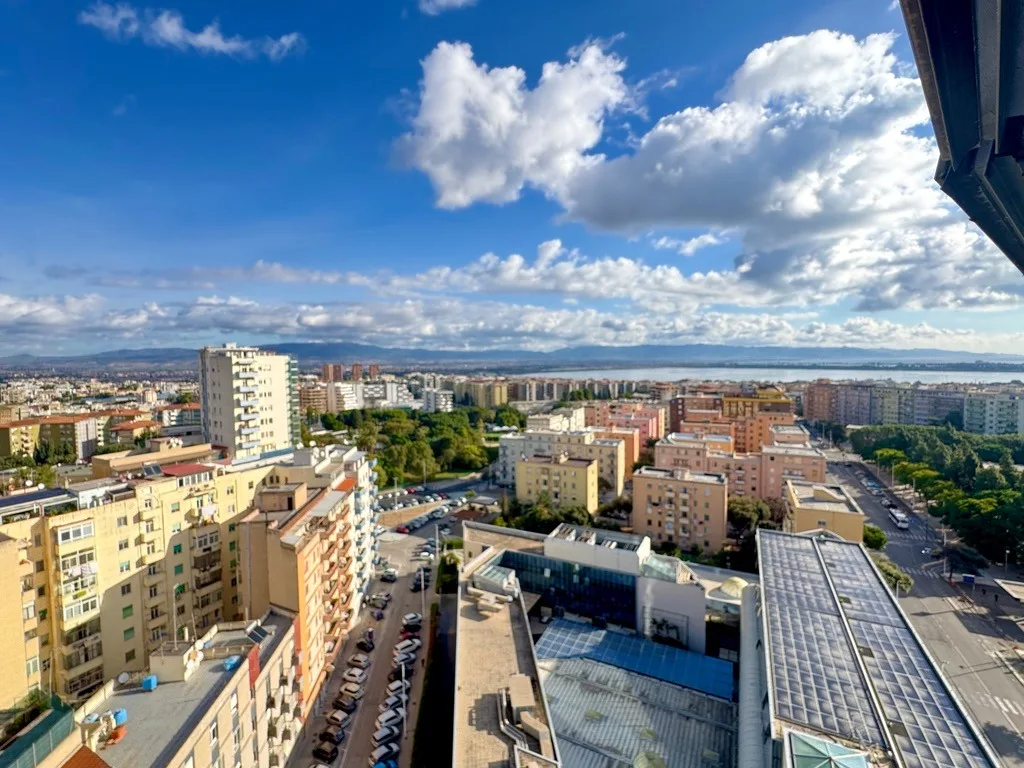
Sardinia already has the most solar capacity per resident in Italy, 1.3 kW per inhabitant together with Basilicata, according to the GSE's 2025 statistical report. Dividing the report's figures, island plants produced about 1,070 kWh per installed kW, against a national average of 1,117 hours of full output. Price guides for 2026, such as Selectra's, put a 3 kW home system at €5,500 to €8,500, with 30% to 40% of the output used at home, or up to 70% with a battery. For a main residence the 2026 tax credit is 50% of the cost, spread over ten years; La Nazione reports it falls to 36% in 2027. Net metering (scambio sul posto) is closed to new systems, so surplus power is sold under the GSE's ritiro dedicato at the hourly wholesale price for the Sardinia zone.
Tax is what makes self-consumption pay. A kWh produced on the roof and used in the house is never bought, so it avoids the energy cost, the network and system charges, the excise and the VAT. A kWh sent to the grid earns only the wholesale price, and ARERA notes that prices in the southern and island zones are low in the hours when solar plants produce most. Our indicative calculation for a 3 kW system in Sardinia: about 3,300 kWh a year, 1,155 kWh used at home at about 30 cents, the island's average price, saving about €346, and 2,145 kWh sold at an assumed 8 to 12 cents, earning €172 to €257. That is about €560 a year in the middle case. On a €7,000 system, the payback is about six years with the 50% credit, eight with the 36% credit, and about twelve and a half with no credit.
Announced, decreed, still waiting
The goal is already in law. The 2023 fiscal delegation, law 111, told the government to reshape excise on energy products and electricity to take account of each product's environmental impact. The 2026 tax sheets still show the same household rate, €0.0227 per kWh, and the same 150 kWh allowance. In 2022 the IEA warned that in some countries tariffs and energy taxes put heat pumps at a disadvantage against fossil-fuel boilers, and said they should be tilted toward the cleaner option instead.
Gas for Sardinia has a longer record of announcements. A prime ministerial decree of 29 March 2022 chose a "virtual pipeline", liquefied gas shipped from mainland terminals, and a further decree was published on 3 November 2025. On 15 May 2026 Enura, the Snam and Società Gasdotti Italia venture, began expropriation procedures for the first section of the island network. No gas from the national network reaches Sardinian homes yet.
The Region has put money down. Under regional law 20 of 2024 it pays the full eligible cost of home solar panels and batteries for households within an income threshold. Of 6,009 applications, 1,290 were funded in 2025 with €20 million, and in September 2026 a further 4,061 were funded, 2,569 for 2026 and 1,492 for 2027, bringing the total to 5,351 households and about €84.9 million, Il Sole 24 Ore reported, for at least 16 MW of panels. Some of those households will wait until 2027 to install.
Our view
This section is the opinion of Sardinia Blog's publisher, not reporting.
Sardinians are penalized for heating the clean way. The mechanism is simple. With no gas network, the island heats with electricity, and every extra kWh of that heat carries VAT, excise once a small allowance runs out, and system charges, at a price that rises and falls with the gas Sardinia does not have. The tax-free allowance fits a household that heats with something else. A household that switches to a heat pump loses part of it in winter, and loses it completely above 3 kW.
The story needs to change, and so does the politics around it. Sardinia does not have Italy's most expensive electricity; per kWh it pays slightly less than the national average. It has the biggest bills largely because so many homes already heat with electricity, which is where EU climate policy wants every home to go. Politicians in Rome have announced tax reform, energy plans and gas decrees, and the household excise line has not moved. While Rome announces, Sardinians pay the bill. The test is the next tax sheet: an excise allowance sized for electric heating in regions without gas, VAT that does not fall on excise, and a decision on Sardinia's gas that ends the wait. The Region's solar grants show what follows when money is put on the table instead of a press release.
A note on the numbers
Facile.it's figures come from people asking for a new supply contract, a self-selected group rather than a census of households, and assume free-market indexed contracts. The national average is given as "just under 740 euro", so the national price per kWh is approximate. The 2024 edition put Sardinia at €903 for 2,677 kWh; we could not trace the €914 figure for 2023 that circulates in search summaries. ARERA's reference bills apply to vulnerable customers on regulated terms, not to every contract. The heat-cost table uses our efficiency assumptions and prices from slightly different months; a gas boiler at 90% on the gross energy content of gas is generous to gas. Solar yields from the GSE report include large plants and plants that started during the year, so a well-placed roof can do better. The solar payback is an illustration, not an offer: it ignores that the credit comes back over ten years and assumes today's prices hold. Our tax figures are upper limits, not a household's actual bill. The regional grant's income threshold is set in the call; we have not reproduced it.
Sources: Facile.it, 2025 household bills, 25 February 2026 · ARERA, electricity reference bill, fourth quarter 2026 · ARERA, gas reference bill, October 2026 · IEA, The Future of Heat Pumps, 2022 · TIM Energia, electricity tax sheet, February 2026 (PDF) · Senate research service, excise reform under law 111/2023 (PDF) · Il Sole 24 Ore, Sardinia's solar grants, 17 September 2026. L'Unione Sarda's provincial figures are linked in the text. Also used, not linked: ARERA's earlier 2026 quarterly updates, its 2022 Sardinia demand scenario and its 2026 market report; European Commission (heat pumps, December 2025); GSE, Rapporto statistico solare fotovoltaico 2025; Selectra (solar prices 2026; heating-oil average from the energy ministry); luce-gas.it (VAT base); La Nazione (2027 credit); Renewable Matter, QualEnergia and L'Indipendente (gas decrees and expropriations).
Related reading
Elsewhere on Sardinia Blog: an island with 111 pensions for every 100 workers; the court fight over where Sardinia's renewable plants can go; and the 319,000 homes with no permanent resident.
Sardinia Blog is published within the Rental12 ecosystem, an owner-operator letting homes it owns in Olbia and Golfo Aranci rather than a property manager acting for other owners. Its press archive holds company statements, not independent evidence.