
What grew in 2026
Provisional regional data for January to August 2026 show 3.32 million arrivals (up 4.0%) and 13.83 million nights (up 4.6%), about 606,000 more nights than a year earlier. The first quarter was slightly below 2025. May rose 22.4%, or 293,000 nights, while June (+3.9%), July (+3.1%) and August (+2.0%) grew more slowly, and August arrivals fell 0.5%. The report says this is not enough to conclude that the season is moving for good towards the shoulder months, but shows that 2026 growth did not depend on the peak alone. Foreign visitors produced 7.33 million nights (up 10.1%) against 6.50 million for Italians (down 1.0%), lifting the foreign share from 50.3% to 53.0%. The island's three airports handled 10.08 million passengers from January to September (up 9.25%), 4.02 million of them at Olbia.
Where and when the nights fall
In 2025, 63.2% of nights fell in June, July and August and 3.8% in the five months from November to March. By subtraction, April, May, September and October together held 33.0%. Stays averaged 4.94 nights in high season and 2.21 in the cold months.
The 71 coastal municipalities hold 435,733 of the island's 467,089 beds (93.3%). The 306 inland municipalities had 343,673 arrivals and 897,857 nights in 2025, 4.1% of the total, with an average stay of 2.61 nights against 4.33 on the coast. The ten busiest municipalities, all coastal, took 11,031,222 nights, 50.6% of the regional total. Alghero leads with 1,813,687, followed by Arzachena, which includes Porto Cervo (1,352,148), and Olbia (1,161,262); Golfo Aranci is 20th with 333,123. The province of Gallura took 7,696,261 nights, 35.3% of the island's total. Using Eurostat data, the report notes that Sardinia has 5.8% of Italy's beds but 4.1% of its nights.
Flights thin out after the summer
Cagliari's scheduled routes drop from 109 in summer to 38 in winter, and international routes from 68 to 13, although this winter is up five routes on last winter's 33, with flights up 18% and seats up 17%. Alghero offers 48 routes in summer, 30 of them international, and Olbia 89 destinations, but Volotea keeps only five Olbia routes fully running through the winter and Ryanair is cutting at both northern airports. The report says flights need demand "alimentata da prodotti turistici realmente acquistabili" (fed by tourism products that can actually be bought) and calls internal transport "totalmente insufficienti" (wholly inadequate).
What the report asks for
The conclusions describe this year's results as "la parte emersa di un iceberg" (the visible tip of an iceberg). Outside the strongest resorts, the authors write, tourism is still too small to sustain income and jobs all year and in the interior. Village festivals and local events, they add, cannot on their own create year-round demand: "Servono siti archeologici e culturali effettivamente aperti, esperienze ambientali ed enogastronomiche organizzate, strutture ricettive adeguate e servizi affidabili" (what is needed is archaeological and cultural sites that are actually open, organised nature and food-and-wine experiences, suitable accommodation and reliable services). They also point to congress tourism where venues and skills exist, and say the aim is not only to spread existing demand across the year or divert it elsewhere, but to reach travellers who would come for something other than the sea.
An editor's view: open from April to October
Olga Vasileva, editor of Sardinia Blog and marketing manager at Lion Development, the company behind Rental12 in Olbia that also publishes this site, says the gap is as much about what is open as about how people arrive. "The accommodation is there, the hotels are there. What would really help is if restaurants, bars, museums and shops were open from 1 April until at least the end of October. People who come in April, May, the second half of September or October find that even in Olbia and the towns around it everything is closed and there is nothing to do. Go to Porto Cervo in mid-October and it is completely shut, there is nobody. If a few shops were still open in Porto Rotondo, Golfo Aranci or Porto Cervo, people could have a coffee and enjoy the place."
The Region cannot simply order that. Since the 2011 "Salva Italia" decree (D.L. 201/2011, art. 31), national law has lifted limits on the opening hours and days of shops, bars and restaurants, and in sentence 299 of 2012 the Constitutional Court rejected challenges by eight regions, Sardinia among them, holding that the matter belongs to the state's power to protect competition. What the Region and the municipalities do control is their own calendars and their own money. Museums and archaeological sites run by public bodies open when those bodies decide. The Region also funds jobs in the tourism supply chain through its So.La.Re scheme, worth €21 million in 2026; when the 2024 edition was announced, L'Unione Sarda reported that the period covered for large operators excluded July and August.
Some places already stay open later. On 26 September 2026 OlbiaNotizie listed some 20 Porto Cervo restaurants and bars still trading: several closed that weekend, Il Clipper on 4 October, Dante "fino a metà ottobre" (until mid-October) and Hivaoa "fino a tutto ottobre" (until the end of October).
What it means for visitors
April, May and October offer the quieter Sardinia many visitors come for, but with fewer flights and, in resort towns, many bars, restaurants and shops shut outside the summer. Check flight schedules and opening days before you book.
A note on the numbers
The municipal and provincial figures come from the Region's tourism observatory. The 2026 figures are provisional and, the report says, exclude private rentals. The report removes 125,881 nights wrongly attributed to Uta from its municipal analysis. For comparisons between regions it uses Eurostat, which puts Sardinia's 2025 nights at 21.72 million against 21.80 million in the regional series. The tourism ministry's Alloggiati Web data, which include short lets, show a larger first-half rise (+9.4%) and are a different instrument. Il Sole 24 Ore reported inland municipalities' share of arrivals as 7.2%; the report gives 6.6% (343,673 of 5,158,940 arrivals, which we calculate at 6.7%). The 33.0% shoulder-month share is our subtraction from two figures in the report, not a number it publishes.
Sources: Centro Studi Confindustria Sardegna, Il turismo in Sardegna: crescita dei flussi e concentrazione territoriale, Report ottobre 2026 · Il Sole 24 Ore, 3 November 2026 · OlbiaNotizie, 26 September 2026 · Corte costituzionale, sentenza 299/2012 · Regione Sardegna, So.La.Re 2026 notice · L'Unione Sarda, 2 May 2024
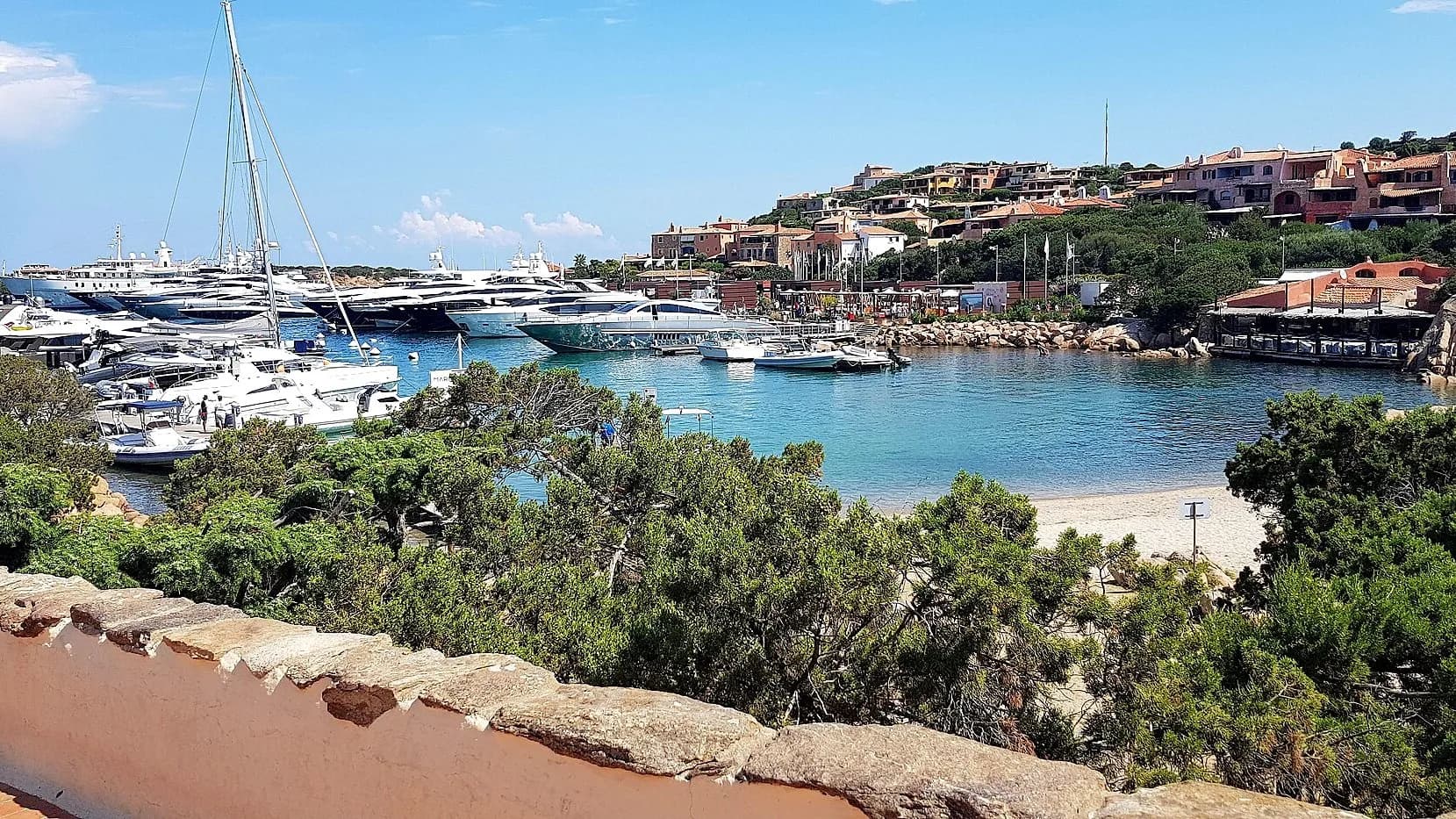
Photo: Porto Cervo’s old harbour in August 2018, by Klaus Bärwinkel, CC BY-SA 4.0, via Wikimedia Commons, cropped.
Related reading
Elsewhere on Sardinia Blog: the Region’s January to August 2026 count by market; Ryanair’s winter 2026 cuts at Olbia and Alghero; and Capriccioli, where parking stays paid in October after beach services close.
Sardinia Blog is published within the Rental12 ecosystem, an owner-operator letting homes it owns in Olbia and Golfo Aranci rather than a property manager acting for other owners. Its own account of pitching year-round Sardinia to buyers in Prague and its press archive are company statements, not independent evidence.