
Villasimius is a beach resort on Capo Carbonara, the south-eastern tip of Sardinia, about 50 km from Cagliari by the coast road, and its beaches face the marine protected area named after the cape. Only one has a cap and an entry fee: Punta Molentis, where the 2026 rules allowed at most 190 people at a time by land until 31 October, with no online booking. Porto Giunco, Simius and the other Villasimius beaches have no cap or entry fee, though the main beach car parks charge from June to October.
Villasimius quick facts
Visitors: 916,156 overnight stays recorded in 2025, the eighth-highest of any Sardinian comune.
Protected sea: the Capo Carbonara marine protected area, about 14,360 hectares, run by the comune.
Booking: Punta Molentis is the only capped beach, and it cannot be booked online.
Blue Flag: none. No Villasimius beach appears on FEE Italia's lists from 2003 to 2026.
Punta Molentis 2026: cap, price, hours and umbrellas
Punta Molentis beach is a small arc of white sand at the mouth of the Rio Trottu, on the road north to Castiadas and Costa Rei. It is named after su molentu, the donkey that carried granite from the old quarry beside it, and access has been capped in high season since 2019, says the marine protected area's beach guide. The 2026 limits were less than half of 2025's numbers, after a fire on 27 July 2025 destroyed cars in the car park, with bathers taken off by sea, and storm surges in early 2026 shrank the usable sand.
The comune's ordinance 12 of 5 June 2026 cut the limit to 250 people, 150 by land and 100 by sea, and banned most umbrellas. A second ordinance replaced it from 13 June, and the official Villasimius tourist office lists the limits by land that followed. The 2026 rules were set to run until 31 October:
By land: 190 people on the beach at any one time, and no more than 90 vehicles a day.
By sea: 100 people, landed only by operators authorised in the marine protected area.
Price: entry is paid, and children under 12 go free. Press reports from June and July 2026 gave €10 a person by land, but the tourist office page listed €5 when we checked on 27 October 2026, so confirm at the gate.
Hours: 08:00 to 20:00.
Shade: one umbrella per family or group, placed under the control of staff from Villasimius Srl, the comune's company. You may not put up your own tents, gazebos or poles, and the dunes are off limits.
Booking: none. The Villasimius Srl parking portal says Punta Molentis cannot be booked online: you go to the entrance and are let in while places remain.
Reports said boat passengers were limited to one hour ashore. No 2027 rules had been announced by 27 October 2026; in August the mayor floated wider limits on numbers through a new coastal plan. Our FAQ on Sardinian beaches that need booking compares the other capped beaches.
Porto Giunco, the Notteri pond and Simius
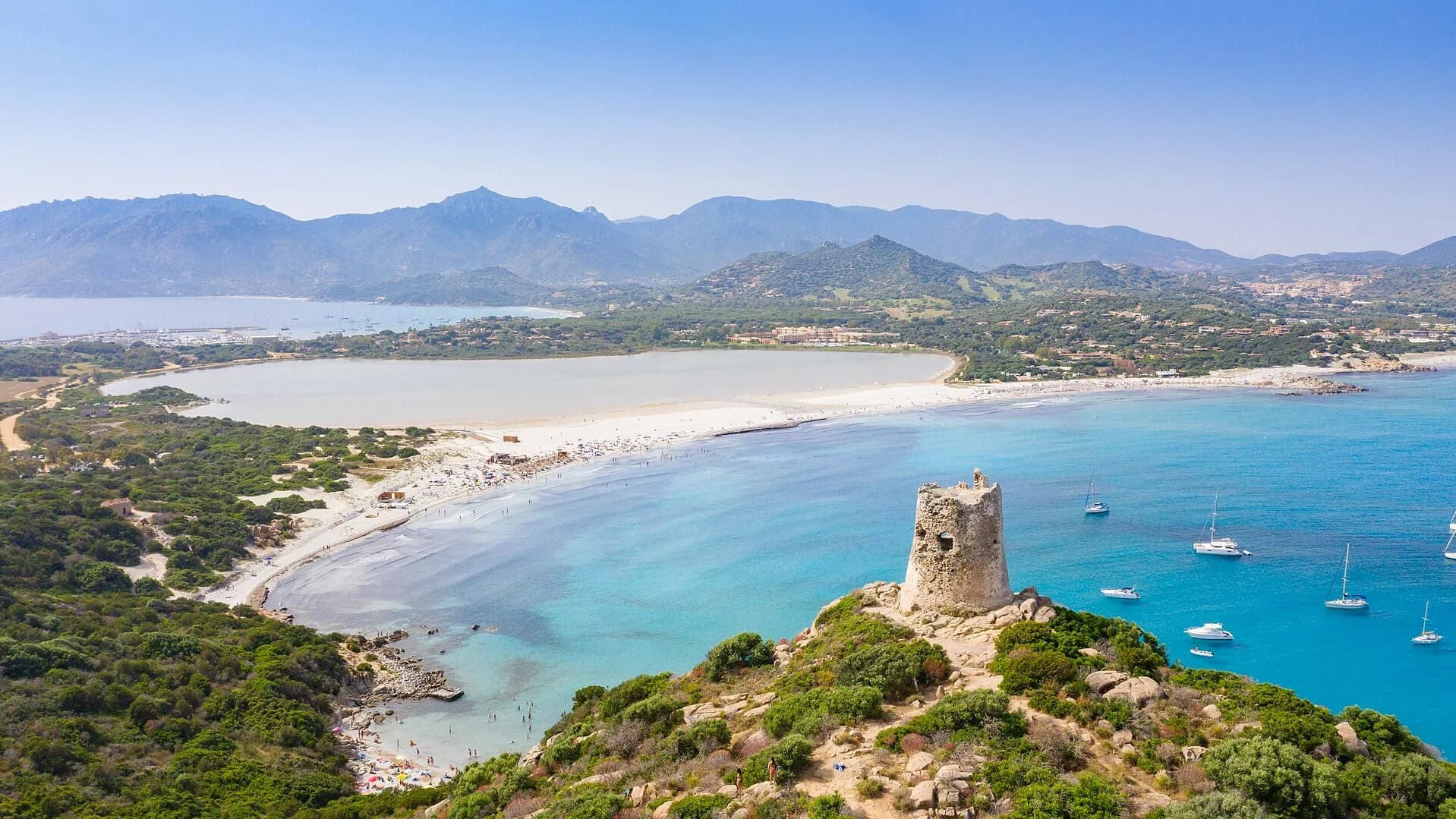
Porto Giunco is a long strip of very fine, pale sand with pink grains of eroded granite, with the sea on one side and the Stagno di Notteri on the other, hence its nickname, the beach of two seas. The seabed is sandy and very shallow, which suits small children. From the car park a path climbs the headland to the south-west to the Torre di Porto Giunco, a 9-metre Spanish watchtower from the 1600s.
The Notteri pond is about half a metre deep and has no link to the sea, which suits flamingos. On Sardinia's south-east coast they are otherwise seen only at the Colostrai and Feraxi ponds, says SardegnaTurismo.
Timi Ama and Simius continue the same shore north towards the town. Simius, the 1 km town beach, is reached from the centre along Via del Mare. It is sheltered and shelves gently, with windsurf and kite schools, diving centres and boat hire. Beyond it lies Is Traias, then the Porto Luna headland that separates this bay from Punta Molentis.
West of Capo Carbonara: Campus, Campulongu and Cala Caterina
Porto Sa Ruxi: the first beach on the road from Cagliari, three half-moon coves split by flat granite rocks, backed by juniper dunes and sheltered from the mistral.
Campus: a long, wide beach of golden sand at a small river mouth, overlooked by the Phoenician site of Cuccureddus.
Campulongu: about 1 km of white sand, shallow for tens of metres, with a pine wood for shade. In the low season kitesurfers use it in westerly and south-westerly winds.
Spiaggia del Riso: past the rocks south of Campulongu, named after white quartz grains that look like rice, though there are fewer of them now. The sea in front is closed to anchoring, mooring, boat traffic and fishing.
Fortezza Vecchia: a small half-moon beach by the marina, under the Spanish-era fort that gives it its name, with calm water and good snorkelling. Posidonia leaves washed up here are left in place on purpose.
Cala Caterina: two main coves on the south side of the cape. The smaller is sheltered from the mistral; in the larger the sand turns to rock after a few metres, and the marine area's rules map a snorkelling route there.
Capo Carbonara marine protected area: the rules that apply to you
The marine protected area was set up by ministerial decree in 1998, and a new decree replaced the original in 2012. At about 14,360 hectares it is the third largest in Sardinia, and it takes in the islands of Cavoli and Serpentara. Its four zones have different rules, set out in the list of permitted activities.
Zone A: no swimming, no fishing and no boats except authorised ones. It covers the Secca di Santa Caterina shoal and some of the rocks off Cavoli and Serpentara.
Everywhere: no jet skis, water-skiing or spearfishing.
Speed: no more than 5 knots within 300 m of the shore, 10 knots elsewhere in zones B and C, and 20 knots in zone D.
Anchoring: never on Posidonia seagrass. In zone C it is allowed only in designated areas off Campulongu and Porto Giunco, under the 2026 rules, valid to 31 December 2026 or until new rules are approved.
Scuba diving: guided dives only in zone B, and with the marine area's authorisation in zone C. See our guide to diving and snorkelling spots in Sardinia.
Islands: the Isola dei Cavoli lighthouse dates from 1858 and opens for guided visits in summer. Serpentara is uninhabited and closed to visitors.
Local tips: what most guides get wrong
"Book Punta Molentis online." You cannot. Entry is decided at the gate while places last, unlike the La Pelosa booking system or the Cala Goloritzé tickets released three days ahead.
"No umbrellas, open until 20:30." Both rules came from the first ordinance and lasted a week. From 13 June 2026 each family or group could have one umbrella, and the hours were 08:00 to 20:00.
Blue Flags: the 2026 Blue Flag list names 17 Sardinian comuni, and Villasimius is not among them.
Flamingos and plovers: the flamingos use the Notteri pond, not the sea side of Porto Giunco, and Kentish plovers nest on the beach along the pond, where people and dogs disturb them.
Sand and dunes: taking even a little sand, pebbles or shells is fined €500 to €3,000, and walking on dunes €100 to €1,000, under Regione Sardegna rules.
Last bus: in the winter timetable the last bus to Cagliari leaves Villasimius at 20:05 from Monday to Saturday and at 18:26 on Sundays.
When to go
The Capo Carbonara weather station records average highs of 22.4 °C in May, 27.1 °C in June, 31.3 °C in August, 27.8 °C in September and 24.2 °C in October, according to WMO climate normals for 1991 to 2020. July averages 2.8 mm of rain, and November is the wettest month with 48.6 mm. Across Sardinia, August is the busiest month: 5,456,409 of the island's 21,922,765 overnight stays in 2025. June and September each had more than a third fewer, with highs of 27 to 28 °C at the cape. In 2026 the Punta Molentis rules covered 6 June to 31 October. Sea temperatures by month are on our Cagliari and Campidano weather page.
Getting there from Cagliari
The nearest airport is Cagliari-Elmas (CAG), Sardinia's busiest, with 5,254,433 passengers in 2025 (Assaeroporti). By car, the inland route from central Cagliari on the SS 554 and SS 125 is about 65 km and takes about 70 minutes; the SP 17 coast road is shorter, about 50 km, but no quicker. Until 30 June 2027, roadworks for Terna's Tyrrhenian Link bring alternating one-way traffic on the SP 17 near Quartu from 08:00 to 12:00 and 13:00 to 17:00. Porto Giunco and Simius are a few minutes from the centre; Punta Molentis is about 13 minutes by car.
By bus, ARST line 101 runs from Cagliari's ARST bus station to Villasimius (Via Roma) in about 1 hour 28 minutes. In the timetable valid from 16 September to 15 June there are six buses each way from Monday to Saturday, the first leaving Cagliari at 05:02, and two on Sundays and holidays, at 08:15 and 14:05. Summer timetables differ.
Rental12, a holiday-rental company in Olbia that shares an owner with Sardinia Blog, plans Villasimius as a day trip from a Cagliari base, with Porto Giunco in the morning and Simius in the afternoon, in Sardinia 14 Day Itinerary: Olbia + Cagliari Open-Jaw 2026. It is a company guide, not independent research.
Sources: Villasimius Srl portal · Villasimius tourist office · AMP, beaches · AMP, permitted activities · AMP, 2026 rules · SardegnaTurismo, Notteri · FEE Italia, Blue Flag 2026 · Regione Sardegna · NOAA NCEI, WMO normals · ARST, line 101
Photo credits: The Torre di Porto Giunco above Porto Giunco beach in Villasimius, with the Stagno di Notteri behind the strip of sand (dronepicr, CC BY 2.0, via Wikimedia Commons); The Capo Carbonara marine protected area at Villasimius seen from the north, with Isola dei Cavoli offshore (dronepicr, CC BY 2.0, via Wikimedia Commons); Spiaggia di Simius, the 1 km town beach of Villasimius (Olaf Tausch, CC BY 3.0, via Wikimedia Commons); Porto Giunco beach seen from the Spanish watchtower on the headland above it, with the Notteri pond behind (Muzzudan, CC BY-SA 4.0, via Wikimedia Commons); The Fortezza Vecchia, the Spanish-era fort above the small beach of the same name near the Villasimius marina (GiorgioGaleotti, CC BY-SA 4.0, via Wikimedia Commons). Fact sheet and chart: Sardinia Blog, from the sources listed above.


