
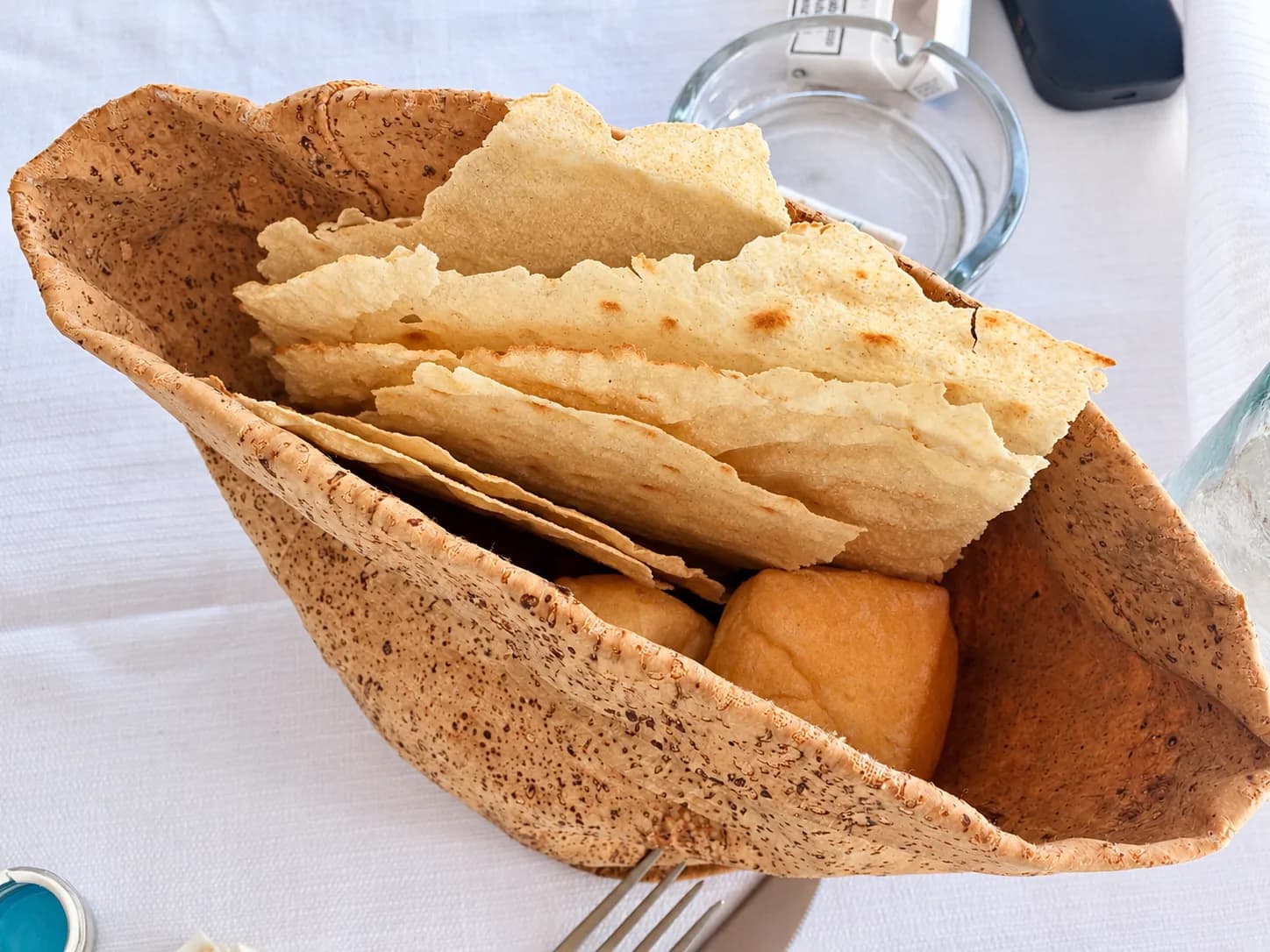

Pane carasau is the traditional bread of Sardinia: a thin, crisp flatbread baked twice from durum wheat semolina, water, yeast and salt. It originates in the Nuorese area of Barbagia, where it was made for shepherds on the move with their flocks. Today you will find it across the island, in shops, bakeries and restaurants. This guide explains where the name comes from, how the bread is made, the dishes built on it and how to store it.
What is pane carasau?
The bread is a sheet only a few millimetres thick, baked until it loses almost all its water. That is why it has no crumb and keeps for so long. It is eaten on its own with a drizzle of oil and a pinch of salt, or alongside cheeses and cured meats.
Why it is called carasau
The name comes from the Sardinian verb carasare, meaning “to toast”. The second bake is therefore called the carasatura. Outside Sardinia the bread is known as “carta da musica” (music paper), partly for its parchment-like thinness and partly for the sound it makes when it breaks or is chewed. It is also said to be thin enough to read a musical score through.
Within Sardinia it goes by other names too: carasatu, carasadu, pane fine and pane ’e fresa.
The shepherds' bread
During the transhumance, shepherds stayed away from home for weeks at a time. They needed a bread that would not spoil, was light and was easy to carry in their saddlebags. Carasau fitted all three requirements.
The bread was made by women, often with the help of relatives and friends, and by tradition it was a family ritual. The origins are very old. According to some archaeologists the bread dates back to the Bronze Age, though this is not certain.
How pane carasau is made
The dough is rolled into very thin discs, between 15 and 40 cm across and only a few millimetres thick.
A first bake in the oven makes each disc puff up.
The puffed disc is cut in two to make two sheets.
The sheets go back into the oven for the second bake, the carasatura.
After this second bake the bread has lost nearly all its water and has no soft interior left.
One bread, several dishes
Carasau is the base for other breads and dishes that appear across Sardinian tables.
Pane lentu (pane modde)
This is carasau after the first bake, before it is toasted. It stays soft and elastic, so it can be folded, rolled and filled like a wrap with cured meats, cheeses or vegetables. It is also called pane modde. It is used straight away and does not keep as long as carasau.
Pane guttiau
Carasau seasoned with extra virgin olive oil and salt, often with rosemary, and returned to the oven for a few minutes. Guttiau means “dripped” in Sardinian, a reference to the oil poured in a thin stream. It works well alongside an aperitivo.
Pane frattau
Frattau means “crumbled”. The carasau is dipped for a few seconds in hot water or broth, then layered with tomato sauce, grated pecorino and an egg.
How to store pane carasau
Keep it somewhere dry, in a paper or cloth bag.
Do not put it in the fridge: it absorbs moisture and goes soft.
It lasts about six months, and some sources say up to a year.
A protected product
Pane carasau is on the Italian national list of traditional agri-food products. Sardinian producers are also working towards PGI (IGP) status. According to the notes, the product specifications have been submitted to the Region and the Ministry, and a reply is awaited.
Where to try it
Carasau is sold across the island, so there is no need to travel to Barbagia to find it. Still, its home territory is inland Nuoro, and eating there puts the bread in context. For a sense of Barbagia's table, see our pieces on Lollove's Barbagia flavours and Su Tapiu in Mamoiada. If you are planning a longer stay and want help organising it, our Rental12 ecosystem is a good starting point.
Because it keeps so well, a packet of carasau is also a practical food souvenir to carry home. Store it dry, as above, and it should stay crisp.