
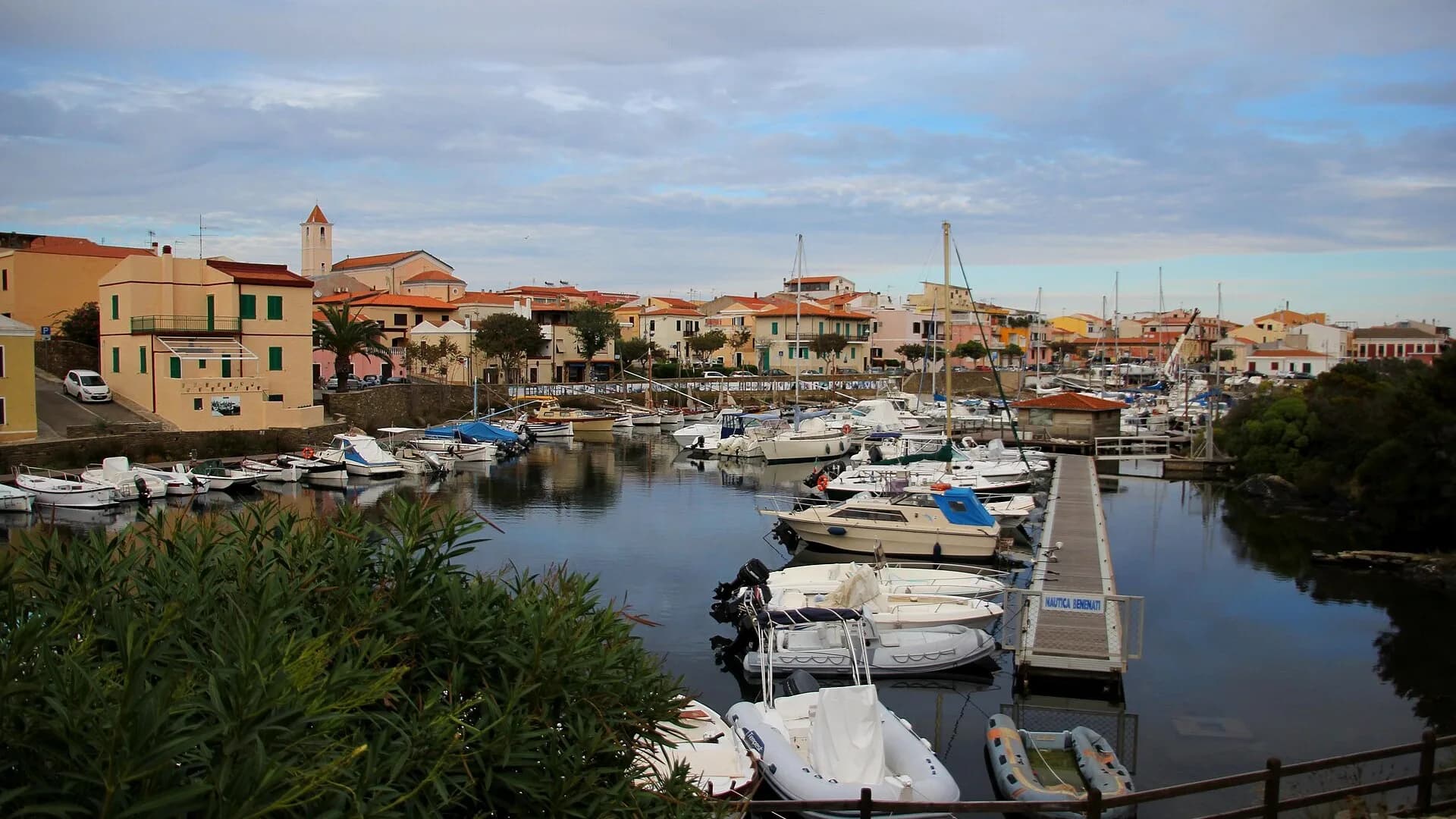

Stintino is a fishing village of about 1,500 residents on Sardinia's far north-west tip, founded on 14 August 1885 by 45 families moved off Asinara when the island became a penal colony. Most visitors come for La Pelosa beach, but the village, its tuna-fishing museum, the Capo Falcone headland, Le Saline and the boats to Asinara National Park are reasons to stay longer. Here is what to see, what it costs and what the rules are now that the 2026 beach season has ended.
Quick facts
Population: 1,537 residents on 1 January 2025 (ISTAT).
Founded: 14 August 1885; an independent municipality since 10 August 1988.
Distances by road: about 45 km from Sassari, 48 km from Alghero airport and 29 km from Porto Torres.
La Pelosa 2026: booking required 15 May to 15 October 2026, €3.50 a day, 1,500 places.
Tuna museum (MUT): Via Lepanto 36, opened 18 June 2016, paid entry.
Asinara: seven authorised passenger boats on the Stintino route.
The village: a town that started on a fixed date
Few Sardinian towns know their birthday. Stintino does. The official La Pelosa booking site, run for the Comune, tells the story: on 14 August 1885 the Italian government chose Asinara for a maritime quarantine station and a penal colony, and the island's 45 families had to leave. They were offered 750 lire each and a choice of two sites. They picked a narrow tongue of land between two inlets the locals called isthintini, "the intestines", which gave the town its name.
The plan still shapes the village. Houses line a strip between the old harbour, Porto Vecchio, and the new one, Porto Nuovo or Portu Mannu, where wooden lateen-sail boats called gozzi still moor. The parish church dates from 1937 and echoes the one at Cala d'Oliva on Asinara. Stintino was a hamlet of Sassari for 103 years and became its own municipality on 10 August 1988. ISTAT counted 1,537 residents on 1 January 2025; SardegnaTurismo notes that summer brings tens of thousands more.
Museo della Tonnara (MUT): the tuna that built Stintino
Before tourism, the tuna trap paid the bills. The Tonnara Saline worked the Gulf of Asinara until the 1970s, and the MUT, Museo della Tonnara tells its story in a restored former fish-processing plant on Via Lepanto 36, on the panoramic road into the village above the Porto Minore. It opened on 18 June 2016.
The route follows the chambers of a tuna net, from the "camera grande" to the "camera della morte", where images and sound recreate the mattanza, the final haul. Videos have Italian narration with English subtitles. Hours published by the regional culture portal (updated 14 October 2026):
October to May: Friday 15:30 to 19:00; Saturday and Sunday 11:00 to 13:00 and 15:30 to 19:00.
June: Tuesday to Sunday 11:00 to 13:00 and 17:00 to 21:00.
July and August: daily 18:00 to 23:00.
September: Tuesday to Sunday 11:00 to 13:00 and 16:00 to 20:00.
Entry is paid, but the portal says ticket prices are not currently available, so phone the museum on +39 345 9378432 before you go.
Capo Falcone: the tower and the two seas
Capo Falcone is the north-western tip of Sardinia, a promontory of black schist where peregrine falcons nest and the rare Eleonora's falcon visits. The same dark rock, known as "pietra di Stintino", faces many old houses in the village. A 16th-century Spanish tower stands at the top, the highest in the Nurra, about 200 metres above the sea.
The headland is about 5 km from the village on the road to La Pelosa. A walking and mountain-bike track climbs to the terrace by the tower. From there you see the contrast that defines Stintino: high cliffs and open sea to the west, and to the east the sheltered "sea of seven colours", with Isola Piana and Asinara ahead and Capo Caccia far to the south. Come late in the day and bring a windproof layer, as the mistral blows hard here.
La Pelosa, La Pelosetta and the Torre della Pelosa
La Pelosa lies about 3.5 km from the village. Its shallow water, fine white sand and the Torre della Pelosa, a watchtower built in 1578 on a rocky islet, make it Stintino's postcard. Tripadvisor ranked it 8th in its 2026 Best of the Best Beaches list. Next to it is the smaller cove of La Pelosetta, which you cross to walk towards the tower. Isola Piana and a natural reef shelter the bay, so the water stays calm even in a mistral. For parking, crowds and the full booking walk-through, see our La Pelosa booking and visit guide.
La Pelosa rules, 2026 season (checked on spiaggialapelosa.it on 29 October 2026):
Booking was compulsory from 15 May to 15 October 2026, with 1,500 places a day.
500 places could be booked at any time; 1,000 were released at 09:00 two days ahead.
The fee was €3.50 per person per day, with up to 4 people per booking and one booking a day.
Children under 12 did not need a booking.
QR codes were checked from 08:00 to 18:00.
A mat under your towel is compulsory, smoking is banned outside marked areas and you must rinse your feet and gear.
On 29 October 2026 the season is over and no booking is needed. The 2027 rules had not been published when we checked. The official site warns that it is the only authorised seller, so ignore third-party sites offering tickets.
Le Saline: pebbles, salt pans and birdlife
South of the village, Le Saline is a long beach of small white quartz pebbles between the sea, a pond and the old salt pans that gave it its name. The salt works were known in the Middle Ages and operated into the early 20th century. Today the pond and pans are habitat for water birds. SardegnaTurismo's Stintino page lists the purple heron, the little egret and the kingfisher in the nearby Cesaraccio and Pilo ponds.
The beach has a large car park, also for campervans, signposted off the SP34, plus kiosks and umbrella hire. The seabed is shallow and sandy, and steady winds make it a windsurf and kitesurf spot. Look for the 16th-century Torre delle Saline to the north and the Second World War bunkers by the car parks: there are 17 posts between Le Saline and Monti Frattu. The shore continues south as Pazzona and Ezzi Mannu, with sections set aside as a dog beach.
Boats to Asinara National Park
Stintino's harbours are the closest departure points for Asinara, which belongs to the municipality of Porto Torres. The park says the island, closed to the public for 112 years because of the prison, now receives more than 100,000 visitors a year. Its list of authorised operators names seven passenger carriers on the Stintino to Asinara route: Alcor, Asinara (Blumare Service), Ausonia (Stintino Dream), Gabbiano (SB Service), Nike 1 (Navisarda), Paradiso (Punta Scorno) and Stella Marina (Windsurfing Center Stintino). On the island you can join guided walks, minivan, off-road or small-train tours, or hire e-bikes and electric cars.
Zone A areas such as Cala Sant'Andrea are closed to visitors. The park advises spring and early summer for walking and recommends avoiding long hikes in July and August because there is little shade. Our Asinara day-trip itinerary covers routes and beaches.
Getting to Stintino
From Sassari: about 45 km, roughly 45 minutes by car. See our Sassari city guide if you are basing yourself there.
From Alghero airport: about 48 km, under an hour. Alghero itself is about 53 km away; our Alghero travel guide covers the town.
From Porto Torres: about 29 km, around 30 minutes, handy if you arrive by ferry.
By bus: ARST line 727 runs Sassari, Porto Torres, Stintino and La Pelosa. The full run takes about 1 hour 19 minutes and there are only a few departures a day.
Road distances and times are routing estimates on OpenStreetMap data; allow more in summer traffic.
When to go
June and September give you warm sea weather with fewer people than July and August, when the official site calls La Pelosa extremely crowded. At the Capo Caccia weather station, the nearest WMO station, average highs are 24.8°C in June and September and 21.8°C in October. July and August are almost dry, with less than one rainy day a month on average. November is the wettest month, with 82 mm of rain.
Local tips: what most guides get wrong
Le Saline is not a sand beach. SardegnaTurismo describes it as small white pebbles; bring water shoes if you dislike gravel.
The La Pelosa cap is not just for July and August. In 2026 it ran from 15 May to 15 October.
Stintino is not a 90-minute hop from Olbia. Our routing gives about 145 km and over two hours to the village; Alghero and Porto Torres are much closer.
Do not take sand or shells home. Sardinian regional law 16 of 2017 fines removing even small amounts from €500 to €3,000.
Book Asinara boats only with listed operators. The park publishes the authorised list each season.
If you are planning around the beach rankings, a company guide puts La Pelosa in context. Rental12, a holiday-rental company in Olbia that shares an owner with Sardinia Blog, covers the 2026 Tripadvisor beach ranking and reaching the beaches from Olbia in Two Sardinian Beaches in Tripadvisor's 2026 Global Top 25: La Pelosa 8th, La Cinta 24th. It is a company guide, not independent research.
Sources: Spiaggia La Pelosa (Comune di Stintino) · SardegnaTurismo: Stintino · SardegnaTurismo: Capo Falcone · SardegnaTurismo: Le Saline · SardegnaCultura: MUT Museo della Tonnara · Parco Nazionale dell'Asinara: authorised operators · ARST line 727 timetable · ISTAT demographic data · Tripadvisor Best of the Best Beaches 2026 · NOAA NCEI: WMO climate normals 1991 to 2020, Capo Caccia
Photo credits: Stintino village above the old harbour, Porto Vecchio (Gianni Careddu, CC BY-SA 4.0, via Wikimedia Commons); Capo Falcone from the air, with La Pelosa, Isola Piana and Asinara beyond (Snakefed, CC BY-SA 4.0, via Wikimedia Commons); The Stagno delle Saline pond behind Le Saline, Stintino (Gianni Careddu, CC BY-SA 4.0, via Wikimedia Commons); Torre della Pelosa (1578) with Isola Piana and Asinara behind (enrico_sirola; derivative work: Discanto, CC BY-SA 3.0, via Wikimedia Commons); The 16th-century Torre del Falcone on Capo Falcone (Gianni Careddu, CC BY-SA 3.0, via Wikimedia Commons). Fact sheet and chart: Sardinia Blog, from the sources listed above.