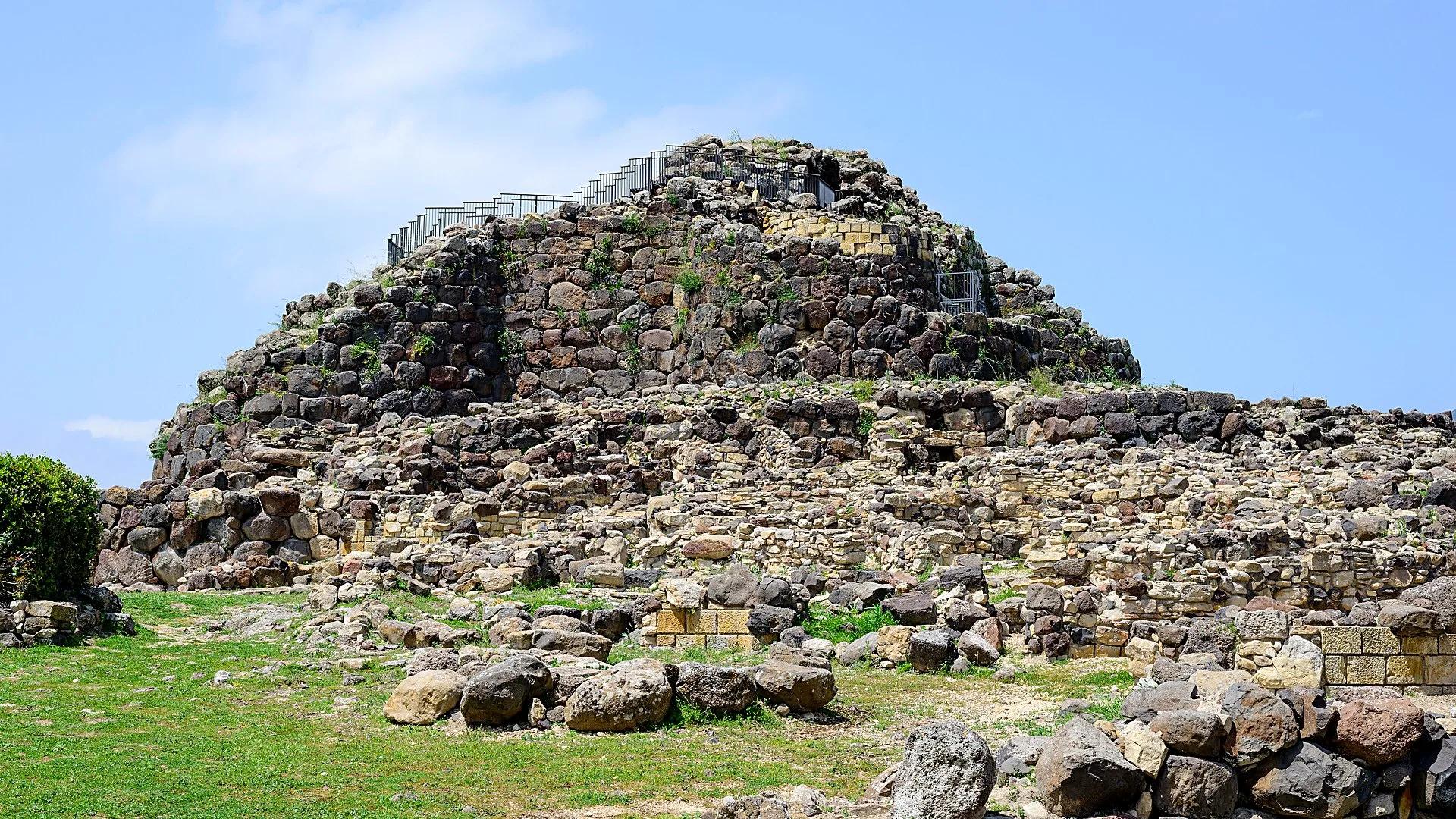

Su Nuraxi di Barumini is open every day of the year, winter included, but you cannot walk in on your own. Every visit is a guided tour. Tours leave every 30 minutes and last about an hour, and on the foundation's 2026 timetable the last one from November to February leaves at 16:00. One ticket, €16 for adults as of November 2026, also covers two museums in the village. If rain means only the outside of the nuraghe can be visited, the price drops to €8.
Quick facts
- What it is: a complex nuraghe, a Bronze Age stone tower with four corner towers and a village of huts around it, on the UNESCO World Heritage List since 1997.
- Where: on the edge of Barumini in the Marmilla, about 62 km by road north of Cagliari.
- Visits: guided only, every 30 minutes, about one hour. Tours are offered in Italian, English and French.
- Winter hours (November to February, 2026 timetable): 09:00 to 17:00, last tour at 16:00.
- Ticket (2026 prices): €16 from age 18, €14 for ages 13 to 17, €12 for ages 7 to 12, free up to age 6. It includes Casa Zapata and the Giovanni Lilliu Centre.
- Buying: as of November 2026 the foundation's online ticketing is not active yet, so you buy at the site.
- Getting there: by car, in practice. The summer train and bus link ran from 1 July to 30 September 2026.
What you are looking at
A nuraghe is a tower of dry-laid stone built during the Bronze Age, and UNESCO notes that no parallel exists anywhere outside Sardinia. It calls Su Nuraxi "the finest and most complete example" of the type.
The oldest part is the central tower. It was built of basalt in the Middle Bronze Age, between the 16th and 14th centuries BC according to SardegnaTurismo, and originally stood more than 18.5 meters high, with three chambers stacked one above the other and linked by a spiral staircase. The top chamber has gone, which after about three and a half thousand years seems forgivable. In the Late Bronze Age four smaller towers were added, joined by a heavy wall into a four-lobed bastion around a courtyard with a well. UNESCO records that this courtyard was later roofed over, which restricted access to the central tower.
Around the fortress lies the village: about 50 huts, wells and cisterns. The best known is hut 80, the "meeting hut", with a stone seat running around its wall and five niches where vases, tools, weapons and votive figures were found. People lived on the site until the 3rd century CE and used it on and off until the 6th or 7th century. After that, UNESCO says, it appears to have stayed buried until the 1950s.
The man who dug it out was Giovanni Lilliu, born in Barumini in 1914, whom the regional tourism board calls the father of Sardinian archaeologists. Few archaeologists get to excavate the most famous hill in their own home village.
What most guides get wrong
It is no longer Sardinia's only UNESCO site. For 28 years it was. In 2025 UNESCO inscribed "Funerary Tradition in the Prehistory of Sardinia: the domus de janas", a series of 18 sites with rock-cut tombs from the 5th to the 3rd millennium BCE. Many pages have not caught up, including the regional tourism board's English page on Su Nuraxi, which in November 2026 still calls it the only Sardinian site named by UNESCO. It is still the island's only UNESCO nuragic site.
You cannot explore it alone. All three Barumini sites are visited only with a guide. UNESCO's own summary gives the reason: visits in small groups with a leader limit the impact of visitors on the site. The upside is that someone explains what each pile of basalt was for.
You cannot book online yet. The "Book now" buttons on the foundation's website lead to a contacts page which says, as of November 2026, that the online ticketing system is still waiting to be activated. Tickets are sold at the site, and the page gives a phone number and an email address for questions. Travel agencies, schools and organized groups must book ahead by email.
Visiting in winter: hours, rain and the order of the day
The 2026 timetable opens Su Nuraxi at 09:00 every day of the year. From November to February the last tour leaves at 16:00 and the site closes at 17:00. Casa Zapata and the Lilliu Centre open and close at the same times in those months, but their last tour leaves at 16:30. In March and October the hours change with the clocks, taking on the next month's times. As of 21 November 2026 the foundation's site still shows the 2026 timetable, so check the hours for January and February 2027 before you set off.
Weather is the bigger variable. The foundation warns that bad weather may restrict access to the archaeological area for safety reasons, and its 2026 price list has an €8 rainy-day ticket for when only the outside of Su Nuraxi can be visited. Casa Zapata and the Lilliu Centre are indoors and open in any weather. On a mixed day, start with the nuraghe and keep the museums for later, since their last winter tour leaves half an hour after the nuraghe's. Wear shoes with grip, as the foundation recommends, and leave the dog with someone: only guide dogs are allowed, by reservation.
For what else stays open in the cold months, see our guide to Sardinia in winter.
Tickets and what they cover
The single ticket (biglietto unico) covers Su Nuraxi, Casa Zapata and the Giovanni Lilliu Centre, which the foundation describes as the home of its permanent and temporary exhibitions. Prices from the foundation's 2026 price list, as of November 2026:
- €16 full price, from age 18
- €14 for ages 13 to 17, school visits, organized groups of at least 20, and tour operators buying at least 100 tickets in advance
- €12 for ages 7 to 12
- €8 on rainy days when only the outside of Su Nuraxi can be visited
- Free for ages 0 to 6, disabled visitors and their companion, and teachers with school groups (one per 15 pupils)
- €7, or €6 for school visits, for the temporary exhibitions only
The foundation lists Italian, English and French for its tours. It does not publish which language each half-hourly departure uses, so ask at the desk when you buy.
Casa Zapata and the Giovanni Lilliu Centre
The other two stops on the ticket are not filler. Casa Zapata, in the village, is a 16th-century residence of the Aragonese Zapata family, built on top of a second nuraghe, Nuraxi 'e Cresia, which came to light in the 1990s. Suspended walkways and glass floors let you look down into it. The house also shows finds from Su Nuraxi, an ethnographic section and the regional museum of the launeddas, the Sardinian three-pipe reed instrument. The tour takes about 30 minutes, the route is indoors, and the foundation lists it as accessible to visitors with reduced mobility.
The Giovanni Lilliu Centre, a short distance from the nuraghe, has a permanent exhibition on Lilliu's life, renovated in 2025, plus photographs of the excavations and a scale model of the nuraghe. Until 30 June 2027 it also hosts "Egypt and the Sherden", which asks who the Sherden shown in pharaonic reliefs were and what linked them to Sardinia. It brings loans from the National Archaeological Museum of Naples and from the museum of the Etruscan Academy in Cortona, including a Magical Statue that is rarely shown outside Naples. The building has a café and a bookshop, which helps when the rain comes in.
Getting there
Barumini lies in the Marmilla, at the foot of the Giara plateau. By road it is about 62 km from Cagliari, roughly an hour's drive, and about 65 km from Oristano. From Olbia it is about 234 km, more than three hours each way, so it works better as a stop on a north-to-south drive than as a day trip. Distances and times are from OpenStreetMap routing, checked in November 2026.
Without a car it is hard work, and UNESCO's own assessment calls public transport to the site poor. In summer 2026 the foundation, the comune, the regional museums directorate and Trenitalia ran the Barumini Link, a combined train and bus ticket via San Gavino, from 1 July to 30 September, with a possible extension. You cannot buy the bus leg on its own. It is a summer service, so for a winter visit plan on driving.
If the weather holds, the Giara is next door: a basalt plateau known for its small horses and its seasonal ponds. Our guides to the Giara di Gesturi and the walks from Tuili cover it. Coming from the south, pair Barumini with our Cagliari guide.
The honest downside
Su Nuraxi is not a lonely ruin on a hilltop. UNESCO's assessment notes that the provincial road along its northern edge, though lightly used, interferes with how the site is perceived, and from the central tower you look straight across the huts to the fence and the road. The visit is also fixed: a group, a guide, about an hour, no lingering on your own. If you want a nuraghe to yourself, this is not it. Come for the scale and the explanations, not for solitude.
Staying in the north instead? Rental12, a holiday-rental company in Olbia that shares an owner with Sardinia Blog, has a guide to the nuragic sites within reach of Olbia, from La Prisgiona near Arzachena to Sa Testa on the edge of Olbia. It covers northern sites, not Barumini, so it is only a partial match for this article. It is a company guide, not independent research.
Photo credits: the bastion and central tower of Su Nuraxi under a blue sky; the village of round huts seen from the central tower, with the road and fence beyond; a round hut with a curved stone bench and a central stone basin; the doorway from the courtyard into the central tower: all by Norbert Nagel, CC BY-SA 3.0, via Wikimedia Commons. The back of Casa Zapata above remains of the nuraghe it was built on: Alina Perra, CC BY-SA 4.0, via Wikimedia Commons. Fact sheet and chart: Sardinia Blog, from the sources below.
Sources: Fondazione Barumini, tickets and opening hours · 2026 opening hours (PDF) · 2026 ticket prices (PDF) · Fondazione Barumini, contacts and ticket sales · UNESCO, Su Nuraxi di Barumini · UNESCO, the domus de janas · SardegnaTurismo, Su Nuraxi · Egypt and the Sherden exhibition · Barumini Link 2026. Checked 21 November 2026.