
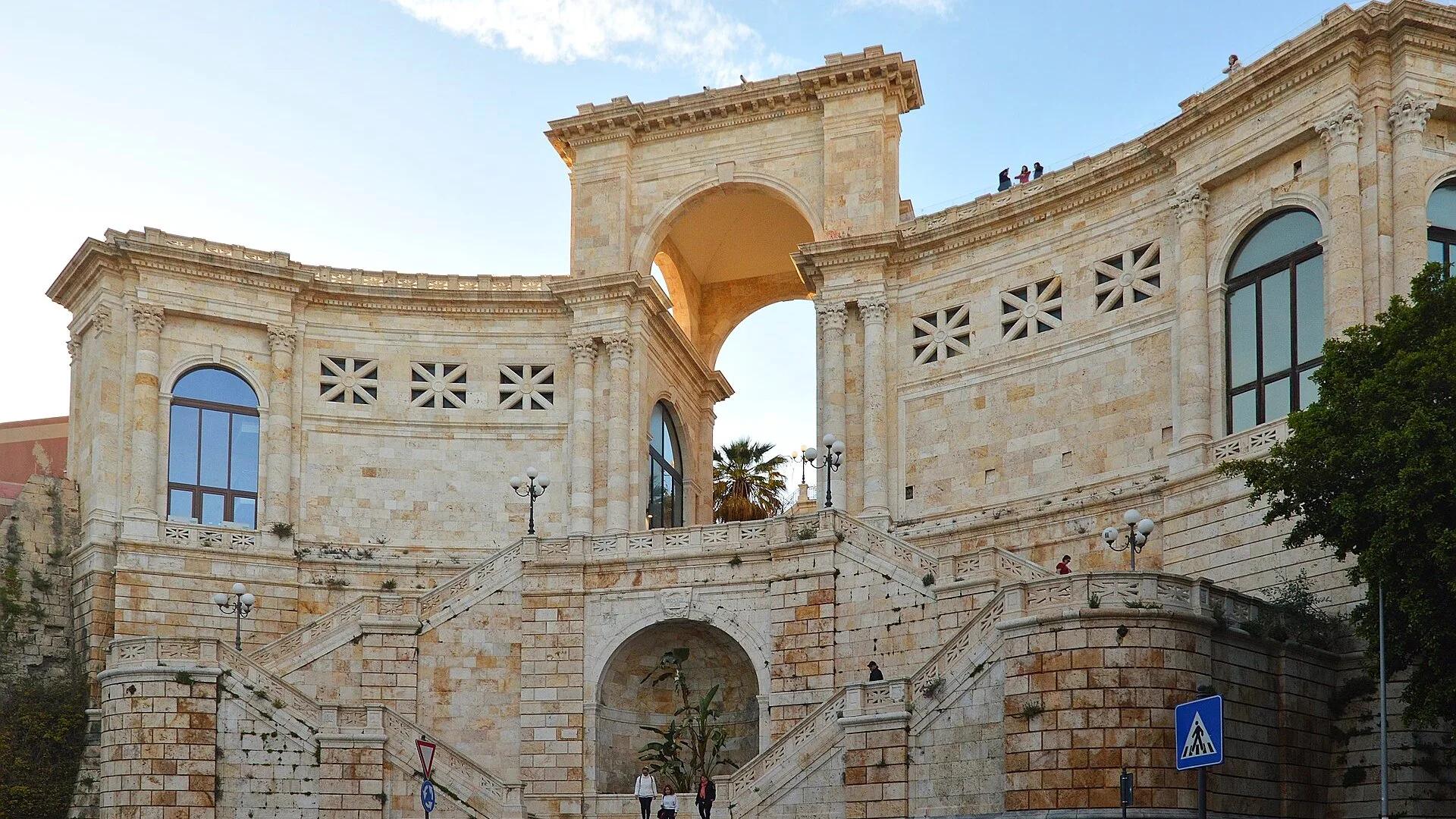
Cagliari, Sardinia's capital on the south coast, deserves two days: one for the walled Castello quarter and its museums, one for Poetto beach and the flamingos of Molentargius, a short bus ride apart. If you only have an afternoon, climb to the Bastione di Saint Remy and look across the city to the Sella del Diavolo headland.
- Airport to center: 7 km; the train from Elmas Aeroporto takes about 6 minutes and costs €1.30 (Sogaer, checked 12 November 2026).
- Old town: four historic quarters, Castello, Marina, Stampace and Villanova, all limited-traffic zones.
- Archaeological museum: 08:30 to 19:30, closed on Tuesdays, €10, free under 18 (checked 12 November 2026).
- City monuments: €3 each or €8 for 7 days; 10:00 to 17:00 from 1 October to 27 April (checked 12 November 2026).
- Poetto: about 8 km of sand shared with Quartu Sant'Elena.
- Molentargius-Saline park: free; 07:00 to 18:00 from 16 October to 28 February, 06:30 to 21:00 the rest of the year.
What has moved or closed in 2026
Three things have moved or shut since many guides were written. The Mont'e Prama statues, the stone giants that drew people to the archaeological museum, have all been at the Museo Civico Giovanni Marongiu in Cabras since April 2026, according to the national museums of Cagliari. Do not go to Cagliari to see the giants. Both Pisan towers in Castello are shut: the city lists the Torre dell'Elefante as temporarily closed to the public (Cagliari Turismo, checked 12 November 2026), and the Torre di San Pancrazio as closed for restoration. And the San Benedetto food market left its historic hall in March 2025 for a temporary market in Piazza Nazzari while the building is rebuilt (L'Unione Sarda). The paper has since reported delays to the works, so no reopening date is certain.
The four historic quarters
Castello
The walled quarter on the hill, about 100 m above the sea, founded and fortified by Pisa in the 13th century; Sardinians still call the whole city Casteddu after it. Go up by the stairs of the Bastione di Saint Remy, designed in 1896 and opened in 1902, to the Terrazza Umberto I on top. The Cathedral of Santa Maria is Pisan work of the 13th century behind a facade rebuilt in 1933. The towers are closed, but you can still walk through the gate under San Pancrazio, described in our piece on Porta di San Pancrazio.
Marina, Stampace and Villanova
Marina, between the Castello walls and Via Roma, began as the Pisan port quarter of warehouses and dock workers' homes. Stampace, to the west, was the craftsmen's quarter; it holds the church of Sant'Efisio and the Baroque churches of San Michele and Sant'Anna. Villanova, to the east, was the farmers' quarter of lower houses, and it fills with processions in Holy Week (Cagliari Turismo).
What to see: museums, Roman and Punic Cagliari, two basilicas
- Museo Archeologico Nazionale: in the Cittadella dei Musei on Piazza Arsenale, at the top of Castello. The €10 ticket also covers the Pinacoteca Nazionale; the ticket office closes at 18:45 (opening hours and tickets).
- Roman amphitheater: cut into the rock on Viale Sant'Ignazio in the 1st or 2nd century AD for about 10,000 spectators. You see it from a walkway; the arena and the rooms below are not open. It is one of six sites on the city's €8 combined ticket, with the Grotta della Vipera, the Cripta di Santa Restituta and the Bastione galleries.
- Tuvixeddu: a Phoenician and Punic burial ground of the 6th to 3rd centuries BC on Via Falzarego, free to enter, open 06:30 to 22:00 from October to December; the upper path to the viewpoint closes at 17:00 (Cagliari Turismo). Our Tuvixeddu guide has the history.
- Nostra Signora di Bonaria: on the Bonaria hill southeast of the center, begun as a small sanctuary in 1324 and called the most important Catholic sanctuary in Sardinia by Sardegna Turismo. Buenos Aires takes its name from this Virgin. Entry is free.
- San Saturnino: in Piazza San Cosimo, built in the 5th and 6th centuries where the martyr Saturninus was buried, and described by Sardegna Turismo as the oldest early Christian monument on the island. Entry is free.
For a wet afternoon there is also the Cagliari planetarium, the reading hall of the Planetario de L'Unione Sarda and Mariano Chelo's atelier.
Cagliari in one day
Morning in Castello: the Bastione stairs, the terrace, the cathedral, then the archaeological museum before the afternoon heat. Walk down through Marina for lunch. In the late afternoon take the bus to Molentargius for the flamingos, which are free to watch, and finish on Poetto at sunset. If you have to cut something, cut the amphitheater: you only see it from a walkway.
Cagliari in two days
Day one as above. On day two, start at Tuvixeddu while it is cool, cross to Stampace and its churches, then walk east to San Saturnino and up to Bonaria. Spend the afternoon on Poetto, and climb the Sella del Diavolo in the evening if you still have legs.
Cagliari in three days
Add a day out of town. Nora, the Phoenician, Punic and Roman town on the Capo di Pula headland, pairs well with a swim at Chia on the same coast road. For the Nuragic side of Sardinia, go inland to Su Nuraxi at Barumini. Both are covered under day trips below. For a full week in the south, see our Sardinia itinerary.
Poetto, the Sella del Diavolo and Molentargius
Poetto runs about 8 km from the Sella del Diavolo to Margine Rosso in Quartu Sant'Elena, with a sandy bottom that stays shallow for tens of meters, according to Sardegna Turismo. It is still divided into numbered "fermate", the stops of a tram that buses replaced long ago. City buses run from Piazza Matteotti, by the port, to Poetto and Molentargius.
The Sella del Diavolo closes the beach to the west above the small harbor of Marina Piccola. The walk from Calamosca to the ruined Spanish tower near the top takes about an hour. Behind the beach, the Molentargius-Saline regional park covers about 1,600 hectares of former salt pans, where salt was made until 1985. Greater flamingos live there all year and nest along the Bellarosa Maggiore pond, which has a bird hide (Sardegna Turismo). The green areas are free, and the hours are on the park's own site. More on the birds in where to see flamingos in Sardinia, and on every beach that needs a booking in our beaches by region guide.
Where to eat and drink
Castello is for coffee with a view: Antico Caffè 1855 by the Bastione, and Caffè De Candia for brunch or an aperitivo with a view of the Bastione. In the lower town, try Oblomow for an easy aperitivo on Corso Vittorio and Al Merlo Parlante for craft beer and panini. For dinner, our guides cover Osteria del Forte for Sardinian cooking, Ristorante Pirani at Palazzo Doglio, the Taurus steakhouse and Pizzeria Su Entu. For food to take away, the San Benedetto stallholders trade in Piazza Nazzari for now. Opening hours and prices are in each guide; check them before you go.
Where to stay in Cagliari
Stay in Marina, Stampace or Castello and you can walk to everything except the beach. Our stay guides cover Palazzo Doglio, Palazzo Ferrucci, Hotel Aristeo on the waterfront and an apartment on Via Manno; for a pool and the sea outside the city there is Phi Hotel Sighientu. The 2026 tourist tax was €1 to €5 a person a night in hotels, depending on stars, and €2 in other accommodation, €3 from July to September (Comune di Cagliari). For other bases on the island, see where to stay in Sardinia.
Getting there, the ZTL and parking
Cagliari-Elmas is 7 km from the center: the train from Elmas Aeroporto reaches Cagliari station in about 6 minutes for €1.30, and a daytime taxi has a €17 minimum fare (Sogaer). ARST buses link the airport with other towns. Ferries from Civitavecchia, Naples and Palermo dock next to Via Roma, and trains run north to Oristano, Sassari, Porto Torres and Olbia; on Trenitalia's November 2026 timetable the direct trains to Olbia took 3 hours 23 minutes to just over 4 hours.
Castello, Marina, Stampace and Villanova are limited-traffic zones, as the Comune di Cagliari lists them. Access hours differ by quarter, so if you are staying inside one, ask your host how access works before you drive in. Otherwise leave the car outside the old quarters: the center is small, steep in places, and easier on foot. Ferries, flights and buses for the rest of the island are in our guide to getting to and around Sardinia.
Day trips from Cagliari
- Villasimius: about 50 km east by the coast road, with the free Porto Giunco beach and the capped Punta Molentis. See the Villasimius beaches guide.
- Nora and Pula: the ancient town on the Capo di Pula headland, founded by the Phoenicians and later Punic and Roman. The culture ministry listed a €10 full ticket when we checked on 12 November 2026 (Ministero della Cultura). The Sant'Efisio procession walks from Cagliari to Nora every year from 1 May.
- San Sperate: a village of murals, and home of the stone sculptures in our guide to the Giardino Sonoro.
- Barumini: the Nuragic complex of Su Nuraxi, a UNESCO World Heritage Site since 1997, visited only on a guided tour (Fondazione Barumini). Nearby is the planetarium at Sardegna in Miniatura.
- With children on a wet day: bowling and games at Playcity in Sestu, just outside the city.
When to go
May, June, September and October are the comfortable months for walking the hills; July and August are hot, and the museum is the cool part of the day. Cagliari's biggest festival, Sant'Efisio, has run every year since 1657; in 2026 it was held from 1 to 4 May (Sardegna Turismo). In winter the city monuments close at 17:00, and our Cagliari weather pages give the averages by month.
Sources: Musei Nazionali di Cagliari, hours and tickets · Musei Nazionali di Cagliari, Mont'e Prama · Monumenti Cagliari · Cagliari Turismo, Torre dell'Elefante · Cagliari Turismo, Tuvixeddu · Cagliari Turismo, Cagliari in un giorno · Comune di Cagliari, tourist tax · Comune di Cagliari, resolution 75/2020 (limited-traffic zones) · Sardegna Turismo, Poetto · Sardegna Turismo, Molentargius-Saline · Parco Molentargius-Saline · Sardegna Turismo, Bonaria · Sardegna Turismo, San Saturnino · Sardegna Turismo, Sant'Efisio · Sogaer, to and from the airport · L'Unione Sarda, San Benedetto market closes · Ministero della Cultura, Nora · Fondazione Barumini, Su Nuraxi. Hours, prices and closures checked on 12 November 2026; the quarters, the San Benedetto market, the tourist tax, the train times and the climate notes come from our check of 29 October 2026.
Rental12, a holiday-rental company in Olbia that shares an owner with Sardinia Blog, lets its own homes in Olbia and Golfo Aranci.
Photo credits: The double staircase and arch of the Bastione di Saint Remy, opened in 1902, leading up to Castello (Ryan Hodnett, CC BY-SA 4.0, via Wikimedia Commons); Poetto beach with the Sella del Diavolo headland on the horizon (Chris, CC BY 2.0, via Wikimedia Commons); Greater flamingos in the Molentargius-Saline regional park, Cagliari (Ryan Hodnett, CC BY-SA 4.0, via Wikimedia Commons); The Sella del Diavolo seen through the arch on the upper terrace of the Bastione di Saint Remy (Nilo1926, CC BY-SA 4.0, via Wikimedia Commons); Poetto, Marina Piccola and the Molentargius salt pans seen from the Sella del Diavolo (Nilo1926, CC BY-SA 4.0, via Wikimedia Commons). Fact sheet and chart: Sardinia Blog, from the sources listed above.