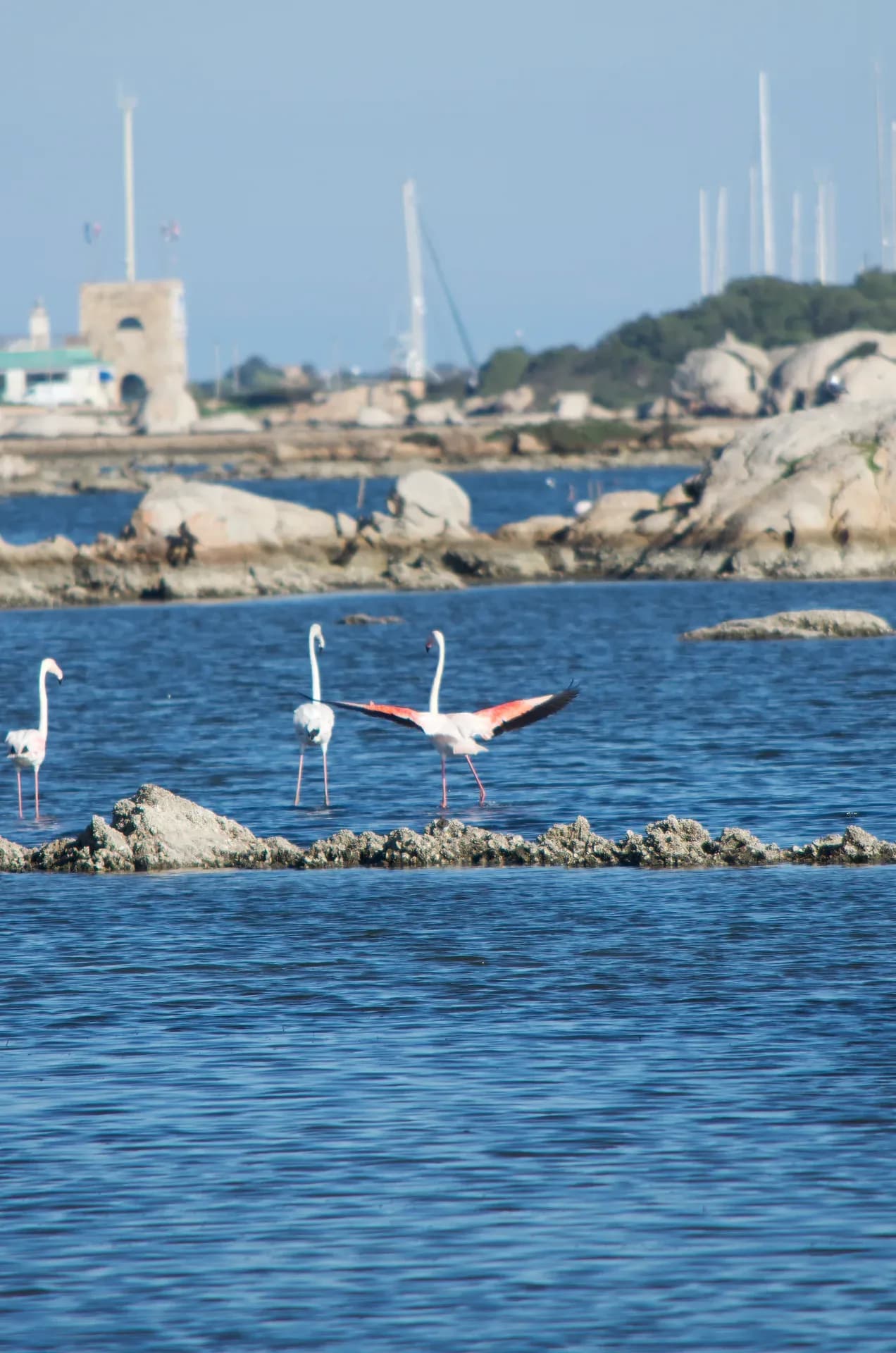

Olbia's salt flats and lagoons fill with greater flamingos in reliable numbers, and at first light the water turns the same colour as the birds standing in it. You need no boat, guide or long drive. Several of the best spots sit minutes from the town centre, and one is beside the airport.
Here is where to look around the Gulf of Olbia, when to go and how to watch without pushing the birds off their feeding grounds. 🦩
Why the flamingos of Olbia thrive
Olbia's wetlands tick every flamingo box: shallow salt lagoons, little disturbance, and a menu of brine shrimp and blue-green algae loaded with carotenoids. These brackish ecosystems mix freshwater and seawater across tidal marshes, evaporating salt pans and calm pools, and that mix produces the micro-organisms greater flamingos filter out with their specialised bills.
Some flamingos migrate seasonally around the Mediterranean. Others, especially at Poltu Quadu, Molentargius near Cagliari and the San Teodoro lagoon, become semi-permanent residents. They breed in favourable years, then linger through winter when conditions hold. Sardinia's low industrial footprint and careful zoning have kept these habitats stable.
Breeding success is well documented. Greater flamingos first bred in Sardinia in 1993 at Molentargius, and thousands now use the island's wetlands every year, according to the park authority.
“They’re kind of our environmental consultants,” says Kristina. “They only show up if we’ve done things right.”
When the flamingos glide back in their V formations, locals take it as a quiet sign that the water is healthy and the habitat intact.
Best time to see the flamingos of Olbia
Peak activity runs from May to July, when flocks court, nest and show off their brightest plumage. Some birds arrive as early as March, and many linger into October if water levels and food hold steady. Where conditions stay favourable, small groups feed right through the winter.
Each season looks different. Spring brings social displays and courtship. Summer concentrates the birds into the remaining pools as salinity rises and the shallows shrink. Winter is quiet, with steady feeding groups and almost nobody else on the paths.
Sunrise and sunset are the golden windows in any month. Soft light wraps the birds in pink-gold reflections, the wind is calmer, and you will see feeding, preening and the occasional synchronised strut. 🌅
“Around 6:30 a.m., it’s like the whole lagoon turns into a watercolour painting,” says Floriana. “It’s magic.”
Where to spot them around the Gulf of Olbia
Five places are worth your time, and the first three are close enough to string together in one morning. The lagoons ring the south and west sides of Olbia Costa Smeralda Airport, so the walking is short.
Poltu Quadu wetlands
Right beside the airport, these salt pans are the most convenient vantage point in the gulf and do not require leaving town. Find a quiet pull-off near the lagoon edge, walk the margins of the saline and scan the open water. Bring binoculars and some patience, keep to existing paths, and stay off the crusted edges. Parking is straightforward and the dawn light is superb. 🔭
Lido del Sole shallows
South-west of the airport, the low silty shallows near Lido del Sole often hold small feeding groups. Arrive early to catch them close to shore, before beach traffic builds.
Vecchie Saline salt flats
These historic salt pans sit behind Le Saline beach. The beach side is easy to reach, and the flats behind it sometimes hold large flocks, particularly outside peak beach hours (Hello Olbia, Le Saline). The pans and coastal ponds along this southern shore of the gulf fall inside the Natura 2000 Special Protection Area ITB013019, "Isole del Nord-Est tra Capo Ceraso e Stagno di San Teodoro", designated under the EU Birds Directive, which lists the greater flamingo among the species it protects (EUNIS site factsheet).
San Teodoro lagoon
About 25 minutes south of Olbia, the lagoon behind La Cinta beach is one of the island's most consistent flamingo hangouts. Paths skirt the water and several natural viewpoints let you watch from a respectful distance. The lagoon is named in the title of that same Special Protection Area, ITB013019, and is recognised for its birdlife and dune habitats (European Commission, Natura 2000).
“San Teodoro is the one place I always bring binoculars,” says Nadiya. “You feel like you’re walking through a BBC documentary.”
Tavolara Marine Park
Sightings here are occasional, but the trip earns its place for the wild scenery alone. Viewpoints around the Tavolara and Punta Coda Cavallo Marine Protected Area give sweeping seascapes and a chance encounter with birds commuting between feeding sites (Area Marina Protetta Tavolara).
Getting there
Reach the lagoons by car or bicycle on local roads. Pull-offs are limited, so park considerately, never block a gate, and respect private property and signed work areas. The salt pans are a working landscape as well as a habitat.
Sardinian flamingo facts at a glance
- Species: greater flamingo (Phoenicopterus roseus)
- Size: up to 150 cm tall, wingspan around 140 to 170 cm
- Colour source: carotenoids from brine shrimp and algae in saline lagoons
- Breeding: regular in Sardinia since 1993, with strong colonies in good years (Parco Molentargius)
- Conservation: many key wetlands in north and south Sardinia sit within the EU Natura 2000 network
What makes flamingos pink?
Flamingos start out grey, then blush pink as pigments from their diet build up in feathers and skin. The richer the diet in carotenoids, the deeper the hue. Colour also signals health and plays a part in mate selection, so a faded flamingo may be underfed, stressed or unwell. According to the Smithsonian's National Zoo, carotenoid-rich algae and small crustaceans are the main source. 🎨
“They’re nature’s minimalist icons,” says Anastasia. “All legs, grace, and effortless style.”
Clean waters, protected habitats
Flamingos are sensitive to disturbance and pollution, so their steady presence is a useful indicator. In northern Sardinia several wetlands are protected or sit next to protected areas. Local conservation, measured visitor access and ongoing water management keep conditions suitable for the flamingos of Olbia year after year.
“Nature is healthy here,” says Floriana. “You can see it. You can feel it. Even the flamingos know.”
How to watch the flamingos of Olbia respectfully
- Stay on marked paths and existing tracks, outside fences and signed zones. The salt crust can be thin and dangerous, and the vegetation fragile
- Keep your distance. If a bird stops feeding or lifts its head to watch you, you are already too close
- Leave the drone at home. Drones disturb nesting and resting birds
- Keep dogs on a short lead, keep voices low and avoid sudden movement
- Never feed or try to approach a flock, especially during nesting or when chicks are present
- Support conservation and choose responsible hosts who share observation guidance
As Kristina adds, “We give guests maps and advice on where to observe them without getting too close. That is part of what we do.” 🌿
What to bring
- Optics: 8x to 10x binoculars are plenty for casual watching
- Clothing: neutral colours, a hat, sunscreen and light layers. Mosquito repellent helps near the reeds
- Time: settle in and watch quietly. Birds often drift closer on their own as they feed
Photography tips for unforgettable shots
- Arrive early or stay late for soft, directional light that keeps feather detail
- Use 300 to 400 mm or longer for portraits, which keeps you far enough back, or go wide for reflections and sky
- Watch the wind. Takeoff and landing usually happen into the breeze, which helps you anticipate the moment
- Expose for the highlights to avoid blown whites on the wings
- Wait for behaviour. Synchronised feeding, wing flaps or mirrored reflections lift an ordinary frame 📸
Phone or serious glass, the flamingos of Olbia reward patience and a respectful distance.
Make a morning of it
After the lagoons, a boat trip or coastal walk in the Tavolara and Punta Coda Cavallo Marine Protected Area shows another side of local wildlife (AMP Tavolara). If you are touring the island more widely, the Molentargius-Saline Regional Park near Cagliari is Sardinia's best known flamingo site, with hides and signed trails, according to the park authority (Parco Molentargius).
Where to stay near the wetlands
Rental12 apartments in Olbia let you combine beach days with birdwatching mornings. Coffee on the terrace, then a short stroll or drive to the lagoon as the first light hits the water. No rush, no crowds. Book your sustainable Sardinian stay with Rental12. Ethical, beautiful, easy.
Final thought
Flamingos are more than the influencers of the animal kingdom. They are a sign of balance and quiet ecological success. When the flamingos of Olbia are here, the system is working. Watch them properly and you become part of that story too. 🦩