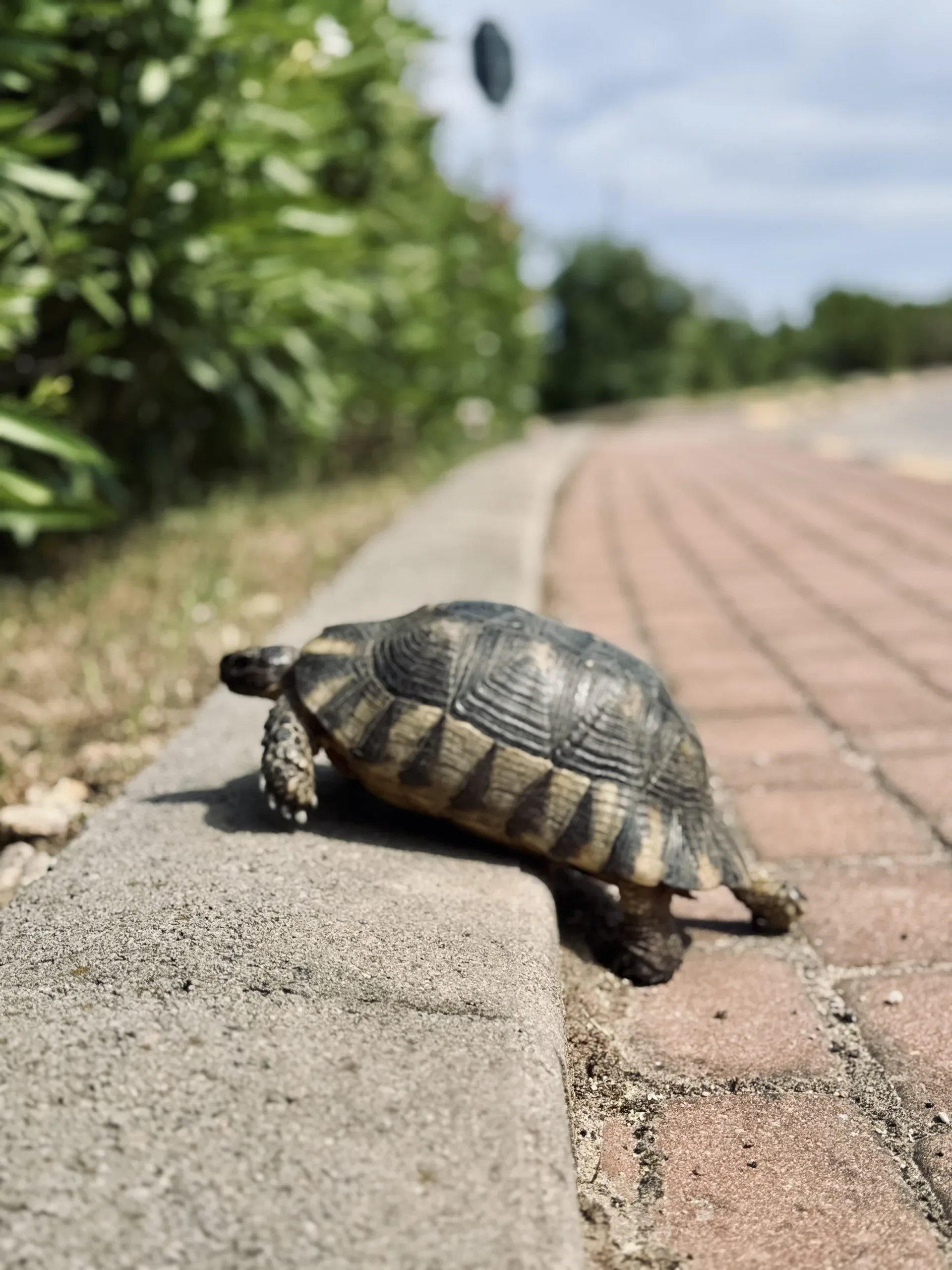

Sardinia is the only Italian region where all three European land tortoises live wild: Hermann's tortoise, the marginated tortoise and the spur-thighed tortoise. All three are strictly protected under EU and Italian law. If one crosses your path in the Gallura scrub or on a country road, the rule is simple: look, help it off the tarmac if it is in danger, and leave it where it lives. Taking one home is a crime, with penalties of six months to two years and a fine of €15,000 to €150,000.
A note on this page: an earlier version called these animals the "Saint Turtles of Sardinia" and described a local nickname and a superstition around Porto Rotondo. We could find no source for any of that, so we have rewritten the article from primary sources.
Quick facts
Species: Hermann's tortoise (Testudo hermanni), native; marginated tortoise (Testudo marginata) and spur-thighed tortoise (Testudo graeca), both introduced in antiquity and long established (IUCN Tortoise and Freshwater Turtle Specialist Group).
Protection: all three are on Annexes II and IV of the EU Habitats Directive, Appendix II of the Bern Convention, CITES Appendix II and Annex A of the EU wildlife trade regulation.
Penalty in Italy: holding, buying, selling or moving an Annex A animal without CITES papers is an offence under Legge 150/1992, art. 1: arrest from six months to two years and a fine of €15,000 to €150,000.
Who to call: 1515, the emergency number of Sardinia's Corpo forestale e di vigilanza ambientale; 112 for any emergency.
When you see them: spring to early autumn, on warm mornings and late afternoons; they hibernate in winter.
Three tortoises, one island
Hermann's tortoise is the native species, with a domed, dark-and-yellow shell. The IUCN specialist group lists it across the Balearics, Corsica, the Tuscan archipelago, Sardinia and Sicily; its last Red List assessment was "near threatened", and ISPRA, Italy's environment institute, rated its conservation status in Italy as bad or inadequate in 2020.
The marginated tortoise is larger and longer, with a flared rear edge to the shell. In Sardinia it is an ancient introduction, concentrated in the north and on some of the small islands; globally it is "least concern". The spur-thighed tortoise, also introduced in antiquity, lives mainly on the central-western coast and on Mal di Ventre island, where researchers recorded the highest density known in Europe; the species as a whole is "vulnerable" on the Red List.
Sardinia's Corpo Forestale has made the point in its own seizure reports: no other Italian region has all three, plus the European pond turtle. That is why the island matters for these animals, and why the rules are strict.
If a tortoise is crossing the road
Road crossings are the one moment when handling a wild tortoise is justified. Park fully off the road with hazard lights on and check the traffic before stepping out. Lift the animal by the sides of the shell, never by a leg or the tail, keep it low to the ground and carry it a few metres off the road on the side it was heading for; a tortoise put back where it came from will simply set out again. Then leave. This is standard wildlife-rescue practice rather than an official Sardinian instruction, and it is the only handling a wild tortoise should ever get.
What not to do
Do not take it home, to your villa or to the garden of your holiday rental. A wild-born tortoise cannot be legalised afterwards, and holding one without CITES documents is an offence under Legge 150/1992.
Do not move it to a "better" place. Tortoises keep to a home range for decades and a relocated animal will try to walk back.
Do not feed it, and do not pour water over it. Wild diets are seasonal and specific.
Keep dogs on a lead in scrubland in spring and summer. Dogs kill and maim tortoises.
Do not buy one. Sardinia's Corpo Forestale seized five marginated tortoises in a Costa Smeralda restaurant in 2021, fifty-four in a camping tent at Capo Coda Cavallo in 2024, and fined three people €15,000 in the Trexenta in 2023 for offering eight tortoises online.
If you find an injured tortoise, or see one being kept or sold
Call 1515, the free emergency number of the Regione Sardegna's Corpo forestale e di vigilanza ambientale, which also handles CITES and protected species on the island. Give the place and, if you can, a photo. For a general emergency call 112. If you are staying in a holiday home and find a tortoise living in the garden, leave it: it was there first.
Watching and photographing them
Tortoises are most active from spring to early autumn, on warm mornings and in the late afternoon, often after light rain, in cistus and lentisk scrub, at the edges of gardens and along quiet lanes. Stay low and still, use a longer lens if you have one, and never block the animal's route. For children, counting the plates of the shell from a metre away teaches more than picking it up ever will.
Sources: IUCN TFTSG, Testudo hermanni · IUCN TFTSG, Testudo marginata · IUCN TFTSG, Testudo graeca (2022) · ISPRA, World Turtle Day 2020 · EU Habitats Directive 92/43/EEC · Bern Convention, Appendix II · Legge 150/1992, art. 1 · Corpo forestale e di vigilanza ambientale, 1515 · L'Unione Sarda, 22 August 2024 · L'Unione Sarda, 8 April 2023 · L'Unione Sarda, 23 October 2021. Checked 31 October 2026.