
Ancient Stars and Sacred Waters: Pozzo di Santa Cristina
In the hidden heart of Sardinia, where the air smells of lentisk and the wind carries ancient secrets, there is a place suspended between myth and science: the Pozzo di Santa Cristina. Here, earth and water meet the sky, and the Nuragic people’s astronomical wisdom still flickers in stone and light.
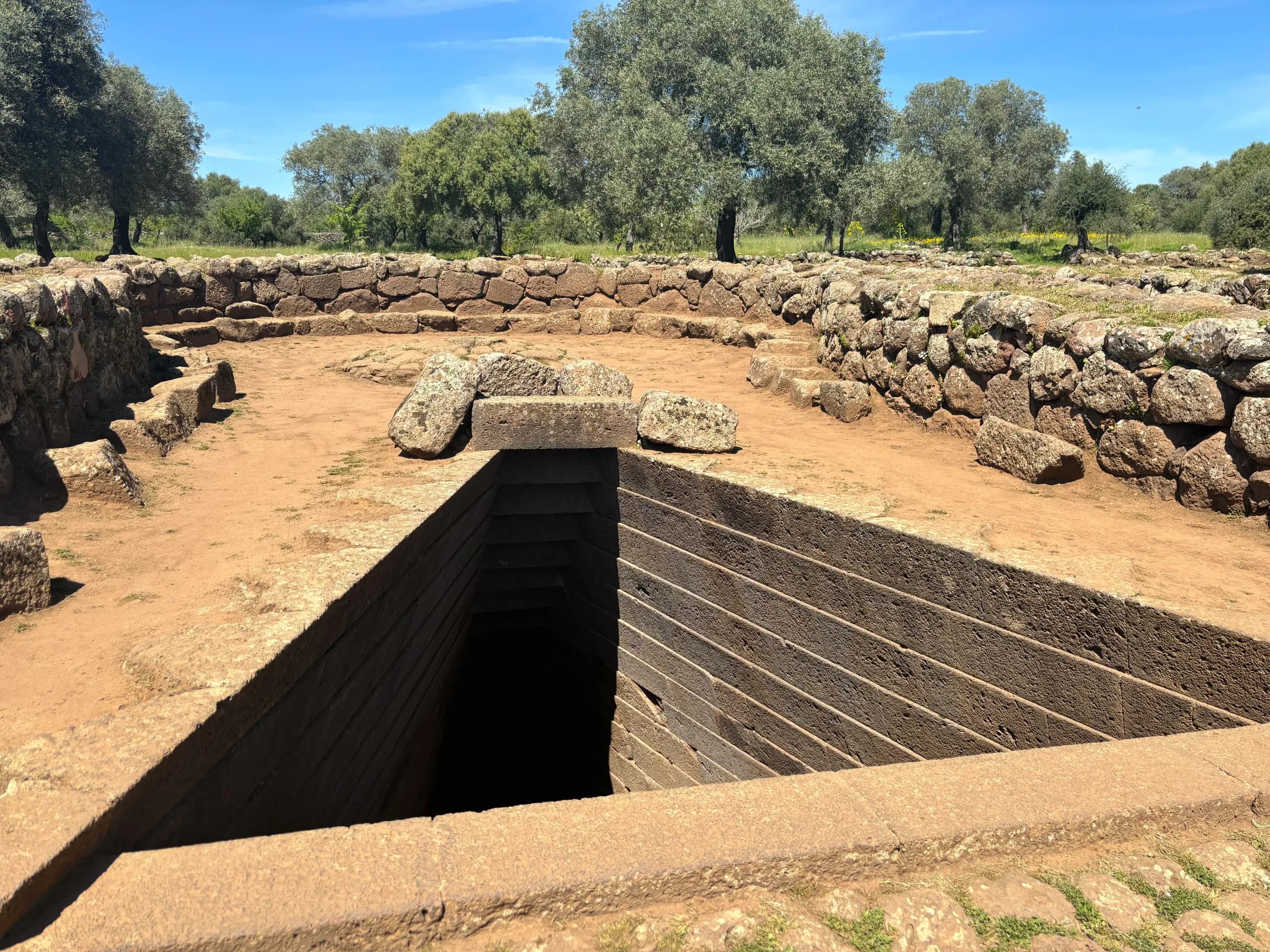
Built around the 11th century BC, this Nuragic holy well is a masterpiece of geometry and craftsmanship. Basalt blocks are fitted with millimetric precision without mortar, creating an elegant, perfectly proportioned sanctuary. The result is not only beautiful but purposeful, uniting architecture and cosmos in a way that feels both timeless and deeply human.
Why Pozzo di Santa Cristina captures the imagination ✨
The Nuragic civilization flourished in Sardinia for more than a millennium, leaving behind towers, villages, and sanctuaries that still inspire awe. Among them, Pozzo di Santa Cristina stands out for its balance of technical mastery and spirituality. Scholars view it as both a sanctuary dedicated to water and an instrument for reading the sky.
As you descend the 25 stone steps toward the underground chamber, you feel the temperature drop and the hush of the earth deepen. Below lies a perennial spring, a mirror of liquid light. Above, an oculus at the top of the tholos roof admits a blade of sky. The entire structure seems to inhale and exhale with the day, guiding sunlight and moonlight into a precise dialogue with water.
A temple of water and stars: the architecture 💧
The site’s plan is strikingly refined. A paved forecourt leads to a trapezoidal staircase that narrows as it descends toward the chamber. The corbelled tholos, built from carefully cut basalt, rises over the well like an inverted cone. Every surface feels intentional, from the angle of each step to the size of the oculus that frames the heavens.
According to Sardegna Turismo, the sanctuary near Paulilatino is open year-round, with site services and a wider complex that includes ancient and later structures (official tourism board). The core well structure at Pozzo di Santa Cristina is widely considered one of the finest examples of Nuragic sacred architecture.
Solar choreography at the equinox
Twice a year, around the spring and autumn equinoxes, sunlight descends the stairway with remarkable precision, illuminating the water in a quiet, golden ritual. The effect is delicate rather than theatrical, but it speaks to careful design and observation. For a few days on either side of the equinox, you can watch the light move across stone and surface as if guided by an ancient metronome.
Moonlight at the major standstill 🌙
Every 18.6 years, the Moon reaches what astronomers call a Major Lunar Standstill, when its path appears at its most extreme in the sky. At this rare moment, moonlight can align with the oculus and reflect onto the well’s surface in the chamber below. The cycle is well documented in astronomy, with the current standstill peaking in 2025, according to the Royal Observatory Greenwich (explanation of lunar standstills). At Pozzo di Santa Cristina, the phenomenon likely helped the Nuragic community track time and celebrate lunar cycles.
The wider sanctuary at Pozzo di Santa Cristina
The archaeological area is more than the well alone. Nearby, a circular meeting hut preserves a stone bench that runs along its interior, often interpreted as a council space. In the center, archaeologists found a small stone model of a nuraghe, underlining how this was a place of gathering and ritual memory.
Just beyond stands the rural church of Santa Cristina and a cluster of low stone houses known as cumbessias. These shelters served pilgrims during religious feasts, hinting at centuries of continuity that reach from the Nuragic era into Christian tradition. The layering of sacredness is palpable, making Pozzo di Santa Cristina an exceptionally rich cultural landscape.
How to visit Pozzo di Santa Cristina 🧭
The sanctuary sits near Paulilatino in central-western Sardinia, a few minutes from the SS131 highway. It is easy to weave into a refined, slow-travel itinerary through the island’s interior.
Getting there
- Driving: From Cagliari, plan about 1 hour 30 minutes via SS131. From Oristano, about 25–30 minutes. From Alghero, around 1 hour 15 minutes. The site has signposting near the Paulilatino exits and on-site parking.
- Navigation tip: Search for “Pozzo di Santa Cristina” directly. Mobile signal is generally reliable, but download offline maps for peace of mind.
Tickets and visiting logistics
- Hours: Open year-round with seasonal schedules; guided visits are often available on site. Confirm current times locally or via the Sardegna Turismo listing linked above.
- Tickets: Purchase at the entrance. Expect card and cash options, but carry some euros just in case.
- Accessibility: The grounds are mostly level, but the descent into the chamber involves 25 steps that can be damp and uneven. Those with limited mobility can still admire the structure from the upper courtyard.
What to wear and bring
- Footwear: Closed, non-slip shoes are essential for the stairway.
- Layers: The chamber is cool even in summer. A light sweater is useful.
- Sun and comfort: In warmer months, bring water, a hat, and sunscreen. Shade is limited outside the trees near the church.
- Photography: Low light in the chamber favors fast lenses or higher ISO. Tripods may be restricted; ask staff. Flash is discouraged.
When to go for the best light
- Equinox magic: Aim for the days around March 20–21 and September 22–23 for the most elegant sunlight effects on the stairway and water.
- Lunar standstill: If your travels coincide with the 2025 peak, consult local guides for night-time observations when conditions are right. Weather and moon phase matter.
- Daily rhythm: Early morning or late afternoon offers softer light on the stones and fewer visitors. In summer, midday can be hot on the upper court.
Refined detours near Pozzo di Santa Cristina 🚗
- Nuraghe Losa: One of Sardinia’s most impressive nuraghi, a short drive away. Combine the two for a rich Nuragic day.
- Santu Lussurgiu: A graceful hill town known for traditional crafts, stone architecture, and excellent slow-food restaurants.
- Oristano and the Sinis Peninsula: Pair archaeology with the coast. Visit Tharros, then linger on the quartz sands of Is Arutas for a late-afternoon swim.
Respectful visiting
- Touch lightly: Oils and pressure can damage ancient stones. Avoid leaning on or climbing the structure.
- Stay on paths: Help protect fragile surfaces and any ongoing archaeological work.
- Quiet moments: Part of the magic at Pozzo di Santa Cristina is silence. A few unhurried minutes by the water are often the most memorable.
A living dialogue between stone and sky
Standing at Pozzo di Santa Cristina, you sense a place designed to measure not just time, but meaning. The equinox beam gliding down the steps, the rare kiss of moonlight at the standstill, and the steady presence of the spring invite a slower way of seeing. For travelers drawn to depth and beauty, this sanctuary is a rare union of engineering, ritual, and the night sky.
Visit pozzo di Santa Cristina with curiosity and care, and Sardinia’s ancient voice feels close enough to hear.