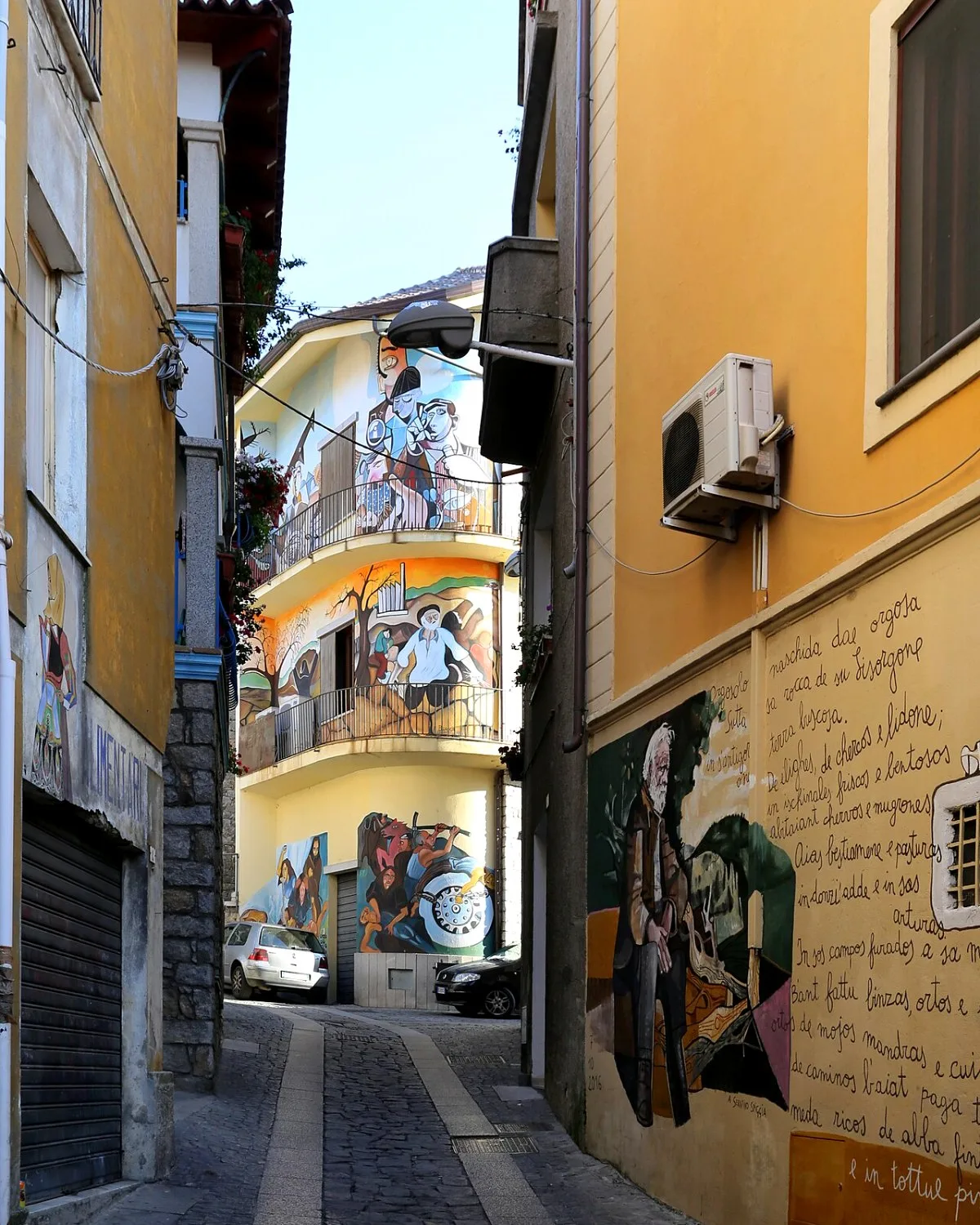

Orgosolo is a hill village of about 3,800 people in the Barbagia, 18 km from Nuoro, that has painted its political and social history on its walls since 1969. The Comune's own tourism portal counts more than 250 murals, in the old centre and on the outskirts, with some of the best known on Corso Repubblica. They are outdoors, free and visible all year, including in winter.
Quick facts
First murals: 1969, by the Gruppo Diòniso, a small anarchist artists' collective from mainland Italy.
The turning point: 1975, when art teacher Francesco Del Casino painted with his middle school pupils for the 30th anniversary of the Liberation.
How many: sources differ, from about 150 to more than 250.
Cost: free to walk around; a guided walk takes about 90 minutes.
Height: 584 m above sea level, so winters are cool and damp.
Who painted the first murals, and when
The Comune di Orgosolo's history of the murals is clear on the start. The first two paintings appeared in 1969: one openly political, the other in the style of an advertisement.
Their authors were the Gruppo Diòniso, young people from the mainland led by Giancarlo Celli of Lucca. Celli, born in 1927 and trained in law, founded the group in 1965 with a libertarian and anarchist outlook. It never had more than five members and stayed active until his death in 1977.
The political mural was painted on today's Corso Repubblica, then Via Vittorio Emanuele, beside a newsagent. It showed a map of Italy with a large question mark where Sardinia should be, and Italy as a woman wearing a tall stars and stripes top hat, a comment on American influence.
The Ministry of Culture's Idese heritage portal links this first series to the protests against the Pratobello firing range that same year.
The turning point came in 1975. Francesco Del Casino, a painter from Siena who had arrived in Orgosolo in 1964 to teach art at the middle school, involved his pupils in painting the bare walls for the 30th anniversary of the Liberation. Sardinian and foreign artists followed, and the subjects widened to world events, including a mural for the attacks on New York's Twin Towers.
Pratobello 1969: the protest behind the walls
To read the murals you need Pratobello. The account on Discover Orgosolo, the Comune's tourism portal, gives the sequence.
May 1969: the army announced a temporary firing range for the Brigata Trieste on common grazing land.
27 May: a notice on the village walls said the area would be used for two months. It covered 12,000 hectares of the best communal pasture.
The cost to shepherds: 40,000 animals had to be moved, with compensation of 30 lire per sheep a day.
19 June: exercises began, and about 3,000 people from Orgosolo occupied the pastures peacefully, sitting on the ground with their hands raised.
The outcome: a village delegation met Defence Minister Luigi Gui and undersecretary Francesco Cossiga and came back with a written promise. The range would be dismantled, exercises would end by August, and no permanent base would be built.
The politician and writer Emilio Lussu, too ill to join the protest, sent a telegram calling it a "colonialist provocation" against shepherds and farmers. His words are painted on a mural on Corso Repubblica.
How many murals are there? It depends who counts
No official inventory is published, and the figures in circulation differ.
More than 250: Discover Orgosolo's murals page, run for the Comune, in the old centre and the outskirts.
About 150: the national tourism site Italia.it.
"Hundreds": the Region's tourism site Sardegna Turismo, without a number.
The gap is partly about what counts: new works are added, old ones fade or disappear when buildings are restored.
What to see on Corso Repubblica
Start at the old town hall, the ex municipio, on the main street. Its facade carries "Concimi, non proiettili" (fertiliser, not bullets), a Pratobello slogan. Del Casino painted it in 1984 over an earlier mural from 1976 that was lost when the building was restored. It reads in three scenes from left to right and works the doors, windows and balconies into the picture.
Then walk the Corso and its side streets, where many more murals are painted. Themes run from shepherds' lives and land disputes to the Resistance, pacifism and world politics.
The Comune's portal sells a guided walk of about 90 minutes in Italian, English, French or Spanish. It ends at the crypt of Antonia Mesina, a 16-year-old from Orgosolo killed in 1935, whom Pope John Paul II beatified on 4 October 1987.
The bandit image, and how to visit with respect
Orgosolo was long known in Italy as the bandits' town, and the Idese portal still says so. Vittorio De Seta's 1961 film Banditi a Orgosolo, shot with non-professional actors, follows a wrongly accused shepherd driven into banditry.
The walls tell a different story, of collective and mostly nonviolent protest. On 25 April 1931 about 50 women occupied the town hall for three days and three nights against the transfer of communal land to the State. In 1969 about 3,000 people sat down in front of the army.
A few points of local etiquette:
Ask before photographing people, especially older residents in traditional dress.
The murals are on homes and shops. Do not block doorways, and keep voices down in the narrow lanes.
Skip the bandit jokes. Banditry is recent local history here, not folklore.
Beyond the village: the Supramonte
The village climbs the slopes of Monte Lisorgòni and looks over the valleys of the Cedrino river. On clear days, according to the Comune, the view reaches Monte Limbara in Gallura.
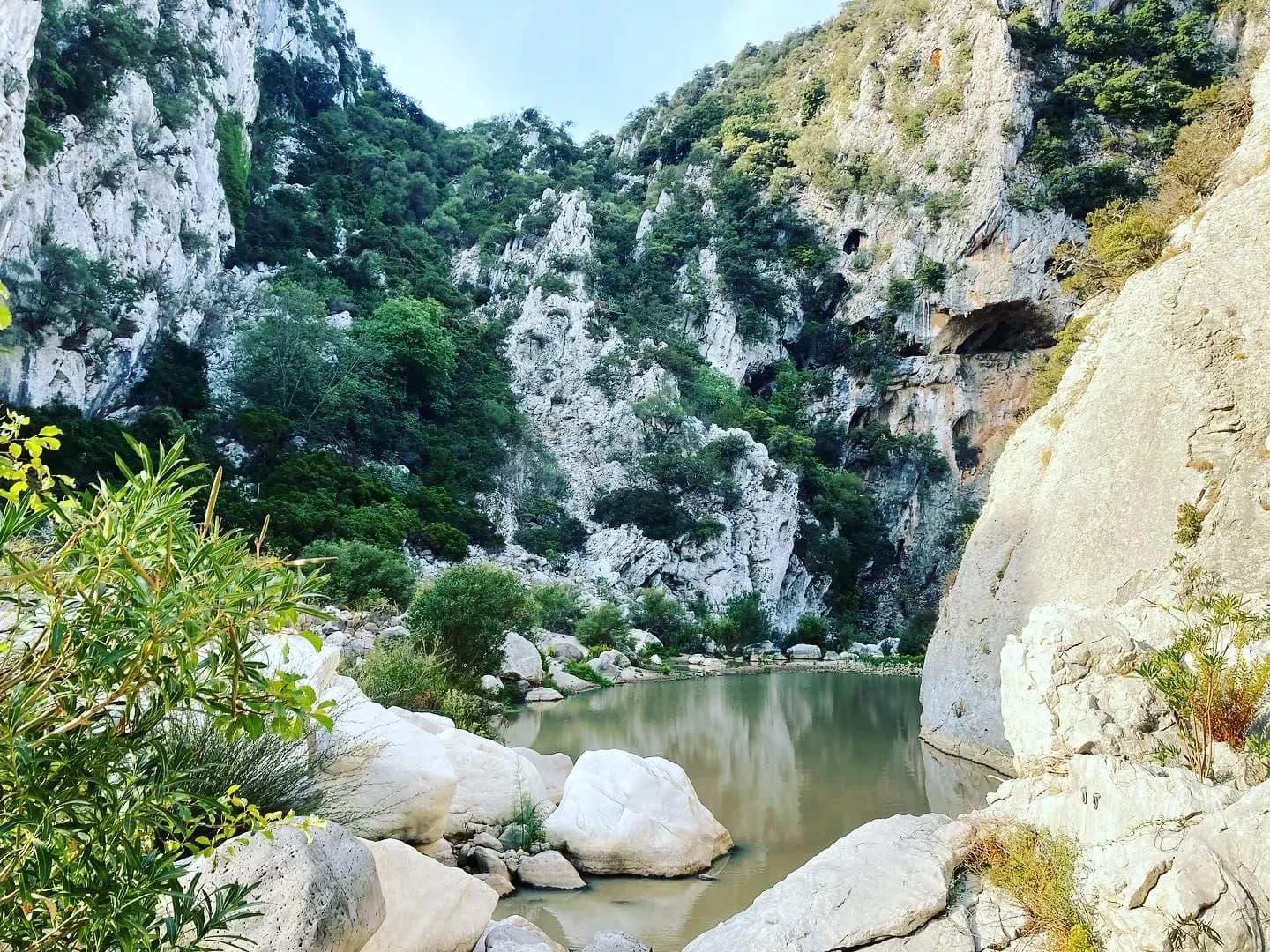
The municipality also takes in the Supramonte di Orgosolo and the Foresta di Montes. The Gola di Su Gorropu gorge marks the border with Urzulei, with walls up to 500 m high. The path from the Orgosolo side starts near the Nuraghe Mereu, has no tourist signs, and the portal advises going with a local guide. Our guide to walking in the Supramonte covers the wider area.
Orgosolo in winter: weather and what is on
At 584 m, Orgosolo is colder than the coast. ERA5 reanalysis data for 1991 to 2020, which we averaged for the village, give a mean daytime high of 11.7°C and a low of 4.1°C in December. January averages 10.8°C and 2.9°C, and February 11.2°C and 2.4°C. November is the wettest month in the same data, with about 77 mm. See our December weather for the Barbagia before you pack.
Bring a warm layer and shoes with grip, because the centre's streets are cobbled, narrow and often steep.
Autunno in Barbagia: Orgosolo's 2026 weekend was 17 and 18 October. The official 2026 programme lists Nuoro, Tiana and Ollolai on 14 and 15 November, Fonni on 6 to 8 December, and Ortueri, Orune and Seulo on 12 and 13 December. Our Autunno in Barbagia 2026 village guide has the full list.
Sa Candelaria, 31 December: children knock on doors asking for bread, sweets and biscuits, and later visits move to the homes of the year's newlyweds.
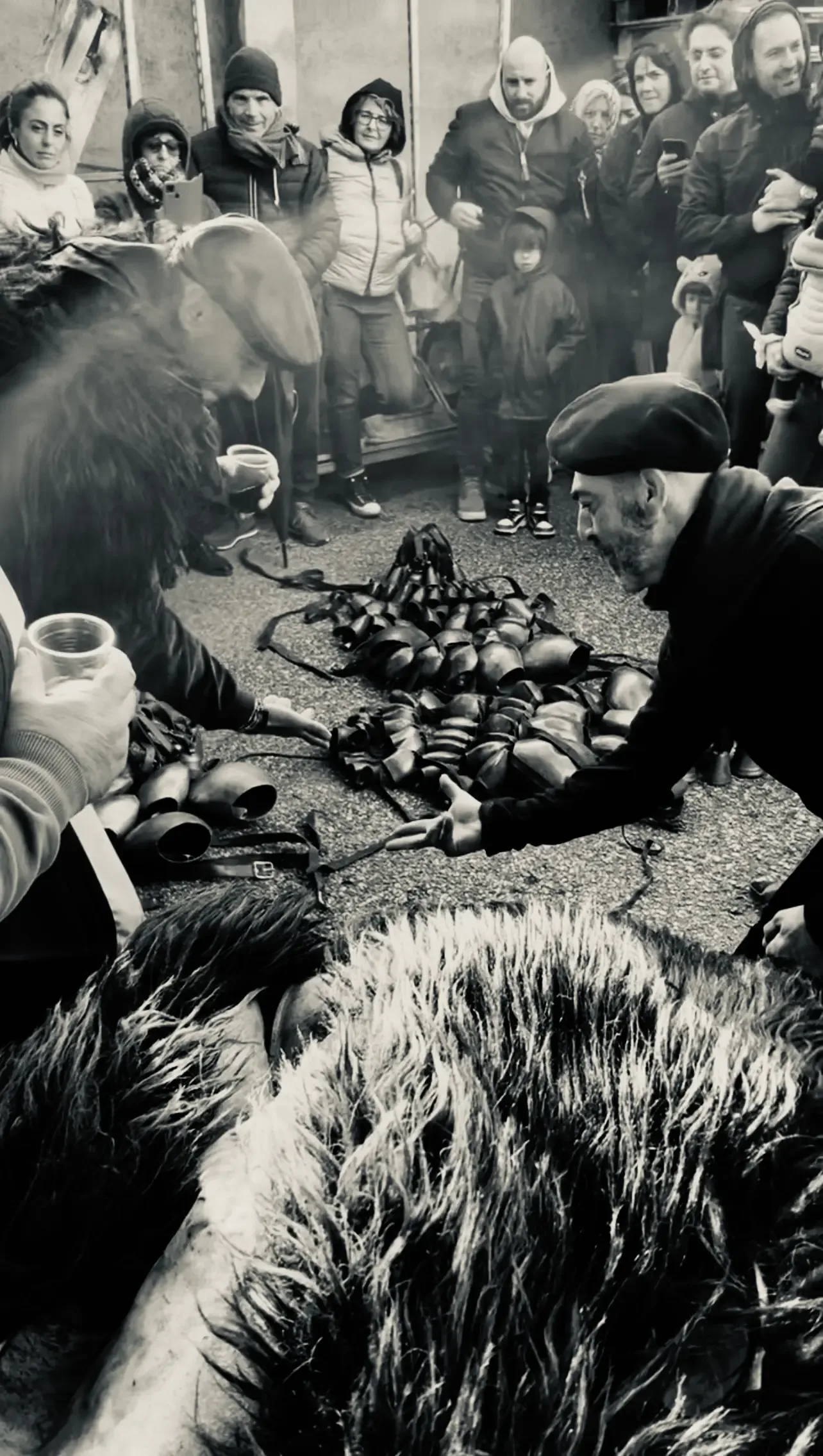
Sant'Antonio Abate, 16 and 17 January: a bonfire is lit in front of the church on the 16th. The portal describes mass at dusk, then the saint's statue carried three times around the fire. The rite opens the Barbagia carnival season.
Combine Orgosolo with Mamoiada
Mamoiada is about 10 km away by road. Its Museo delle Maschere Mediterranee lists opening hours of 10:00 to 18:00, Monday and Wednesday to Sunday, with last entry at 17:30, so it is closed on Tuesdays. Tickets can be bought online with a €1.50 booking fee; check the current prices on the museum's site before you go.
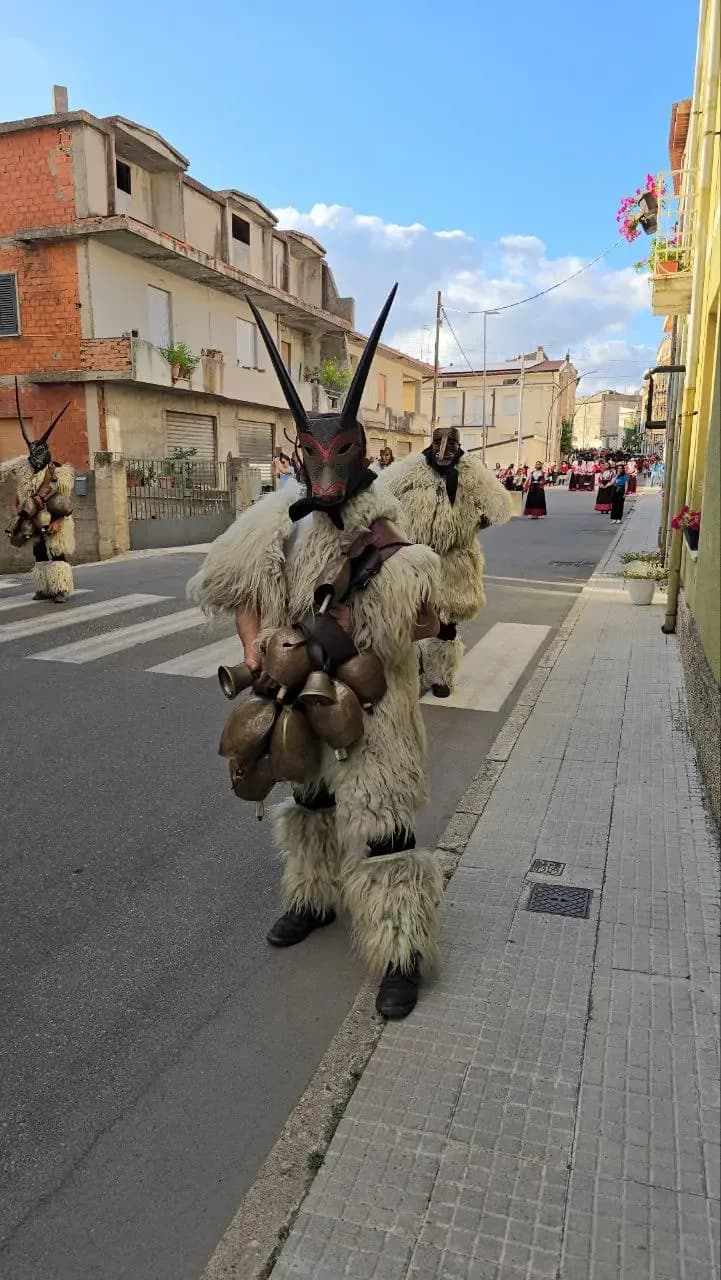
Mamoiada lights its own Sant'Antonio bonfires on 16 January, and the Mamuthones and Issohadores make their first outing of the year on 17 January. Our Mamoiada Mamuthones and carnival guide explains the masks.
How to get to Orgosolo
Driving times and distances from the Comune's travel page:
From Nuoro: about 18 km, 20 to 25 minutes, on the SS 129 towards Macomer as far as Locoe, then the SP 58.
From Olbia: about 115 km, 2 hours, on the SS 131 DCN towards Nuoro, then the Orgosolo exit and the SP 58.
From Cagliari: about 165 km, 2 hours 15 minutes, on the SS 131, then the SS 131 DCN at Abbasanta.
By bus: an ARST line links Nuoro and Orgosolo, but services are not frequent, so check the ARST timetable before you set out.
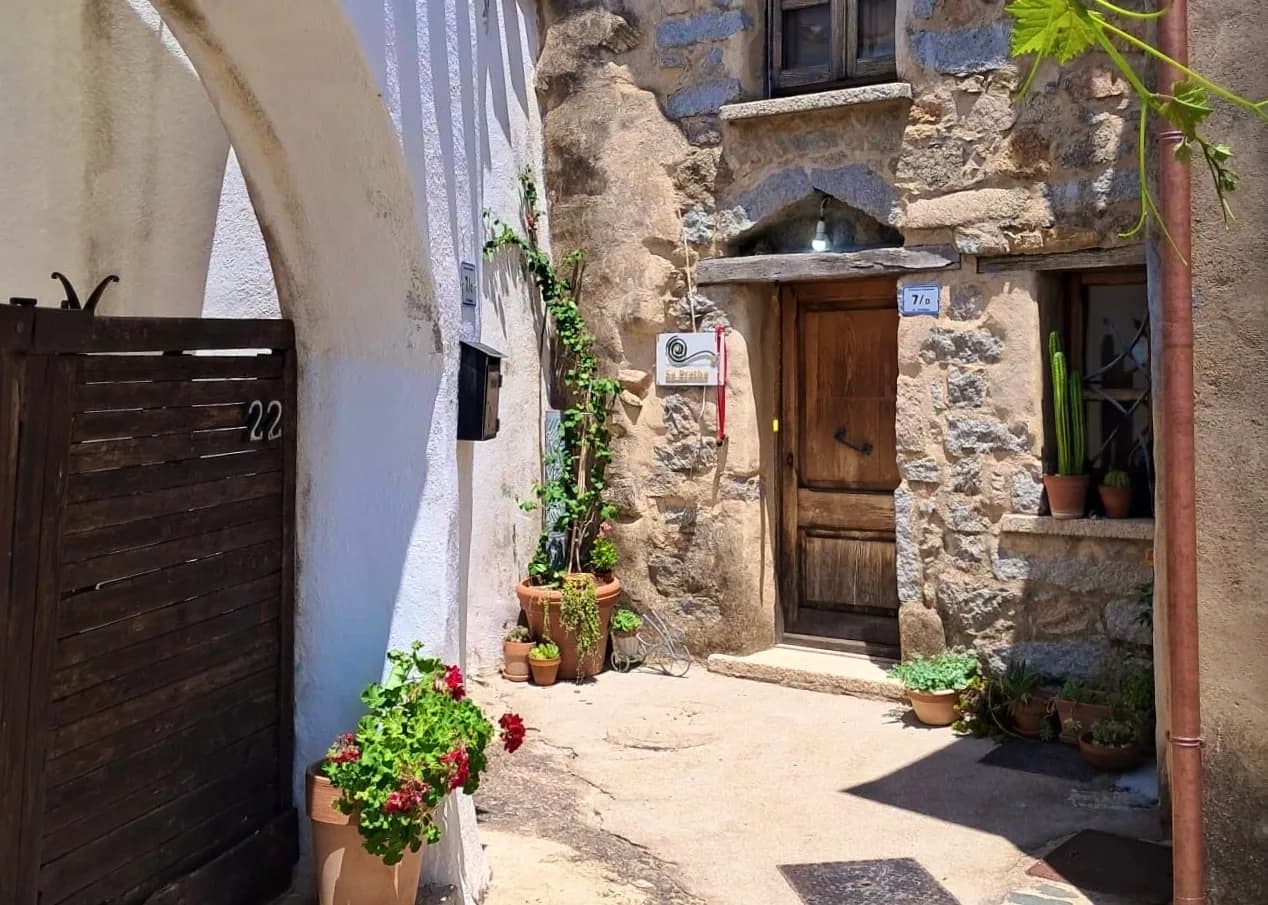
Park on the main roads and walk. Nuoro makes an easy base; our Nuoro city guide covers its museums. For an overnight stay, look for homes let directly by their owners in Orgosolo or Nuoro.
What it costs and what to eat
Walking the murals costs nothing, and the Idese portal lists free entry and parking. The guided walk is paid; the portal quotes the same price for private groups of 2 to 4 and groups of up to 20.
The portal names su polheddu, roast suckling pig, as the village dish, with local cured meats and cheeses, pane carasau, Cannonau wine and abbardente, a strong spirit. The village's food and crafts event, Gustos e Nuscos, is held in October.
What most guides get wrong
"The murals began in 1975." The Comune dates the first two to 1969 and the Gruppo Diòniso. 1975 is when Del Casino and his pupils made them a village practice.
"Del Casino was a local." He came from Siena and arrived in 1964 as a teacher.
"There are exactly 150" or "exactly 250". No one publishes a count; official sites range from about 150 to more than 250.
"Pratobello was a riot." The Comune's account stresses a peaceful occupation by about 3,000 people.
"Go for Autunno in Barbagia in November." Orgosolo's 2026 weekend was in October.
Planning a week of inland and coastal outings from one base? Rental12, a holiday-rental company in Olbia that shares an owner with Sardinia Blog, lists Nuoro and Orgosolo among eight trips in its guide Best Day Trips from Olbia. It is a company guide, not independent research.
Sources: Comune di Orgosolo, I murales di Orgosolo · Discover Orgosolo, Sulle orme della dissidenza · Ministero della Cultura, Idese · Museo delle Maschere Mediterranee · Autunno in Barbagia 2026. Checked 13 November 2026.
Photo credits: Murals of women carrying baskets in an Orgosolo lane (Sailko, CC BY 3.0, via Wikimedia Commons); Orgosolo's Twin Towers mural dated 11 September 2001 (Avisadehh, CC0 1.0, via Wikimedia Commons); painted house fronts with a poster-style mural of the film Banditi a Orgosolo (Avisadehh, CC0 1.0, via Wikimedia Commons); a cobbled lane leading to a house painted with murals on every floor (Sailko, CC BY-SA 4.0, via Wikimedia Commons); Orgosolo on its hillside with limestone mountains behind (Sailko, CC BY-SA 4.0, via Wikimedia Commons). Fact sheet and chart: Sardinia Blog, from the sources listed above.