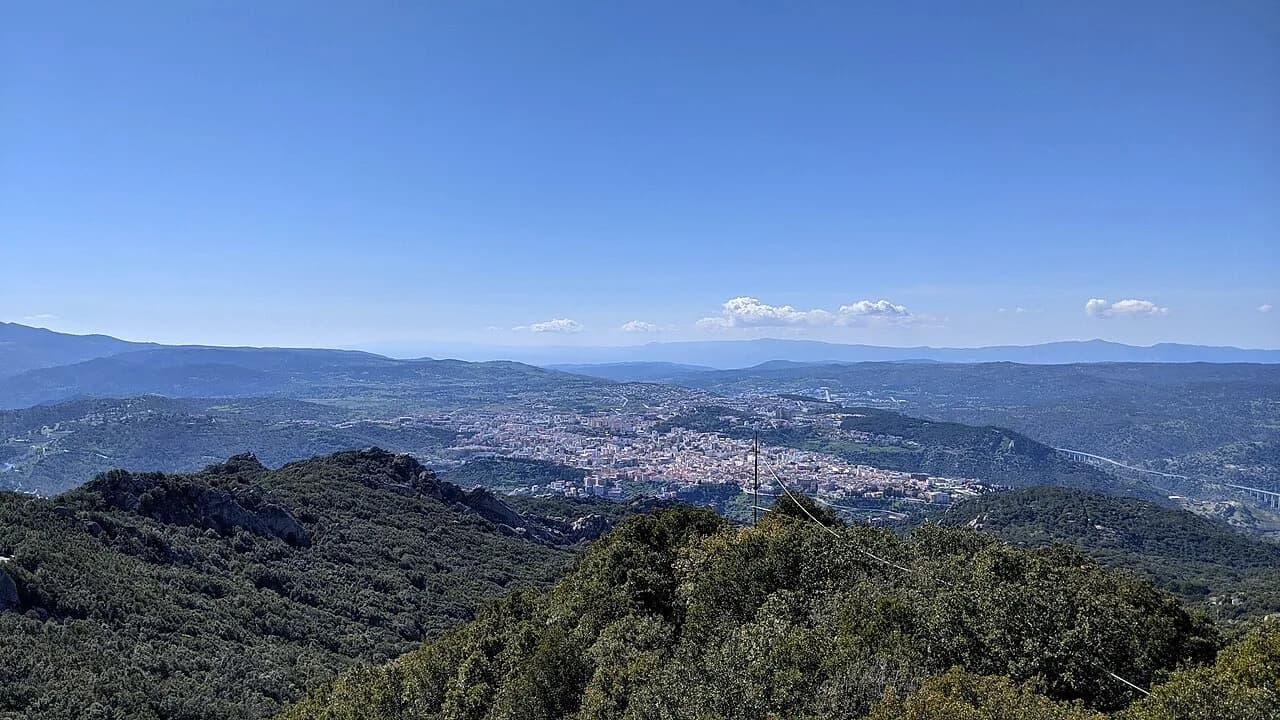
Nuoro, a provincial capital of 32,718 people in the mountains of central Sardinia, is the birthplace of Grazia Deledda, winner of the 1926 Nobel Prize in Literature, and the best base for the Barbagia villages. In one day you can see her family home, the island's largest ethnographic museum, the MAN art museum and the 7 m bronze Redentore on Monte Ortobene, whose summit reaches 955 m.
Nuoro quick facts
Population: 32,718 at 31 December 2025, a provisional ISTAT figure, down from 33,054 a year earlier.
Where: central-eastern Sardinia, about 100 km by road from Olbia airport and about 180 km from Cagliari airport.
Famous daughter: Grazia Deledda, born in Nuoro on 27 September 1871, died in Rome on 15 August 1936; the 1926 prize was presented to her in 1927.
Winter rule: from 1 November the museums of ISRE, the regional ethnographic institute, close on Mondays and from 13:00 to 15:00.
Big dates: Festa del Redentore in late August (22 to 29 August in 2026); Autunno in Barbagia in Nuoro on 14 and 15 November 2026.
Grazia Deledda's Nuoro
Start at the Museo Deleddiano, Via Grazia Deledda 42, in the old San Pietro quarter. Deledda was born here in 1871 and lived here until her marriage in 1900. The Comune bought the house back in 1968 and ISRE opened the museum on 5 March 1983. Its ten rooms on three floors were arranged partly from the descriptions in her novel Cosima, and the original Nobel diploma and medal are on show. Tickets cost €5, or €3 for under-18s and over-65s (ISRE page for the Museo Deleddiano).
In the old centre, Piazza Sebastiano Satta honours Nuoro's poet. Costantino Nivola designed it in 1967: whitewashed walls, square paving and raw granite boulders holding small bronze figures of Satta. The Deledda walking route from SardegnaTurismo takes in the Chiesa della Solitudine on Viale Ciusa, at the foot of Monte Ortobene. Deledda's remains have rested there since 1959, in a church rebuilt in the 1950s with a bronze door by Eugenio Tavolara.
Museo del Costume and the MAN
The Museo del Costume, Via A. Mereu 56, calls itself Sardinia's largest ethnographic museum. It opened in 1976 and reopened after enlargement on 19 December 2015. Ten themed rooms show more than 5,000 objects from a collection of about 8,000, including 54 traditional costumes arranged as a procession, 350 ceremonial breads and the carnival masks of Mamoiada, Ottana and Orotelli (ISRE page for the Museo del Costume). Tickets are €5 or €3; a €10 combined ticket covers it, the Deledda house and the Museo della Ceramica in Piazza su Connotu.
The MAN, the Museo d'Arte Provincia di Nuoro at Via Sebastiano Satta 27, opened in 1999. Its collection of about 850 works by Sardinian artists runs from Antonio Ballero and Francesco Ciusa to Maria Lai and Costantino Nivola, but while the building is extended the works go on show in rotation. On 31 October 2026 the current exhibitions, including Futurama and Paolo Cavinato's Hall of Mirrors, ran to 14 and 15 November 2026. Tickets cost €5, €3 for ages 18 to 25, free under 18 and on the first Sunday of the month; it is open 10:00 to 19:00 in winter and closed on Mondays (MAN tickets and hours).
Monte Ortobene, the Redentore and the cathedral
Deledda called Ortobene "our soul". The granite massif, about 1,600 hectares of holm oak and rock, rises just east of the city and its summit is 955 m (SardegnaTurismo on Ortobene). The road up passes the 17th-century churches of Nostra Signora del Monte and Valverde. At the top stands the Redentore, a bronze Christ by Vincenzo Jerace, 7 m tall and weighing 1,800 kg, raised on 29 August 1901 after Pope Leo XIII's jubilee call for statues of Christ the Redeemer on Italian summits. On a clear day the view runs from the Gennargentu to the Gulf of Orosei.
The statue is the reason for the Festa del Redentore, a week of faith and folklore that ran from 22 to 29 August in 2026 (SardegnaTurismo, Festa del Redentore 2026). The costume parade of groups from all over Sardinia was on Sunday 23 August, and on 29 August pilgrims walk about 6 km to the summit.
Back in town, the Cattedrale di Santa Maria della Neve dominates its square with four granite columns, a triangular pediment and twin bell towers. Its first stone was blessed in 1835 and the church in 1853; its feast is on 5 August. Corso Garibaldi has always been the centre of the city's social life, lined with shops and historic cafés, and at its end stands the sanctuary of Nostra Signora delle Grazie.
Is Nuoro in the Blue Zone?
Not on its own. The 2004 AKEA study by Michel Poulain, Gianni Pes and colleagues (AKEA study abstract on PubMed) looked at Sardinians born between 1880 and 1900 and found extreme longevity concentrated in the central-eastern part of the island, across the mountainous areas of central Sardinia. The sex ratio among centenarians born in that zone was 1.35, against 2.43 in the rest of Sardinia, which points to unusually long-lived men. Blue Zones' Sardinia page describes "a cluster of villages in a kidney-shaped region" and names no town. A 2006 follow-up found the highest longevity in Villagrande Strisaili, in Ogliastra. Nuoro lies within the wider area, but the village-level evidence belongs to the mountains south and east of it.
What to eat in Nuoro
Pane carasau: the crisp, paper-thin sheets listed among Sardinia's traditional food products, with the province of Nuoro named as the area of production. More in our guide to pane carasau, the shepherds' bread.
Su filindeu: durum-wheat strands pulled by hand into fine threads and dried on asphodel mats, also on the traditional products list with particular reference to the province of Nuoro. It is cooked in mutton broth with fresh soured cheese and is rarely on menus, so ask.
Culurgionis: the potato and cheese parcels you will see in Nuoro are an Ogliastra speciality, protected as Culurgionis d'Ogliastra IGP since 2016.
Day trips: Orgosolo, Mamoiada, Oliena and the Supramonte
Orgosolo, about 20 km: a village of about 4,500 people known for some 150 murals on politics, protest and pastoral life. ARST line 509 links it with Nuoro.
Mamoiada, about 16 km: home of the Mamuthones, who wear black wooden masks and about 30 kg of cowbells; their first outing of the year is on 17 January for Sant'Antonio. Its Autunno in Barbagia weekend runs from 6 to 8 November 2026. Read our Mamoiada Mamuthones carnival and travel guide.
Oliena and Su Gologone, about 12 and 20 km: ARST line 520 reaches Oliena in about 20 minutes. Beyond it, Su Gologone, Sardinia's most important spring and a natural monument since 1998, pours out an average of 500 litres a second as the main outlet of the Supramonte's karst system. Plan walks with our Supramonte walking and canyon guide.
Lollove, about ten minutes by car: Nuoro's only frazione, home to 26 people, where Deledda set her 1920 novel La madre; see our Lollove day-trip guide.
Getting there
By car: from Olbia airport it is about 100 km, roughly 1 h 30, on the SS131 DCN; from Cagliari airport about 180 km, roughly 2 h 30, on the SS131 then the SS131 DCN from Abbasanta.
By bus from Olbia: ARST line 514 runs from the airport to Nuoro's Centro Intermodale in about 2 h 30, with several direct runs a day (ARST line 514 timetable, read 31 October 2026).
By bus from Cagliari: ARST line 9342 stops at Cagliari-Elmas airport and takes about 2 h 15, with two runs a day each way on the timetable read on 31 October 2026.
By train: Nuoro is not on the Trenitalia network. A narrow-gauge ARST line to Macomer has long been the subject of conversion plans, so check ARST before relying on it; ARST buses also link Macomer and Nuoro.
When to go
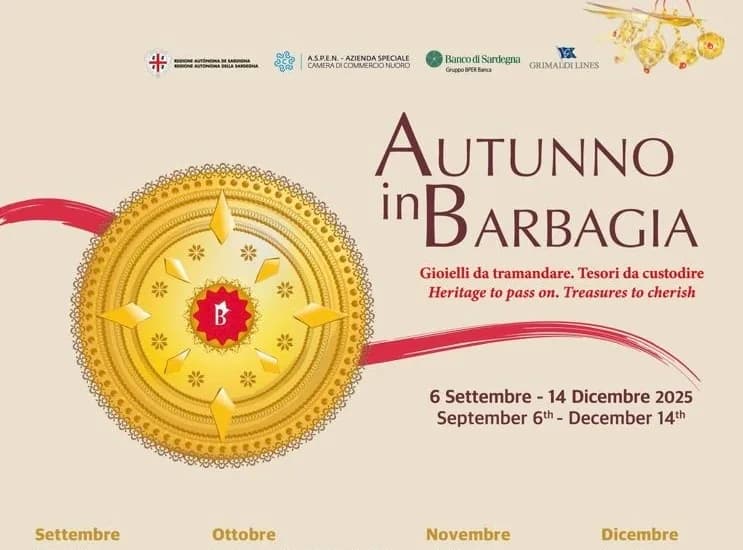
Nuoro is cooler than the coast. Our ERA5 calculation for 1991 to 2020 gives mean highs of about 30 °C in July and August and mean lows of about 3 °C in January and February. Late August brings the Redentore. Autumn is the season for Autunno in Barbagia, which runs from 5 September to 13 December 2026; Nuoro's own weekend is 14 and 15 November (official Autunno in Barbagia 2026 calendar). See what is planned in our Autunno in Barbagia Nuoro 2026 listing.
Local tips: what most guides get wrong
Winter hours start on 1 November. The Deledda house and the Museo del Costume then open 10:00 to 13:00 and 15:00 to 19:00, closed Mondays, until 15 March; the MAN is also closed on Mondays.
The first Sunday of the month is free at the ISRE museums and at the MAN.
Deledda's Nobel is the 1926 prize, but it was presented to her a year later, in 1927; both dates appear in guides and both are right.
The costume parade is not always on the last Sunday of August. In 2026 it was on 23 August, while the summit procession stays on 29 August.
Watch for ZTL cameras. Nuoro is on the transport ministry's January 2026 list of towns authorised to fine by camera, so park outside the old centre.
If the longevity story is what draws you inland, read the wider background before you drive south. Rental12, a holiday-rental company in Olbia that shares an owner with Sardinia Blog, covers the Blue Zone more broadly, with a focus on Ogliastra villages rather than Nuoro, in Sardinia Blue Zone Guide 2026: Why Sardinians Live Longest. It is a company guide, not independent research.
Sources: ISRE, Museo Deleddiano · ISRE, Museo del Costume · MAN Nuoro · SardegnaTurismo, Deledda route · SardegnaTurismo, Ortobene · SardegnaTurismo, Festa del Redentore · Poulain et al. 2004, Experimental Gerontology · Blue Zones · Autunno in Barbagia, ASPEN Nuoro · ARST
Photo credits: Nuoro seen from Monte Ortobene, near the Redentore statue (Paola Asproni, CC BY-SA 4.0, via Wikimedia Commons); Grazia Deledda's birthplace in Via Grazia Deledda, now the Museo Deleddiano (Sailko, CC BY 3.0, via Wikimedia Commons); Murals of village women painted on the stone walls of a lane in Orgosolo, about 20 km from Nuoro (Sailko, CC BY 3.0, via Wikimedia Commons); Vincenzo Jerace's bronze Redentore, raised on Monte Ortobene in 1901, at the top of the summit steps (Sailko, CC BY 3.0, via Wikimedia Commons); The Chiesa della Solitudine in Nuoro, where Grazia Deledda has been buried since 1959 (Sailko, CC BY 3.0, via Wikimedia Commons). Fact sheet and chart: Sardinia Blog, from the sources listed above.