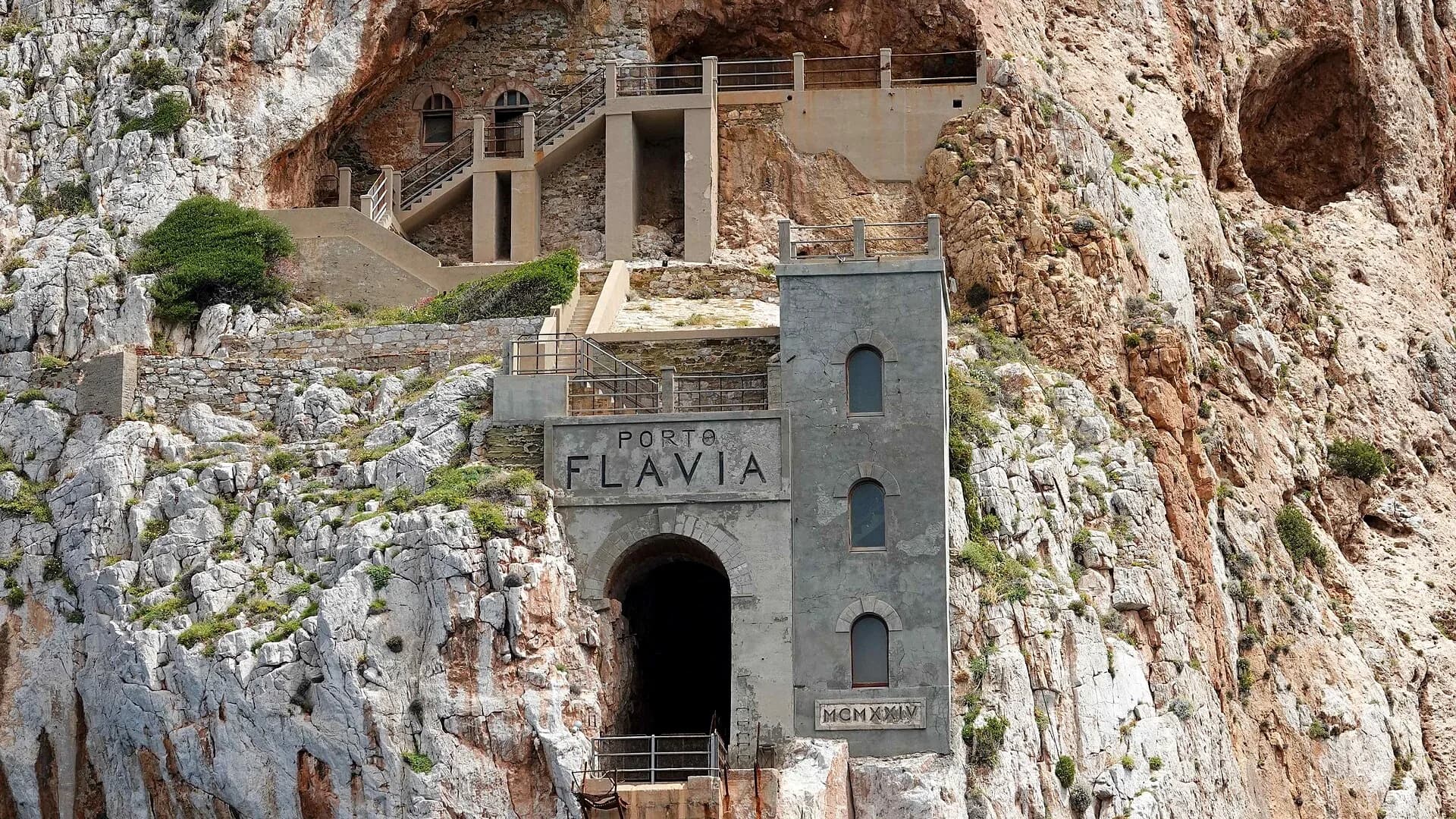
Porto Flavia is a 1924 ore-loading port cut into the limestone cliffs at Masua, near Iglesias in south-west Sardinia, where two stacked tunnels and nine silos fed lead and zinc straight into the holds of waiting ships. Today the Comune di Iglesias runs 50-minute guided tours that cost €13 for adults, and the tunnel ends on a balcony facing Pan di Zucchero, a 133-metre sea stack.
Porto Flavia quick facts
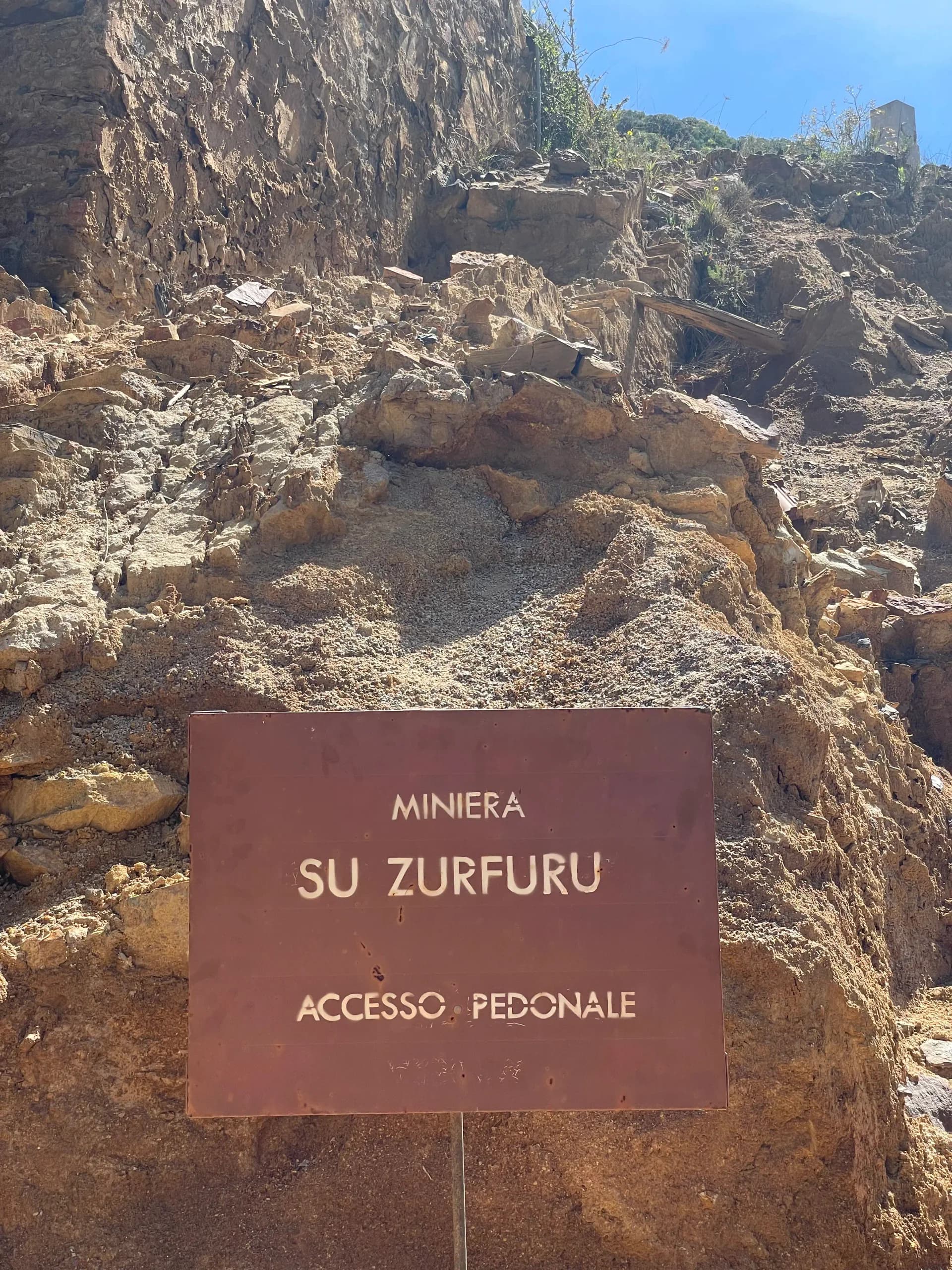
What it is: a mining port, not a mine. It shipped ore from the Masua mines and the mines around them.
Built: tunnels dug between 1922 and 1924, designed by engineer Cesare Vecelli and named after his eldest daughter, Flavia.
Storage: nine silos between the two tunnels held up to 10,000 tonnes of ore.
In use until: the 1960s.
Tour: about 50 minutes, a 600-metre upper tunnel, then 108 steps down to the 100-metre lower tunnel.
Price (as listed on 25 October 2026): €13 full, €8 reduced, free under 6 with a ticket.
Run by: the Comune di Iglesias, with timed, capped guided tours.
What Porto Flavia is and why it was built
Mining at Masua began in the mid-19th century, and the concession went to the Società di Montesanto in 1859. By the end of that century the mine employed more than 700 workers. In 1922 the Belgian company Vieille Montagne revived the mine.
The problem was shipping. Ore was loaded by hand onto small sailing boats, the bilancelle, and carried to Carloforte on the island of San Pietro, where large cargo ships collected it. Vecelli's answer was to bring the ships to the cliff.
He had two tunnels dug one above the other inside the headland. Trains from the mines ran through the upper tunnel and tipped the ore into nine silos. From the lower tunnel, a retractable conveyor belt on a movable arm reached out over the sea and loaded the lead and zinc straight into steamships moored below. According to Sardegna Turismo's Masua and Porto Flavia page, this cut the time and cost of getting ore to the foundries of northern Europe.
The medieval-looking tower at the tunnel mouth carries Flavia's name. Porto Flavia worked until the 1960s, when mining in the area wound down. It was restored in the 2000s, and the lower level, where the hoppers emptied onto the conveyor, reopened to guided tours in May 2022 after maintenance work.
Who runs the tours and how to book
The site is lent by IGEA, the mining company controlled by the Sardinian Region, and the Comune di Iglesias has managed it since 2017 under a free loan-for-use agreement, according to the Comune's 2022 regulation for the Porto Flavia site. Tickets are sold by the town's tourism service on the official Porto Flavia page at Iglesias Turismo.
There are three ways to buy:
Online, on the Iglesias Turismo page (up to 30 people per order).
At the tourist office, Piazza Municipio 1, Iglesias.
At the ticket office at Porto Flavia itself.
Prices listed on 25 October 2026:
Full: €13
Reduced: €8 for ages 6 to 12 and over-65s, and for Cammino di Santa Barbara pilgrims with credentials
Groups of at least 20 adults: €10 each
Schools: €8, not sold online
Under 6: free, but they still need a ticket
Visits run in hourly slots with capped numbers. On 25 October 2026 the booking calendar showed six slots a day, starting at 10:00, 11:00, 12:00, 14:00, 15:00 and 16:00, with up to 80 places each, and dates bookable until 13 November. The Comune lists English-language tours at 11:00, 12:00, 14:00, 16:00 and 17:00, so check which ones run on your date. You can change the time after buying. Arrive 15 minutes early: latecomers are not admitted and are not refunded.
What the tour is like
The visit lasts about 50 minutes. You walk the upper tunnel first, about 600 metres on a fairly even dirt floor. A staircase of 108 steps then leads down to the lower tunnel, about 100 metres long, which opens onto the sea. You come back the same way, so count the steps twice.
The official visitor rules:
Closed, comfortable shoes are compulsory. Flip-flops, heels and swimwear are not allowed.
The stairs are not recommended for pregnant women or people with heart or mobility problems.
The upper tunnel can be visited by people with reduced mobility with a companion, assessed case by case.
Babies under one must be carried in a front baby carrier, and staff provide a small protective helmet.
No pets.
The view of Pan di Zucchero
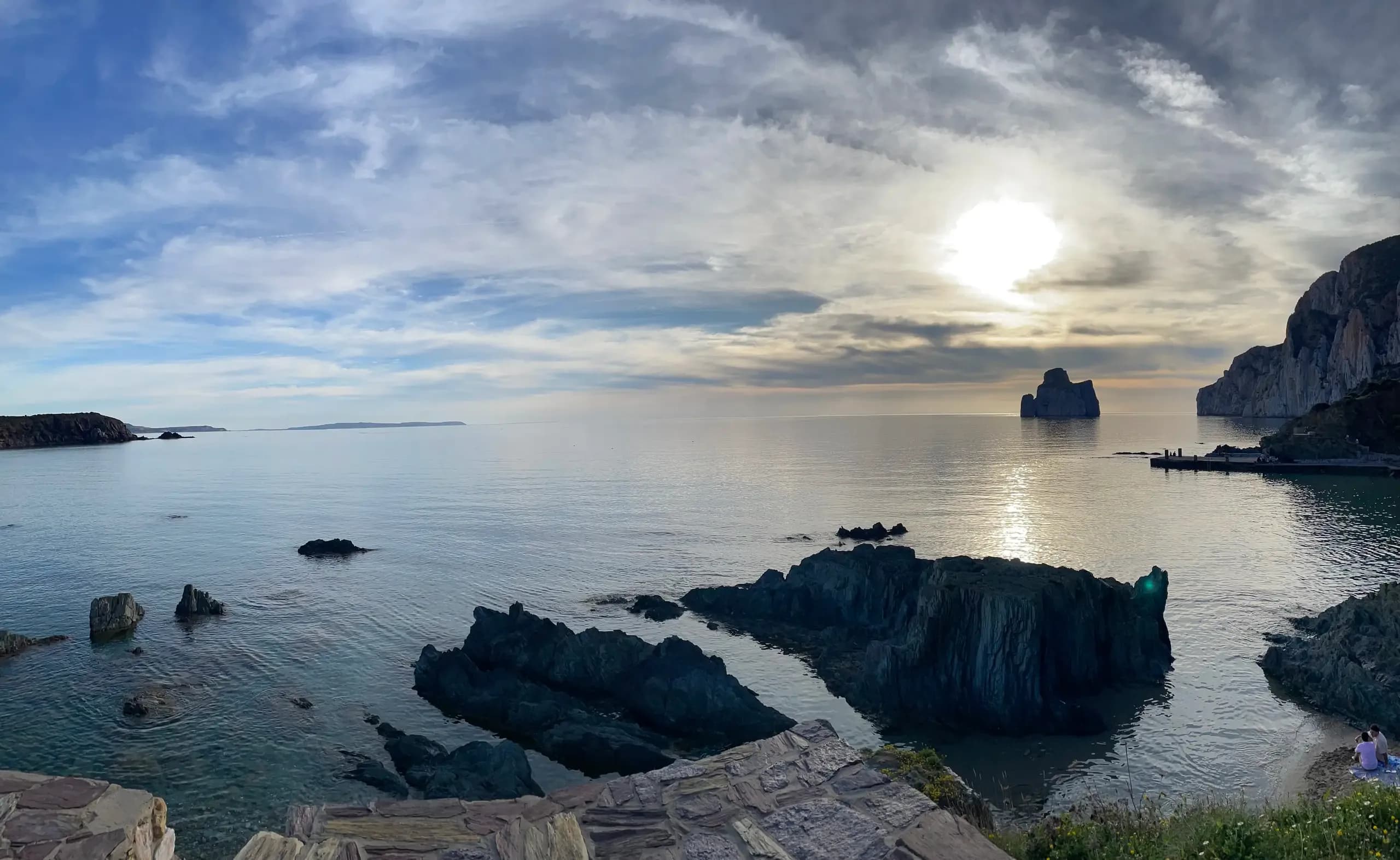
The tour ends on the sea balcony facing Pan di Zucchero, which the Comune describes as the highest sea stack in the Mediterranean at 133 metres (Sardegna Turismo gives 132). Until the 18th century it was known by the Sardinian name Concali su Terràinu. It and the three smaller stacks beside it are made of almost pure Cambrian limestone.
You can also see it for free from Masua beach or from a boat, and climbers scale it with specialist guides. For more on the rock itself, read our story on Pan di Zucchero, Masua's white sea stack.
How to get to Porto Flavia
You need a car, or a tour that includes transport. The Comune's directions: take the SS130 to Iglesias, then the SS126 towards Gonnesa, and shortly before Gonnesa turn onto the SP83, following signs for Masua and Porto Flavia. From the small free car park it is about 200 metres on foot to the ticket office.
From Iglesias: about 21 km, roughly 35 to 40 minutes by road.
From Cagliari: about 78 km, around an hour and a half. Iglesias is about 40 minutes from Cagliari-Elmas airport.
By train: Iglesias has a station with trains from Cagliari, but Porto Flavia is still about 21 km away by road, so you need a car or taxi for the last stretch.
The ticket form also lists a "Porto Flavia + bus" combined ticket, but it could not be booked when we checked on 25 October 2026. Treat it as a possible seasonal option and check before you plan around it.
Porto Flavia visitor numbers: why booking ahead matters
Visitor numbers more than tripled between 2015 and 2022. The Comune counted 19,756 visitors in 2015 and 31,097 in 2018. In 2021 the figure was 40,212, and in 2022 it reached 63,825, a 59% rise in a year. Outside summer, April 2018 alone brought 4,415 visitors and October 2,298.
Entry is capped for safety reasons, and the Comune strongly recommends buying in advance. Book online a few days ahead, especially for spring and summer dates.
What most guides get wrong
"Porto Flavia mine". The Comune is clear that it is not and never was a mine. It was a port for ore dug elsewhere.
"A UNESCO World Heritage Site". Neither Porto Flavia nor the Parco Geominerario is on the World Heritage list. The Parco Geominerario's own history page says a 1997 UNESCO recognition later lapsed. The park, founded by ministerial decree in 2001, joined the UNESCO-backed Geoparks network in 2007 and was later removed from the UNESCO Global Geoparks network in September 2019, ANSA reported.
Old prices. Older pages, including a 2017 Comune notice, quote €10. The official page listed €13 in October 2026.
Parking. The English version of the official page mentions a "parking fee", but the Italian original says the small car park is free.
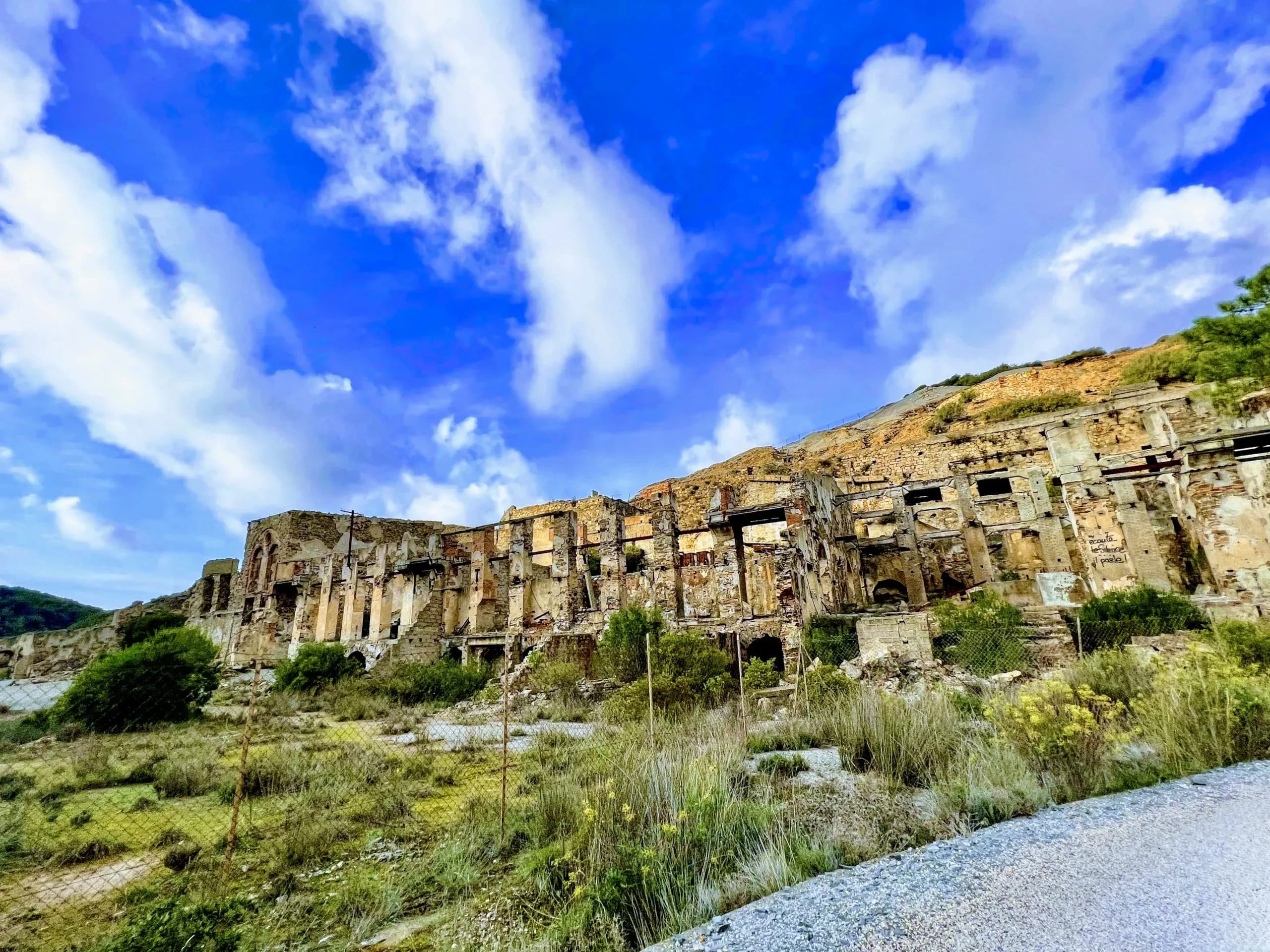
Laveria Lamarmora. Many itineraries send you inside. The Comune's Laveria Lamarmora page says it is currently closed for safety work, so view it from the road.
Combine Porto Flavia with Nebida, Masua beach, Buggerru and Cala Domestica
A full day on this coast can take in several more mining sites and beaches.
Masua beach (Il Molo): a small crescent of fine golden sand, nicknamed after the old concrete mine pier at its north end, with Pan di Zucchero offshore.
Laveria Lamarmora, Nebida: about 7 km south. The ruined ore-washing plant, where mostly women sorted lead and zinc ore from waste rock, overlooks the sea at Nebida. In 1919 Nebida had 3,000 residents, a third of them working in the mine, which closed in the 1970s.
Galleria Henry, Buggerru: about 20 km north. This tunnel was dug in the last three decades of the 19th century. On the Sardegna Turismo Galleria Henry page, visits are by booking only: an electric train out along the old steam railway, a walk back, and a final view 50 metres above the sea.
Cala Domestica: about 14 km north, 2 km south of Buggerru. A mining tunnel leads from the main cove to the smaller La Caletta, and minerals were shipped from here until 1940, according to Sardegna Turismo's Cala Domestica guide.
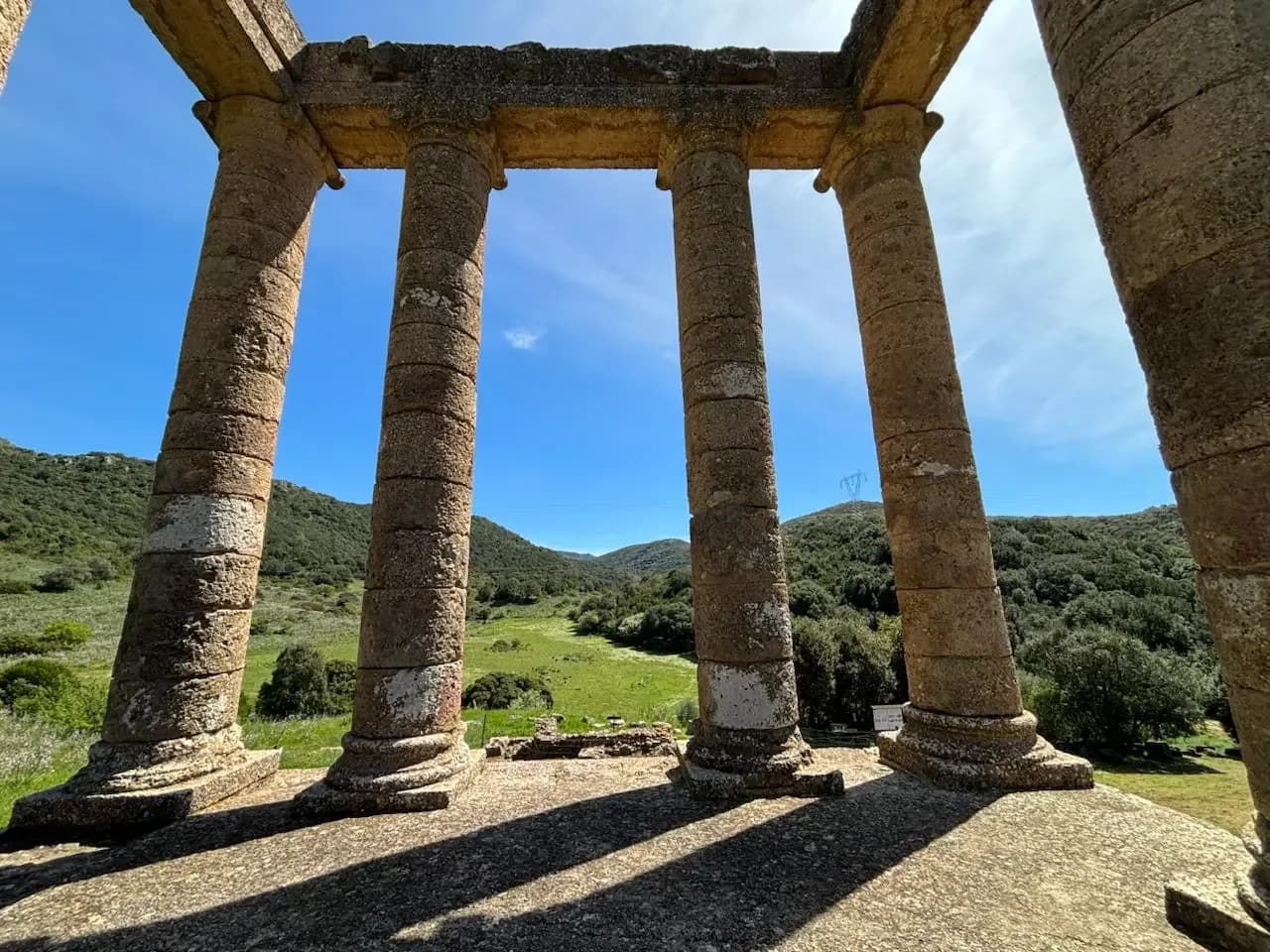
Inland, you can add the Temple of Antas near Fluminimaggiore. For a two-day route through the old mine villages, see our guide to Sardinia's abandoned mines and coast, and further up the west coast, the Piscinas dunes and Montevecchio mines.
Local tips
Book the slot first, then plan the beach. Late arrival means no visit and no refund.
Pack trainers even in August. Closed shoes are compulsory, and sandals or flip-flops are not allowed.
Stay on for sunset. The Comune recommends the view from the coast at dusk, when the light behind Pan di Zucchero turns yellow and orange.
Sources: Iglesias Turismo, Porto Flavia · Comune di Iglesias, Porto Flavia regulation (2022) · Comune di Iglesias, visitors 2015 to 2018 · Comune di Iglesias, visitors 2021 and 2022 · Sardegna Turismo, Masua and Porto Flavia · Parco Geominerario, Chi siamo · ANSA, 24 September 2019 · Iglesias Turismo, Laveria Lamarmora · Sardegna Turismo, Galleria Henry · Sardegna Turismo, Cala Domestica
Photo credits: The sea-facing tower of Porto Flavia, dated MCMXXIV (1924), where the lower loading tunnel opens onto the cliff at Masua (DeeJay05, CC BY-SA 4.0, via Wikimedia Commons); Dusk over the bay of Masua, with the abandoned mine plant in the foreground, Pan di Zucchero offshore and the cliffs that hold Porto Flavia on the right (DeeJay05, CC BY-SA 4.0, via Wikimedia Commons); The gravel terrace by the Porto Flavia ticket office, looking out to Pan di Zucchero (Allie_Caulfield, CC BY 2.0, via Wikimedia Commons); The landward entrance to the Porto Flavia tunnels, where guided tours begin, with an old mine locomotive on display (DeeJay05, CC BY-SA 4.0, via Wikimedia Commons); The ruins and chimney of the Laveria Lamarmora above the sea at Nebida, with Pan di Zucchero on the horizon (Mboesch, CC BY-SA 4.0, via Wikimedia Commons). Fact sheet and chart: Sardinia Blog, from the sources listed above.
Porto Flavia is hard to reach without a car. Rental12, a holiday-rental company based in Olbia, explains when a car is worth it and when buses or trains will do in Do I need a car in Sardinia?. It is a company guide, not independent research.