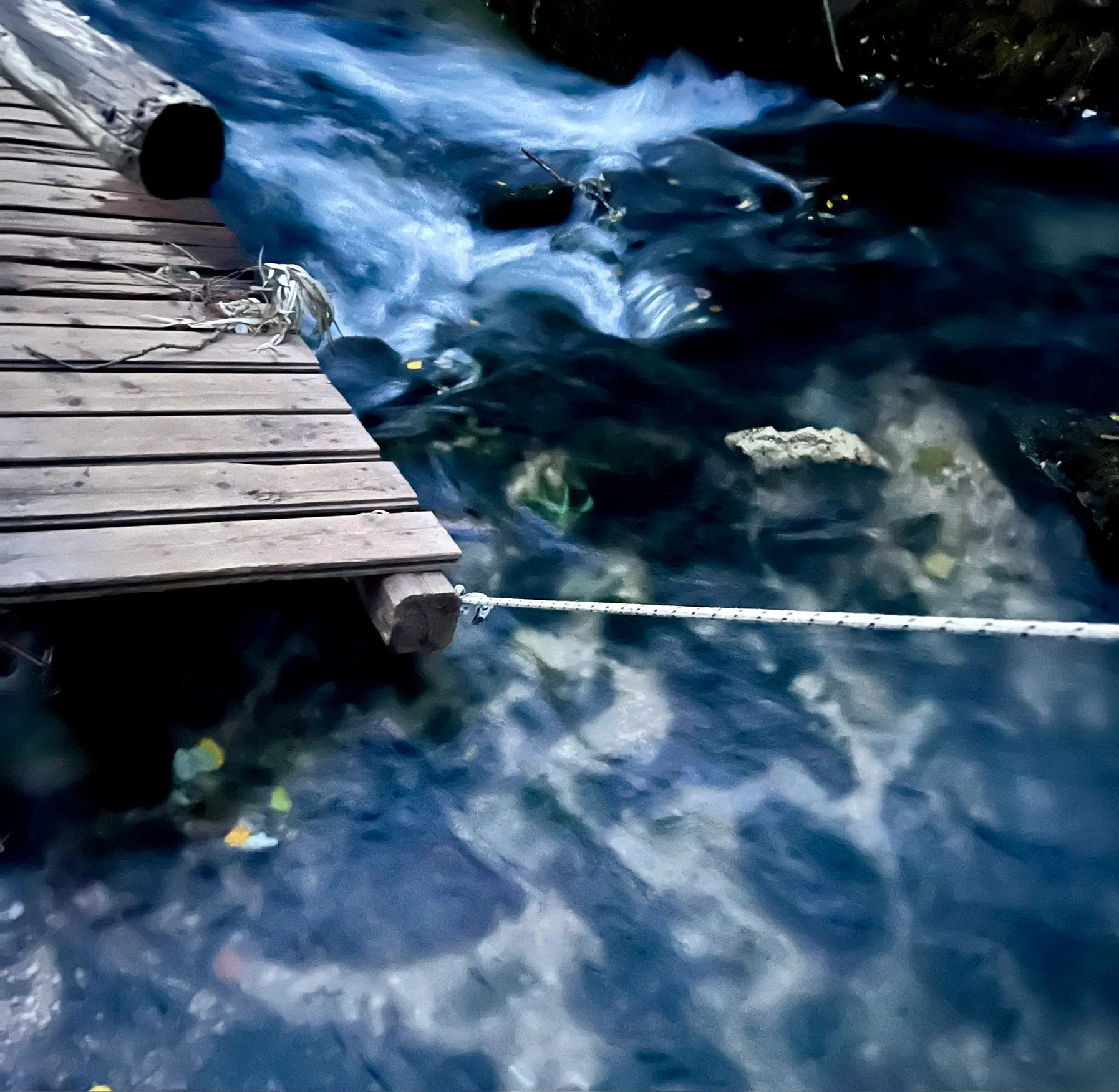

Su Gologone is a karst spring in the territory of Oliena, in the Supramonte mountains of central-east Sardinia, and it has been a protected natural monument of the Sardinian Region since 1998. Cave divers have followed its flooded shaft down to 135 metres without reaching the bottom. A well-known hotel-restaurant on the same road carries the same name, but it is a separate place.
- What it is: the main outflow of the Supramonte karst system, a small blue-green pool at the foot of Monte Uddè.
- Where: comune of Oliena, province of Nuoro, about 6 km along the SP46 Oliena to Dorgali road, then a signposted turn.
- Cost: the operator lists 2 euro full price and 1.50 euro reduced, with free parking.
- Next door: the Valle di Lanaittu, about 7 km away, leads to Tiscali and Sa Sedda 'e sos Carros.
- Winter: Tiscali is listed as open 9:00 to 17:00 from October to April, 6 euro, cash only.
The spring and the hotel are two different places
The spring is owned by the comune of Oliena. The Region made it a natural monument by decree no. 845 of 12 May 1998, according to the Ministry of Culture's Idese heritage record for Su Gologone. A local company, Le Fonti, holds the concession to look after, monitor and clean the site, and it runs the park beside the pool.
The Su Gologone hotel and restaurant stands on the same access road, and official directions to Lanaittu tell drivers to pass it and carry on to the spring. When a map app or an AI assistant answers "Su Gologone", check which one it means.
What you see at Su Gologone spring
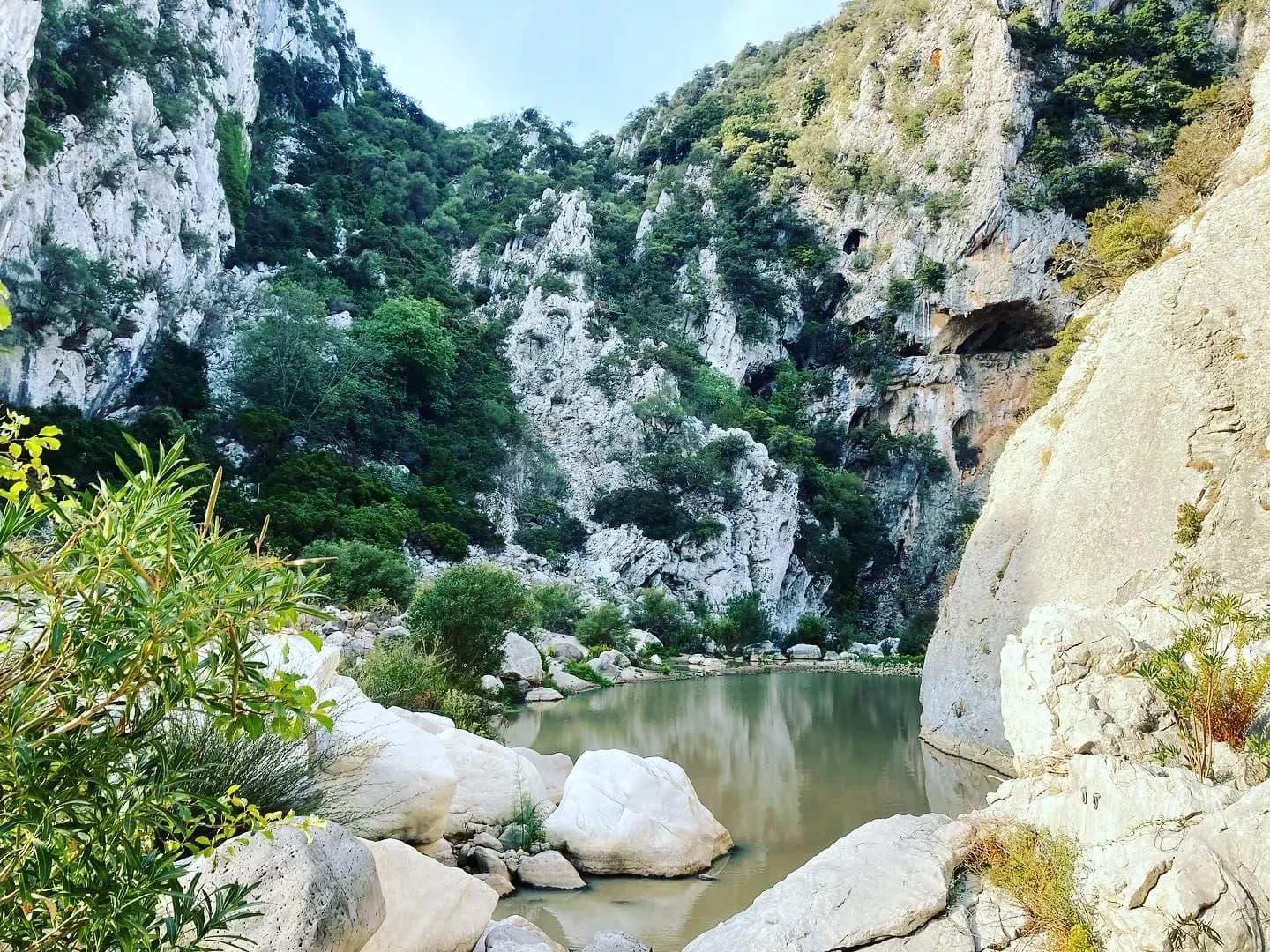
Water rises from a cleft in dolomitic limestone and fills a narrow pool between two rock walls. SardegnaTurismo, the Region's tourism site, calls it the most important spring in Sardinia and the main resurgence of the Supramonte karst system. The underground river that feeds it flows from the uplands of Orgosolo and Urzulei through the Su Bentu cave.
- Flow: SardegnaTurismo gives an average of 500 litres a second. ISPRA, the national environment institute, lists about 250, and 60 to 70 in dry spells. In big floods it can pass 10,000 litres a second.
- Depth: in 2010 the Italian cave diver Alberto Cavedon reached 135 metres. The operator says he could go no further, and Idese says the full depth is still unknown.
- Where the water goes: a short stream leaves the pool and joins the Cedrino, which SardegnaTurismo describes as Sardinia's fifth longest river.
- The walk: Idese lists a 250 metre signposted path from the car park, easy, at about 100 metres above sea level.
- The park: a eucalyptus wood with picnic tables, a children's play area and a kiosk bar. The country church of Nostra Signora della Pietà is a few steps away.
Swimming in the spring is forbidden under the park rules.
Su Gologone in winter: hours, tickets and what is closed
The spring is listed as open every day from 9:00 to 20:00 on Italia.it and in ISPRA's register. Neither listing is dated, so we could not confirm winter 2026/27 hours. Call the operator on +39 328 5649983 before a winter visit.
The operator's park page sets the ticket at 2 euro full price and 1.50 euro reduced, valid for the whole day in the park. The car park at the entrance is free. That page is undated, so treat the price as indicative. Kayak hire for the Cedrino canyon runs only from April to early September, so it is not available in winter.
Wild boar hunting is open until 31 January 2027 on Thursdays, Sundays and weekday public holidays, under the Region's 2026/27 hunting calendar. Walkers in the Supramonte on those days should wear bright colours.
Winter days are cool and nights are cold. In NASA's modelled climate data for the area around Oliena, December averages a high of 11.9°C and a low of 4.9°C over 1991 to 2020. January has the lowest average high, 11.0°C, and February the lowest average low, 3.2°C. November is the wettest month, with about 76 mm of rain. Our December weather guide for Barbagia and the Nuorese has more detail.
SardegnaTurismo notes that after heavy rain water pours out of the Sa Oche cave and floods the Lanaittu valley. Check the forecast before driving the dirt road.
Valle di Lanaittu: caves and Sa Sedda 'e sos Carros
The Valle di Lanaittu (also spelt Lanaitto or Lanaitho) begins about 7 km from the spring and lies across the territories of Oliena and Dorgali. The road in is mostly unsurfaced. Idese says it can still be driven as far as Sa Sedda 'e sos Carros.
- Parking: SardegnaTurismo directs drivers to a car park by the "Rifugio", the caving society's house, where paths to Sa Oche and Sa Sedda 'e sos Carros start.
- Sa Oche cave: the entrance opens at 150 metres above sea level, and the cave runs for about 400 metres, with three lakes. Entry is paid.
- Su Bentu cave: about 16 km of passages on several levels, open to experienced cavers only.
Sa Sedda 'e sos Carros is a late Nuragic village at about 300 metres, on the slopes of Monte Uddè, dated to the 12th to 9th centuries BC. Its best-known room is a round water shrine of white limestone and dark basalt, with carved mouflon heads that spouted water into a basin. Entry is paid and the access is rated easy. A local cooperative runs the site, but we found no published winter 2026/27 hours, so ask in Oliena before you go.
Walking to Tiscali in winter
Tiscali is a Nuragic village hidden inside a collapsed sinkhole on the summit of Monte Tiscali, at about 500 metres. Sardegna Cultura describes two groups of huts, about forty on the north side and about thirty on the south-west side.
SardegnaTurismo allows two hours for the climb, one hour for the visit and an hour and a half for the descent. Paths go up from the Oliena side and from the Dorgali side. Idese rates the route difficult and advises going in a group or with a local guide.
The Dorgali archaeological museum, which manages Tiscali through the Ghivine cooperative, lists these hours and prices:
- October to December: 9:00 to 17:00.
- January to April: 9:00 to 17:00.
- May to September: 9:00 to 19:00.
- Tickets: 6 euro full, 3 euro reduced, 4 euro per person in groups.
- Payment: cash only at the entrance, as the site has no card payment service.
That is about four and a half hours in all, so on a winter day start walking in the morning. The page names no year, so confirm before you set out. For the wider area, read our guide to walking and exploring the Supramonte, and our account of the Gorropu canyon on the Dorgali side.
Oliena: the village under Monte Corrasi
Oliena lies about 10 km from Nuoro, at the foot of Monte Corrasi. At 1,463 metres, Corrasi is the highest peak of the Supramonte. The village holds the Touring Club Italiano's Orange Flag, an award for inland towns. SardegnaTurismo names its embroidered silk scarves, its filigree jewellery and its carved wooden chests for carasau bread among its crafts.
Nepente is Oliena's red wine, made from Cannonau grapes. "Oliena" or "Nepente di Oliena" is one of three official subzones of the Cannonau di Sardegna DOC. The poet Gabriele D'Annunzio praised it in writing. Wines from Oliena were among those recognised in the latest Gambero Rosso guide, as we reported in Mamoiada and Oliena wines in the Gambero Rosso 2027 guide.
Oliena's best-known rite is S'Incontru, on Easter Sunday morning. Two processions, one with the statue of the Madonna in mourning and one with the risen Christ, meet in Piazza Santa Maria. Hundreds of riflemen fire blanks into the air as the two meet. The bearers then bow the statue of Christ before his Mother. Easter Sunday falls on 28 March 2027, but no 2027 programme has been published yet.
How to get to Su Gologone
- From Nuoro: take the SP22 to Oliena, about 10 km. Our Nuoro city guide covers the town itself.
- From Oliena: follow the SP46 towards Dorgali for about 6 km, turn right at the signs for the spring, and drive on to the car park at the park entrance.
- From Dorgali: take the SP46 towards Oliena and turn left at the signposted junction for the spring.
- From Olbia: take the main road south towards Nuoro, leave at the junction for Dorgali and Oliena, follow the signs for Oliena, and turn left for the spring before reaching the village.
- Public transport: we could not confirm any bus to the spring or to Lanaittu, so plan on driving.
What most guides get wrong
- Hotel versus spring. Su Gologone is first a natural monument owned by the comune of Oliena. The hotel of the same name is a separate business on the access road.
- Tiscali is not in Oliena. Idese and Sardegna Cultura file it under Dorgali, whose museum runs it. The usual approach through Oliena's Lanaittu valley causes the confusion.
- Tiscali is not a nuraghe. It is a village of huts inside a sinkhole, with no stone tower.
- 135 metres is not the bottom. It is the deepest point a diver reached, in 2010.
- The flow figure varies. Official sources give averages from about 250 to 500 litres a second, so a single precise number is misleading.
Planning food and wine around a Supramonte walk? Rental12, a holiday-rental company in Olbia that shares an owner with Sardinia Blog, names Oliena among the Cannonau heartlands in Sardinian Food: Traditional Dishes, Blue Zone Diet & Wine; the page covers Sardinian food more broadly and does not cover Su Gologone itself. It is a company guide, not independent research.
Photo credits: Su Gologone pool, Gianni Careddu (CC BY-SA 4.0); Su Gologone water, Aggrucar (CC BY-SA 4.0); Valle di Lanaittu and Tiscali juniper, FrancescaEA (CC BY-SA 4.0); Oliena under Monte Corrasi, trolvag (CC BY-SA 3.0); all via Wikimedia Commons. Fact sheet and chart: Sardinia Blog, from the sources listed below.
Sources: SardegnaTurismo, Su Gologone · Idese, Su Gologone · Le Fonti, Sorgenti di Su Gologone park · Museo archeologico di Dorgali, Tiscali · Sardegna Cultura, Village of Tiscali · SardegnaTurismo, Valley of Lanaitto · Idese, Sa Sedda 'e sos Carros · SardegnaTurismo, Oliena · Idese, S'Incontru · Regione Sardegna, hunting calendar 2026/27 (ANLC copy)