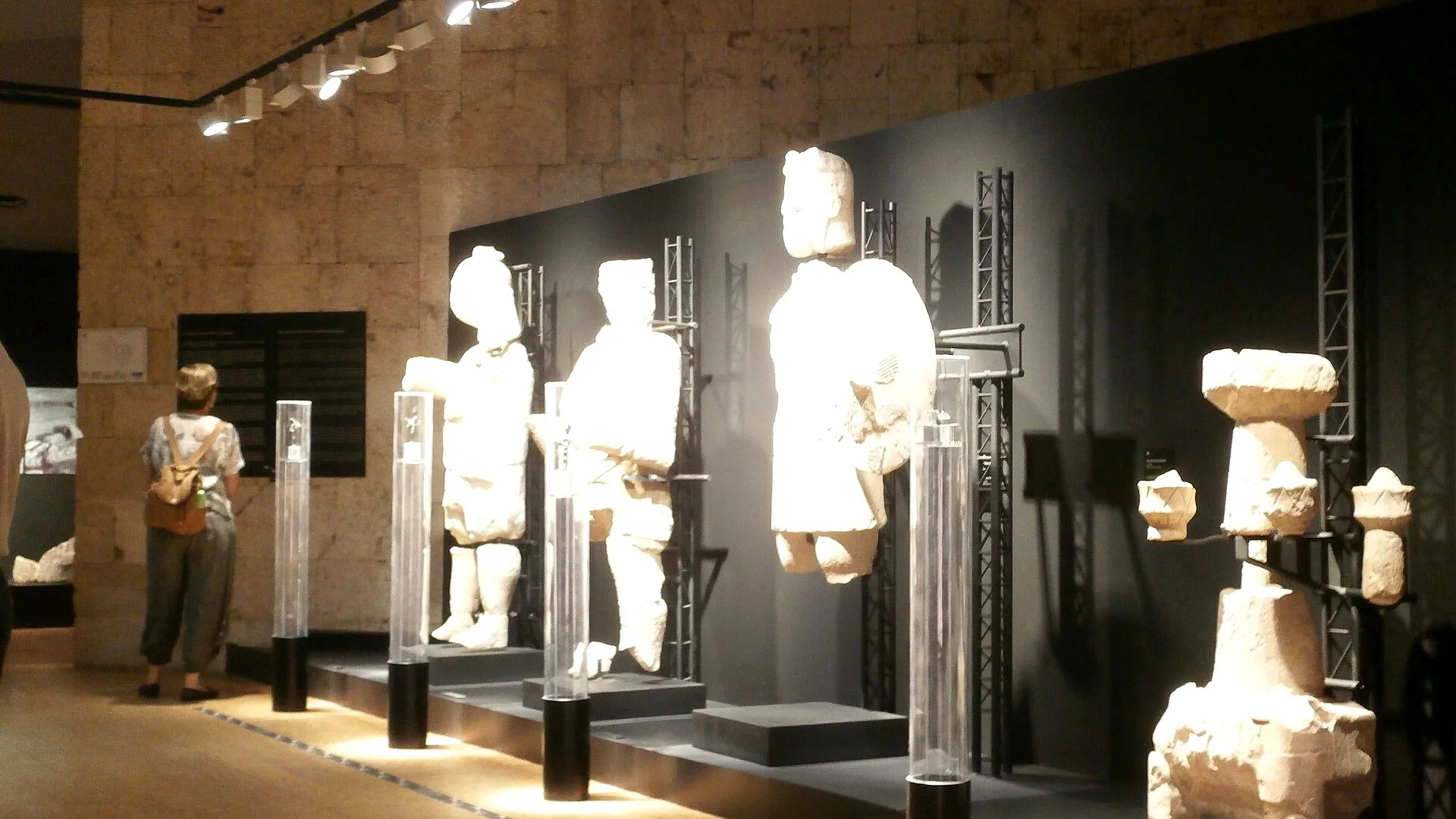

The giants of Sardinia are limestone statues, about two metres tall, of boxers, archers and warriors, carved by the Nuragic people for a burial ground at Mont'e Prama, near Cabras, and found by farmers in 1974. Since 5 April 2026 the whole group, which the Fondazione Mont'e Prama counts as 25 statues, 15 model nuraghi and one betyl, is shown together for the first time at the Museo Civico Giovanni Marongiu in Cabras. A full ticket costs €10 in 2026.
What: Iron Age stone statues of boxers, archers and warriors, plus models of nuraghi, from a Nuragic necropolis.
Size: 185 to 200 cm tall, according to the Fondazione Mont'e Prama.
Found: spring 1974, by two farmers ploughing a field on the hill of Mont'e Prama, Cabras.
Date: most researchers place them between the end of the 9th and the first half of the 8th century BC; the Ministry of Culture gives 900 to 700 BC.
Where now: all of them in Cabras since April 2026, not split with Cagliari any more.
Cost (2026): €10 museum, €13 museum plus Tharros.
What are the giants of Mont'e Prama?
The statues come from a Nuragic necropolis on a low limestone hill in the Sinis peninsula, west of the Cabras lagoon. They stood along a straight funerary road lined with single tombs.
Most figures are boxers, with a glove on one forearm and a shield held over the head. There are also archers with a bow over the shoulder and warriors with round shields. The faces share the same style: a flat brow and large eyes carved as two concentric circles.
Alongside them are stone models of nuraghi, the island's Bronze Age towers, and betyls, conical sacred stones.
The Ministry of Culture's Cagliari museum calls them the only Nuragic stone statues found in Sardinia so far and "among the oldest groups of statuary from the Mediterranean area". It also calls the nickname incorrect: at about two metres they are tall, not giant.
How many statues are there?
There is no single number, because fragments are still being matched and new pieces keep emerging. Each source counts something different:
Ministry of Culture (Cagliari museum page): more than 5,000 fragments from the 1970s digs, reassembled into 38 statues by 2014.
Fondazione Mont'e Prama, restoration page: about 5,200 limestone fragments weighing over 10 tonnes, and 44 restored sculptures plus numerous betyls.
Piroddi and colleagues, Remote Sensing (2020): 28 statues and 16 nuraghe models and betyls from over 5,000 fragments.
Fondazione Mont'e Prama, April 2026: 25 statues, 15 nuraghe models and one betyl, 40 pieces in the reunited display.
In 2023 the foundation said experts expected the group to pass 75 statues as restoration and digging continue.
Discovery and excavations, from 1974 to today
The Fondazione Mont'e Prama's page on the first excavation campaigns sets out the early digs.
1974: first documented finds in spring, after two farmers turned up sculpture fragments while ploughing.
December 1975: first short campaign by the Soprintendenza of Cagliari, led by Alessandro Bedini.
1977: a one-day dig in January by Giovanni Lilliu and Enrico Atzeni; in December, trenches by Maria Luisa Ferrarese Ceruti and Carlo Tronchetti found two statues on 15 December.
1979: first systematic campaign, directed by Carlo Tronchetti.
2014: digging resumed on 5 May after more than 30 years and found two boxers of a new type, called Cavalupo after a Sardinian bronze from Vulci.
2016: test trenches revealed two large models of nine-tower nuraghi, now in Cabras.
2022: a campaign that began on 4 April uncovered two more Cavalupo boxers, announced by the Ministry of Culture on 7 May 2022.
2023 to 2024: a dig from July 2023, planned to run to June 2024, found more nuraghe model fragments, including pieces of the two 2016 models.
We found no announcement of new statues from a 2025 campaign on the official sources we checked.
How old are the giants? The dating debate
The Fondazione Mont'e Prama's dating discussion says most researchers now place the tombs and sculptures between the end of the 9th and the first half of the 8th century BC, based partly on a scarab and beads from one of the tombs. The Ministry of Culture's museum page uses a broader 900 to 700 BC.
Radiocarbon dates from the skeletons broadly fit, but with a wide margin of error. When and why the statues were smashed is also debated: theories range from conflict between Nuragic groups, to the Phoenicians of Tharros at the end of the 7th century BC, to the Carthaginians in the second half of the 4th century BC.
Restoration at Li Punti and the first displays
From November 2007 to November 2011 a team from the Centro di Conservazione Archeologica worked on about 5,200 pieces at the Soprintendenza's restoration centre at Li Punti, near Sassari, in a project funded with €1.6 million.
The statues were shown to the public for the first time in November 2011, at Li Punti, in a temporary exhibition called La pietra e gli eroi. On 22 March 2014 they went on show in two museums at once, in Cagliari and Cabras.
Where to see them now
Since April 2026 the full statuary group is in Cabras. The Fondazione Mont'e Prama's announcement says the statues opened to the public on 5 April 2026 in the museum's enlarged Sala del Paesaggio, which looks across the lagoon towards the hill where they were found.
The layout is temporary: the foundation said in April 2026 that the statues will move to the new Sala dei Giganti wing "next year". No opening date has been published.
The Museo Archeologico Nazionale di Cagliari states that the entire statuary complex has been in Cabras since April 2026, so do not plan a Cagliari visit around the giants.
La Voce di New York reported that one boxer will be lent to the Metropolitan Museum's Across Wine-Dark Seas show, listed from 20 December 2026 to 11 April 2027.
Tickets, hours and the Tharros combined ticket
2026 prices and hours from the Fondazione's visitor page; 2027 prices were not published on 28 October 2026.
Museo Civico Giovanni Marongiu, hours: April to October 10:00 to 19:00 (last entry 18:15); November to March 10:00 to 18:00 (last entry 17:15), closed Mondays; closed 25 December and 1 January. Winter hours start on 1 November.
Museum tickets: €10 full (ages 18 to 64); €7 reduced (groups of 20 or more, over-65s, university students under 26); €5 for school groups and under-18s.
Free: residents of Cabras and Solanas, children aged 0 to 5, visitors with disabilities and a companion.
Combined tickets: museum plus Tharros €13; museum, Tharros and the Torre di San Giovanni €15.
Mont'e Prama excavation area: visits only by booking, for school classes and groups of at least 10; €8 full.
Since February 2026 tickets can also be bought online on the foundation's website.
The Fondazione Mont'e Prama
The foundation was created on 1 July 2021 by the Ministry of Culture, the Regione Sardegna and the Comune di Cabras. It runs five sites: the Cabras museum, the Mont'e Prama area, Tharros, the tower of San Giovanni and the hypogeum of San Salvatore.
Its sites sold 177,230 tickets in 2024, up from 156,071 in 2023 and 133,286 in 2022. Over Easter 2026, the first weekend of the reunited display, the foundation counted 6,934 visits in four days.
Getting there
The museum is on Via Tharros in Cabras, about 8 km (12 minutes' drive) from central Oristano and about 100 km (around 1 hour 30 minutes) from Cagliari, by OpenStreetMap road routing.
The Mont'e Prama hill and the Tharros ruins are each about 13 km by road from the museum. Cabras is also home to the cured mullet roe described in our guide to bottarga di Cabras, and the quartz-grain beach covered in our Is Arutas beach guide is on the same peninsula.
What most guides get wrong
"Most of the statues are in Cagliari." True from 2014, and some official pages still say it, but since April 2026 the whole group is in Cabras.
"They were first shown in 2014." The first public showing was in November 2011 at Li Punti; 2014 is when the museum displays opened.
"The oldest statues in the western Mediterranean." The Ministry of Culture says "among the oldest groups of statuary from the Mediterranean area". We found no primary source claiming they are the oldest.
Local tips
Pair the museum with Tharros on the €13 combined ticket. In winter Tharros closes at 17:00 (last entry 16:15), an hour before the museum, so start there.
Mondays from November to March are a bad day: both the museum and Tharros are closed.
To see a Nuragic sacred well on the way back towards Cagliari, read our page on the Santa Cristina well near Paulilatino, and browse more nuraghi and archaeology stories.
Want to see more of the Bronze Age world the giants came from? Rental12, a holiday-rental company in Olbia that shares an owner with Sardinia Blog, describes nuraghi, giants' tombs and sacred wells near Olbia in Archaeological Sites in Northern Sardinia: Nuraghi, Giants' Tombs and Sacred Wells near Olbia. The page covers the north of the island rather than Mont'e Prama. It is a company guide, not independent research.
Sources: Musei Nazionali di Cagliari (MiC), Mont'e Prama · Fondazione Mont'e Prama, Giganti riuniti (7 Apr 2026) · Fondazione Mont'e Prama, hours and tickets 2026 · Fondazione Mont'e Prama, The restoration · Fondazione Mont'e Prama, first excavation campaigns · Fondazione Mont'e Prama, Archaeology narrates · Ministero della Cultura press release, 7 May 2022 · Piroddi et al., Remote Sensing 12(3):461, 2020 · Fondazione Mont'e Prama, visitors 2024 (3 Jan 2025) · La Voce di New York, 11 Aug 2026
Photo credits: Mont'e Prama statues and a nuraghe model as they were displayed in Cagliari's archaeological museum before the April 2026 move to Cabras (Daniel Ventura, CC BY-SA 4.0, via Wikimedia Commons); The Cabras lagoon, with the town and its parish church of Santa Maria Assunta on the far shore (Gianni Careddu, CC BY-SA 4.0, via Wikimedia Commons); Head of a Mont'e Prama boxer, with the concentric-circle eyes shared by all the statues (Sailko, CC BY 3.0, via Wikimedia Commons); A Mont'e Prama archer seen from behind, with long braids carved down the back (Sailko, CC BY 3.0, via Wikimedia Commons). Fact sheet and chart: Sardinia Blog, from the sources listed above.