Last updated: November 17, 2026.
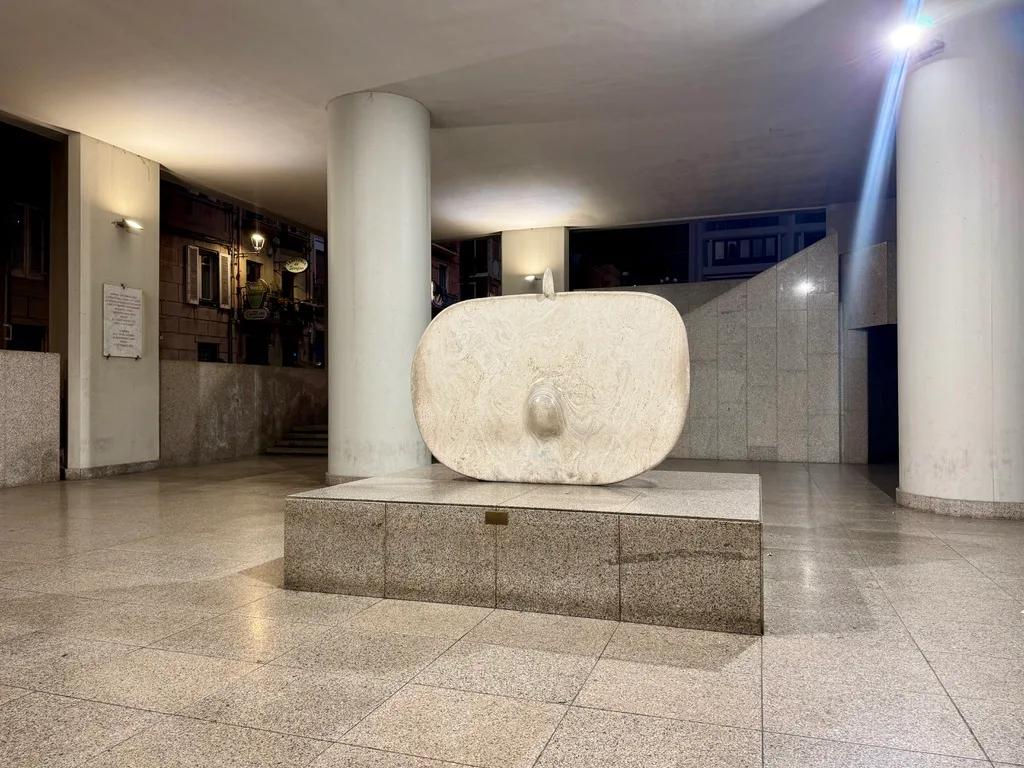
Eight sculptures by Costantino Nivola, one of Sardinia’s greatest twentieth-century artists, stand under the columns and in the square of the Palazzo del Consiglio Regionale on Via Roma in Cagliari. They are outdoors, free to see at any time, and the evening is the best moment, when lamps light the pale stone. They were Nivola’s last major work.
Good to know before you go
- Where: Palazzo del Consiglio Regionale, Via Roma, Cagliari, opposite the port
- Cost: free; the sculptures are outdoors and always accessible
- Best time: in the evening, when the lighting brings out the stone
- Combine it with: a walk along Via Roma and the port
Art in front of the island’s parliament
Most people on Via Roma are looking at the sea, the port and the arcades full of cafés. Few stop at the large modern building behind the columns. It is the seat of the Consiglio Regionale della Sardegna, in effect the parliament of Sardinia, designed by the architect Mario Fiorentino. The Council has met here since 1988.
From the outside the building looks heavy and serious, a typical piece of late-twentieth-century public architecture. What softens it is the art.
The artist: Costantino Nivola
Costantino Nivola (1911–1988) was born in Orani, a village in the heart of Sardinia. He spent much of his life abroad, mainly in the United States, but his work kept its link with the island: its stone, its ancient symbols and its people.
In 1985 he was officially asked to decorate the new Council building. He worked on the project in 1986 and 1987, and these sculptures are considered his last major work. He died in 1988, the same year the Council moved in.
Eight figures in stone
The collection is made up of eight sculptures in marble and travertine, arranged around the building. Some sources count seven, but the Italian Ministry of Culture’s catalogue of contemporary works lists eight.
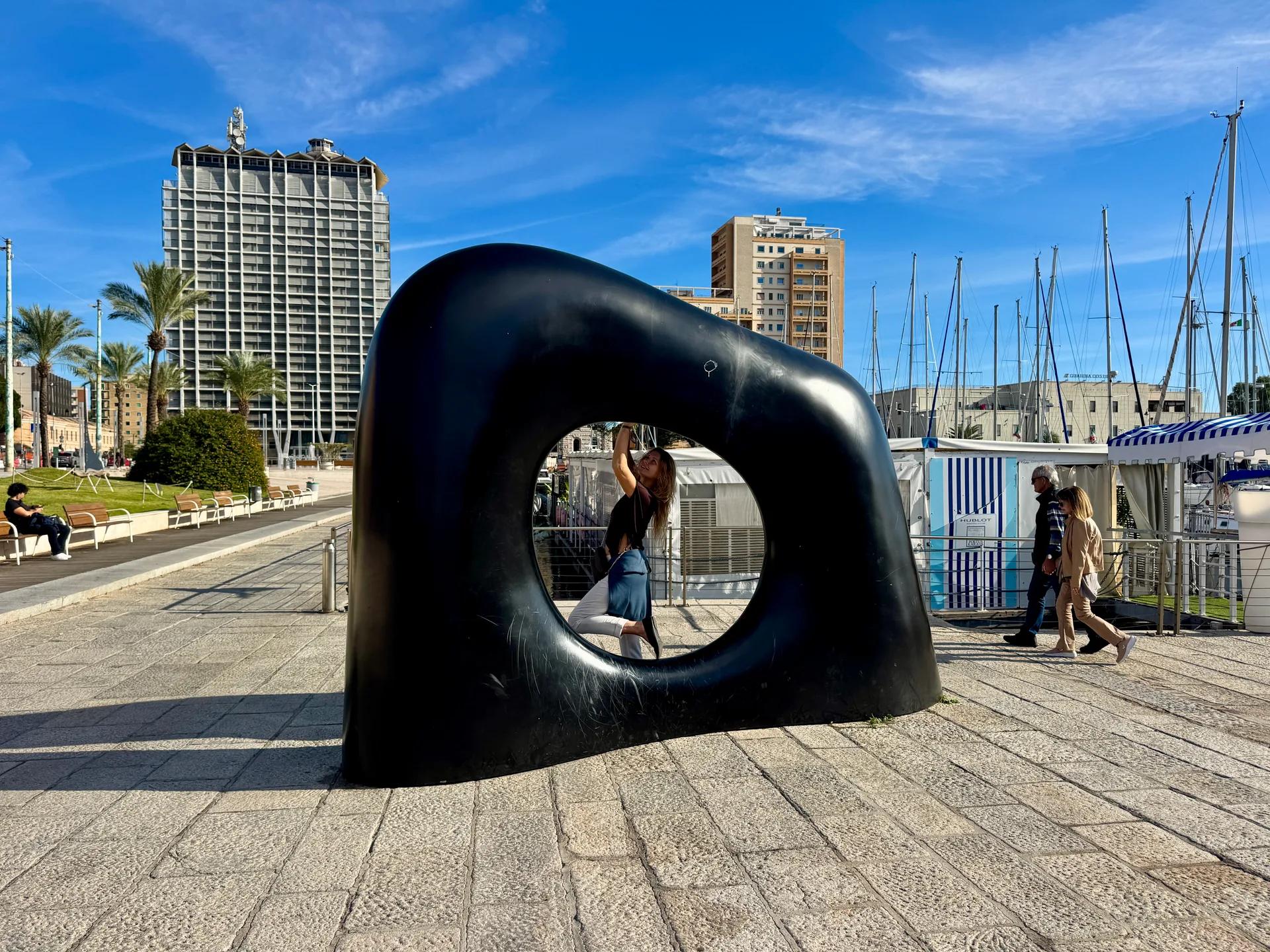
At first glance they look abstract: rounded slabs, stacked blocks, smooth curves. Look a little longer and two figures appear again and again.
The Mother
One of the most striking pieces carries a small brass plaque reading Figura femminile (Madre), Marmo, 1987. It is a large oval of pale, veined marble rising from a granite base, calm and almost maternal.
The Builder
Nearby, another figure is built from angular, interlocking blocks, solid and upright, like a wall raised stone by stone.
Why “Mother” and “Builder”?
Nivola rarely gave his sculptures individual titles. Almost all of his work returns to two figures, the Mother and the Builder, which is why the plaques here read simply Figura femminile or Figura maschile.
The Mother and Sardinia’s deep past
Since the 1950s Nivola had drawn inspiration from the island’s prehistoric female statuettes, ancient images of a mother goddess found in places such as Senorbì and Porto Ferro. For him the Mother stood for fertility, care and the beginning of life. He saw ancient Sardinia as a source of spirituality and community, a counterweight to modern materialism and loneliness.
The Builder and the nuraghi
The Builder is more personal. Nivola’s father was a mason, and as a young man Nivola worked as a labourer himself. He liked to describe himself as an heir of the people who built the nuraghi, Sardinia’s ancient stone towers. For him, building was the essence of art, hence male figures that look like walls of stacked stone.
Set together in front of the island’s parliament, the two form an ancient pair: strength and care, work and life.
A “salt lake” of granite
Nivola also designed the space around the figures. The square in front of the building is paved with polished grey granite slabs that reflect the light like water. He thought of this surface as a “salt lake”, a shining plane on which his figures would rest, like ancient monuments standing in a lagoon.
At night the effect is especially beautiful. Lamps under the columns light the pale stone, the granite floor glows softly, and the white figures seem to float between the massive pillars.
Cows and horses on the walls
Before you leave, look at the exterior walls. Engraved into the granite slabs, across four panels, are drawings of cows and horses. They are made in the style of Salvatore Fancello (1916–1941), a young Sardinian artist and Nivola’s close friend, who died in the Second World War. It is a quiet tribute from one artist to another, in plain sight.
How to visit
The sculptures stand under the arcades and in the square in front of the Council, so you can see them whenever you pass. Evening is the best moment, with the lights on the stone and the street quiet. Walk slowly around each figure: the shapes change completely as you move, and the play of light and shadow on the marble is part of the work.
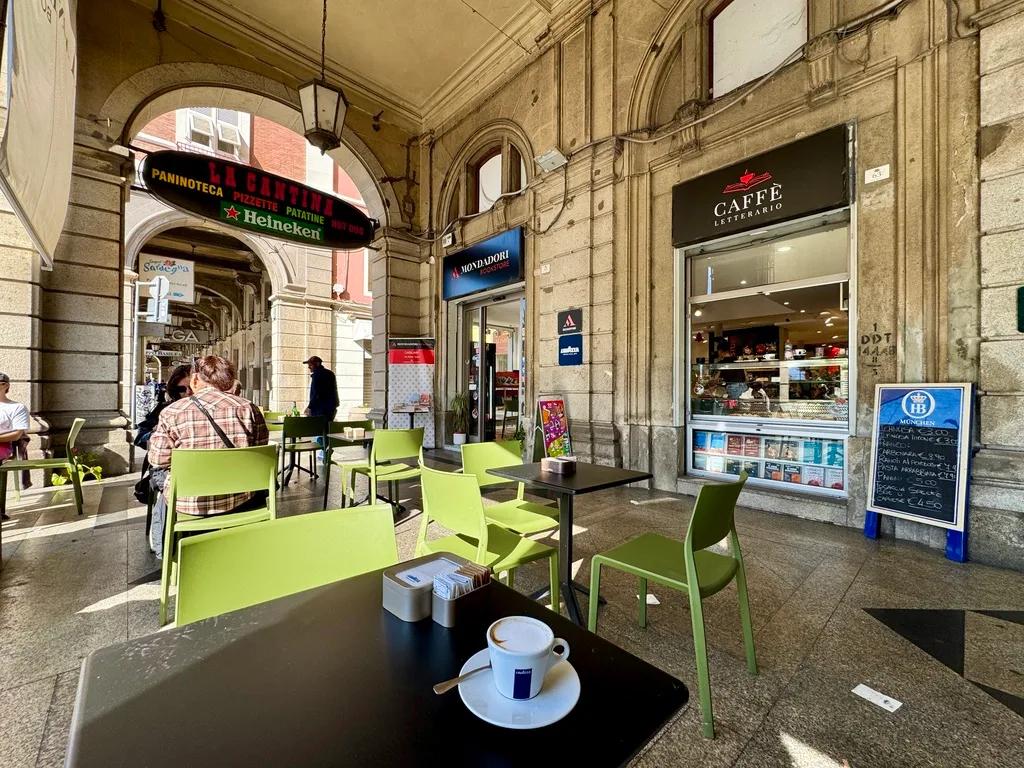
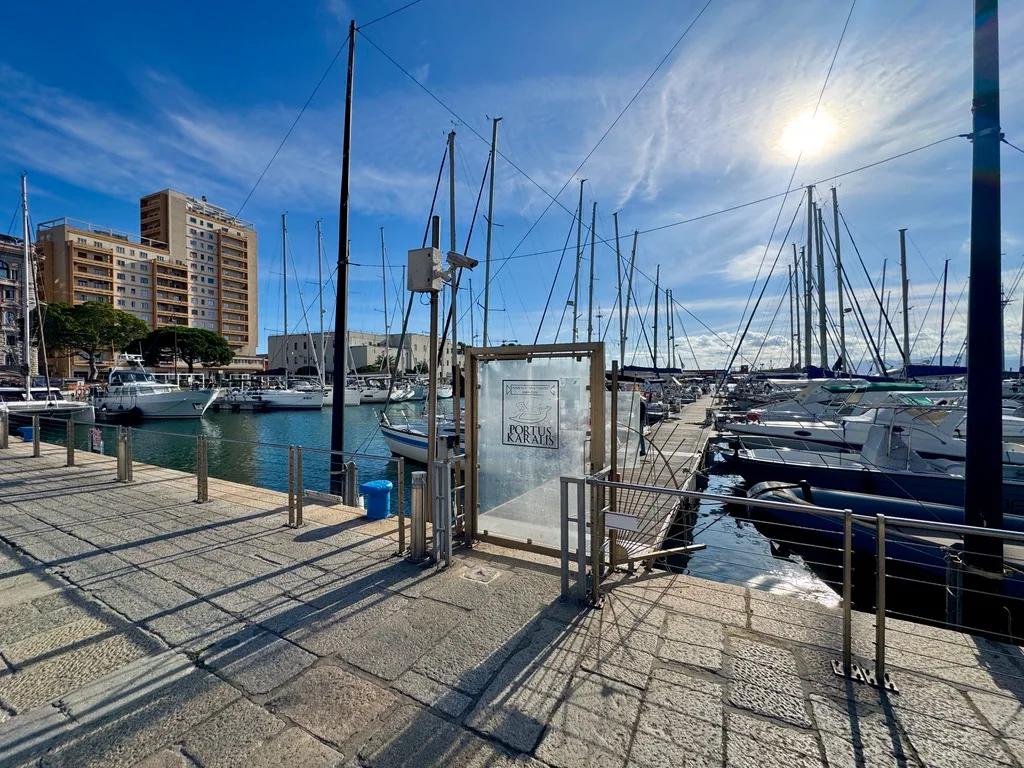
It makes an easy pause in a walk along Via Roma and the port: continue to the Marina di Portus Karalis and Andrea Mura’s sail, or stop for a coffee at the Mondadori bookstore café under the arcades. For more art in the city, see our visit to Mariano Chelo’s atelier in Cagliari, and our guide to what to see in Cagliari in one to three days for the rest of the city.
If Nivola’s work moves you, the Museo Nivola in his home village of Orani, in the hills near Nuoro, holds a large collection of his sculpture. Our Nuoro city guide will help you plan a day in the area. If you are planning a longer stay, our Rental12 ecosystem is a place to start.
In short
The square in front of Sardinia’s parliament is easy to pass by, but worth stopping at. Here Nivola left his final work: eight figures of mothers and builders on a lake of granite in the centre of Cagliari, open to everyone, day and night.