Olbia's Mercato del Sabato is the town's main weekly street market. Every Saturday from 08:00 to 13:00 it fills Via Sangallo, Via Palladio and Via Poletti, the side streets off Viale Aldo Moro, with 95 pitches. It is where people who live in Olbia do their weekly shop, and 12 of those pitches are reserved for farmers selling what they produce.
Olbia Saturday market: quick facts
When: every Saturday morning, 08:00 to 13:00, according to Hello Olbia, the town's official tourism portal.
Where: Via Sangallo, Via Palladio and Via Poletti, off Viale Aldo Moro, north of the centre.
Size: 95 pitches in the layout the city council approved in 2024.
Mix: 53 non-food pitches, 27 food pitches, 12 farmers' pitches and 3 free pitches.
Entry: free, no tickets, no booking.
Bring: cash, a shopping bag and time before 13:00.
Where and when the market is held
The market runs on Saturday mornings in three parallel side streets off Viale Aldo Moro: Via Sangallo, Via Palladio and Via Poletti. OpenStreetMap places these streets in the Quartiere Ospedale, about 1.4 km north of Piazza Regina Margherita in a straight line. On foot from the old town, allow 20 to 25 minutes.
Hello Olbia lists the hours as 08:00 to 13:00. The stalls are set up in the street itself, so these streets are not a place to park on a Saturday morning. Leave the car in the surrounding streets and walk the last few minutes.
The Mercato del Sabato is a weekly market, not a summer event. Hello Olbia lists it without a season, while the summer-only markets on the same page carry their season. A 2023 report in L'Unione Sarda described Via Sangallo as the street where one of Olbia's two local markets is held on Saturdays.
Dates for the rest of 2026
The remaining market Saturdays in 2026 are 7, 14, 21 and 28 November and 5, 12, 19 and 26 December. Saturday 26 December is Santo Stefano, a public holiday in Italy. Check the Comune's notices or ask the tourist office before going on that day.
The Comune can also suspend the market for events. On 2 July 2022 it was cancelled for the arrival of the Giro d'Italia Donne cycle race and came back the following Saturday, as Olbia.it reported at the time.
What you will find on the stalls
The clearest picture of what the market sells comes from the Comune's own layout. In 2024 the city council approved a new plan for the Saturday market. It cut the number of pitches from 102 to 95 and moved the stalls in Via Palladio to the shaded side of the street, especially for the food sellers. Olbia.it's report of the decision gives the split:
53 non-food pitches. In Italian weekly markets this means mainly clothes, shoes, bags, linen and household goods.
27 food pitches. Licensed traders selling fruit and vegetables, cheese, cured meats, bread and other groceries.
12 farmers' pitches. Reserved for farm businesses selling their own produce.
3 free pitches, plus a space in Via Sangallo that can be assigned to non-profit associations and one in Via Poletti for the local police.
The mix has hardly changed since 2016. When the Comune let the pitches for a ten-year term in 2016, the call for applications listed 99 pitches: 58 non-food, 30 food and 11 for farmers, on concessions that run from 9 May 2017 to 8 May 2027.
How local is it?
It is a local market in the plain sense: it is run by the Comune, held in a residential district, and used by Olbia residents for their weekly shopping. It is not a craft fair or a souvenir market.
It is not a farmers' market from end to end. The produce that is local by law is on the 12 farmers' pitches. Under Italian law, article 4 of Legislative Decree 228 of 2001, registered farm businesses may sell retail only products that come mainly from their own farms. If you want fruit, vegetables, cheese, eggs or honey that were grown or made by the person selling them, those are the stalls to find.
The other food stalls are run by licensed traders who buy their stock, so origin varies from stall to stall. Look out for Sardinian staples such as pecorino and pane carasau, the thin shepherds' bread. The label or the seller is the only way to know where a particular cheese or crate of oranges comes from.
A simple question helps. "È vostro?" (is it yours?) tells you whether the seller produced it. "Da dove viene?" (where does it come from?) gets you the farm, the village or the region. On price cards, the figure is per kilo unless the card says "al pezzo" (each) or "a mazzo" (per bunch).
Sardinian food to look for
Stock changes with the season and from week to week, so treat this as a list of what to look for, not a promise of what every stall carries.
Pecorino sardo. A cheese made only from whole sheep's milk and one of Sardinia's three DOP cheeses. Italia.it, the national tourism portal, gives two types: dolce, ripened for 20 to 60 days, and maturo, aged for 5 or 6 months. Ask for a taste before you buy a piece.
Pane carasau and other breads. Carasau is a thin, dry flatbread, light and flat enough to pack in a suitcase.
Spiny artichokes in winter. The carciofo spinoso di Sardegna has DOP status, and its main harvest runs from December to February, according to the food magazine Dissapore. Picking can start in October or November.
Whatever the farmers have that week. On the 12 farmers' pitches the range follows the season on the seller's own land, which is the point of buying there.
Local tips
It is not a farmers' market. Some travel guides call it one, but only 12 of the 95 pitches are for farmers. The rest are traders, and more than half of all pitches sell non-food goods.
It is not in the old town. It runs in the side streets off Viale Aldo Moro, north of the centre. The seasonal tourist market is the one on the waterfront.
Go in the morning. The market ends at 13:00, and there is no afternoon session.
Check holiday Saturdays. The Comune suspends the market for some events, and holiday Saturdays such as 26 December 2026 are worth checking first.
Other markets in Olbia
Hello Olbia lists several other markets. All of them are worth checking before you go, as dates and places can change from year to year.
Tuesday: Mercato Porto Romano, Via Milano, in the centre, 08:00 to 13:00.
Friday: Mercato Campagna Amica, Via Torquato Tasso by Parco Mario Cervo, in the Sacra Famiglia district, 08:00 to 13:00.
Third Saturday of the month: Mercato Contadino at the Olbia Community Hub in Poltu Quadu, 08:30 to 13:30. It is a producers' market that the Hub runs with Slow Food Gallura, with farmers from across Sardinia, as Olbia.it reported in 2025.
Thursday, May to mid-October: the artists' market in San Pantaleo, the village above Olbia. Our guide to shopping in San Pantaleo covers it.
Summer, every day: the seasonal tourist market on Via Principe Umberto, on the waterfront, every day from 10:00 to 23:00.
Make a morning of it
The market is a working morning out rather than a sight, so pair it with something else. The old town and Corso Umberto are a 20 to 25 minute walk south, and our easy day plan for the Olbia waterfront starts from there. For the rest of the town, from the Basilica di San Simplicio to the beaches, see our guide to things to do in Olbia.
Planning more than a morning in town? Rental12, a holiday-rental company in Olbia that shares an owner with Sardinia Blog, lists the markets and shop hours in its Olbia old town walking guide. It is a company guide, not independent research.
Sources: Hello Olbia, markets (June 2026) · Olbia.it, Saturday market layout (1 August 2024) · Olbia.it, call for pitches (30 June 2016) · Olbia.it, suspension for the Giro d'Italia Donne (1 July 2022) · L'Unione Sarda (25 June 2023) · Legislative Decree 228/2001, article 4 · Olbia.it, Mercato Contadino (18 February 2025) · Italia.it, Pecorino Sardo · Dissapore, carciofo spinoso. Checked 3 November 2026.
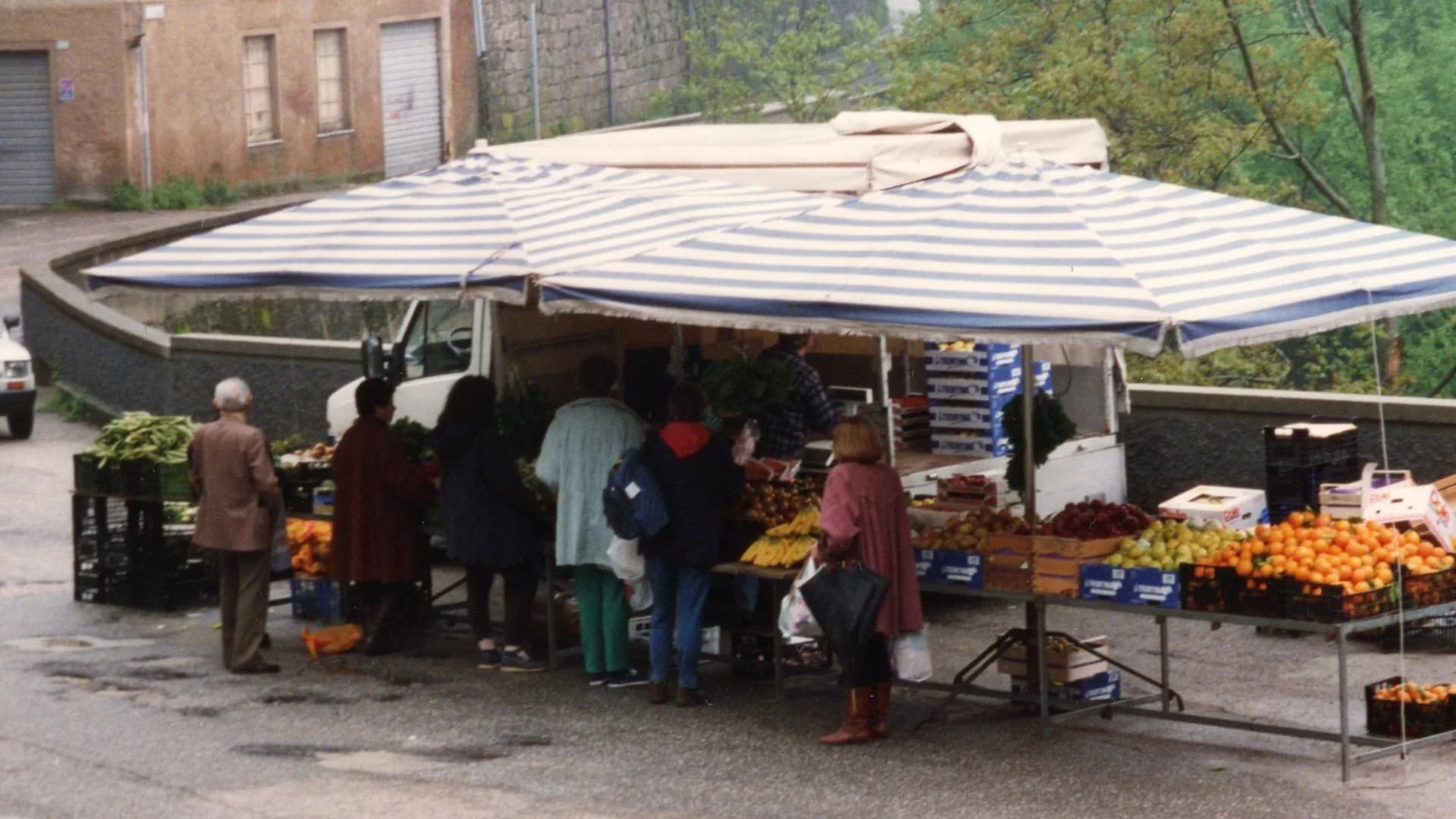
Photo credits: fruit and vegetable stall at a weekly market in Aritzo, Sardinia, 1996 (JopkeB, CC BY-SA 4.0, via Wikimedia Commons); Pecorino Sardo from the Sa Fortaleza dairy (Helge Høifødt, CC BY-SA 4.0, via Wikimedia Commons); pane carasau (Luigi Chiesa, CC BY 3.0, via Wikimedia Commons); Corso Umberto I, Olbia, September 2025 (Dr. Thomas Liptak, CC BY-SA 4.0, via Wikimedia Commons). None of these photos shows the Saturday market itself. Fact sheet and chart: Sardinia Blog, from the sources listed above.