Last updated: November 17, 2026.
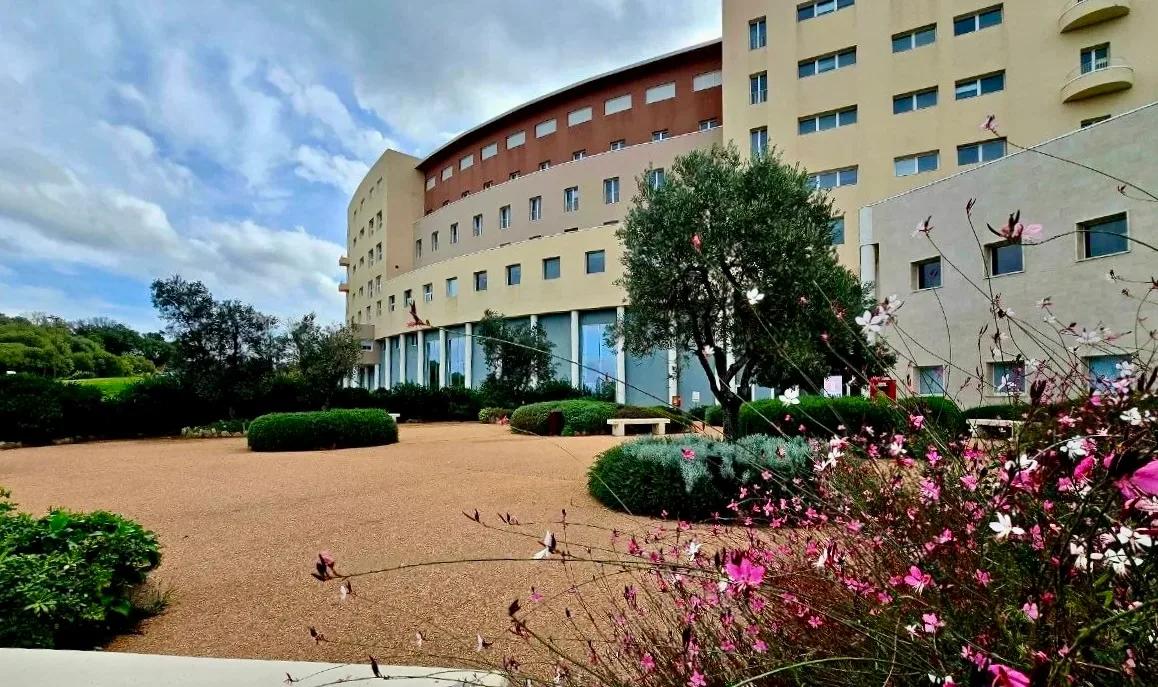
Mater Olbia Hospital, on the SS125 in Olbia, is not a place you would expect to notice for its interiors. This is not a sightseeing stop, and nothing here suggests you should treat it as one. But the author of these notes arrived as a patient, and very quickly the designer in them started paying attention to the building itself. What follows is that account: how a hospital in north-east Sardinia uses art, light and local craft to feel less clinical.
First impressions: a hospital that avoids feeling clinical
What caught the author's eye was the scale of the entrance hall, the natural light, the colour accents, the furniture and the artworks along the corridors. Together they keep the interior from feeling aggressively clinical.
That matters more than it may seem. People often arrive at a hospital anxious, tired or uncertain. In that context, design is not only about aesthetics. Light, proportion, colour, materials and art can shape how a place feels long before a doctor enters the room.
Mater ART: contemporary art as part of the patient experience
Mater Olbia has developed a project called Mater ART, which brings contemporary art into the hospital environment as part of the patient experience. The idea is simple: the space around a person matters. Artworks placed throughout the building create moments of pause, distraction and emotional relief, so the environment feels less institutional and more human.
Art as part of the atmosphere of care
“Here, art is not treated as decoration. It becomes part of the atmosphere of care.”
The Sardinian artists involved
The project includes works by Sardinian artists such as:
- Costantino Nivola
- Mariano Corda
- Ferdinando Medda
- Marco Pili
- Lello Porru
- Emilio Ortu Lieto
That local connection is important. The hospital does not feel culturally anonymous: Sardinian identity appears through art, materials and contemporary readings of traditional craft. If this kind of dialogue between art and place interests you, our piece on the Liquid Art System at W Sardinia follows a different curatorial project on the island.
Art that belongs to the place
One of the things the author noticed was how naturally local identity appears inside a contemporary medical environment. Among the works and design elements is Trigu by Mariantonia Urru, created with designer Paulina Herrera Letelier. Mariantonia Urru is a Sardinian textile company based in Samugheo, a village with a long weaving tradition, known for combining traditional weaving techniques with contemporary design collaborations. For another angle on the island's weaving tradition, see our guide to traditional textiles in Gallura. The weaver's profile on Homo Faber, the Michelangelo Foundation's guide to European craftsmanship, tells the story of the Samugheo workshop.
Seeing Sardinian textile culture in a hospital corridor feels very different from seeing it in a showroom or hotel. Here it becomes part of everyday life, and perhaps that is what makes the art feel relevant rather than decorative: it belongs to the place.
Design as part of care
The most interesting aspect, for the author, was not any single artwork but the cumulative effect of the environment:
- Large windows bring daylight deep into the building.
- Art appears along circulation routes rather than being isolated in a dedicated gallery.
- Strong pieces of furniture introduce colour and help break up large spaces.
- Outside, landscaped areas with olive trees and Mediterranean planting soften the arrival.
The result is a space that feels considered without trying too hard to impress. None of this replaces medicine, of course. But healthcare design works on a different level: it influences whether a building feels intimidating or navigable, institutional or human.
A different kind of luxury
We often use the word luxury for hotels, villas or restaurants. Perhaps one of the more meaningful forms is simpler: dignity in a place where people may feel vulnerable. A chair positioned near daylight. A piece of art that makes you stop for a moment. Materials that do not make a corridor feel like a corridor. A view outside that gives the eye somewhere else to go.
That is how Mater Olbia made the author think about healthcare design: not as decoration, but as care expressed through space.
Practical notes
The hospital is at SS125, 07026 Olbia. As it is a working medical facility, the notes do not cover public access, visiting arrangements or whether the artworks can be viewed outside of an appointment, so check the hospital's website before assuming anything. For the wider area, our Olbia guide covers things to do, our Olbia waterfront walk takes in the city's public art, and our Rental12 ecosystem is a place to start if you are planning a longer stay nearby.