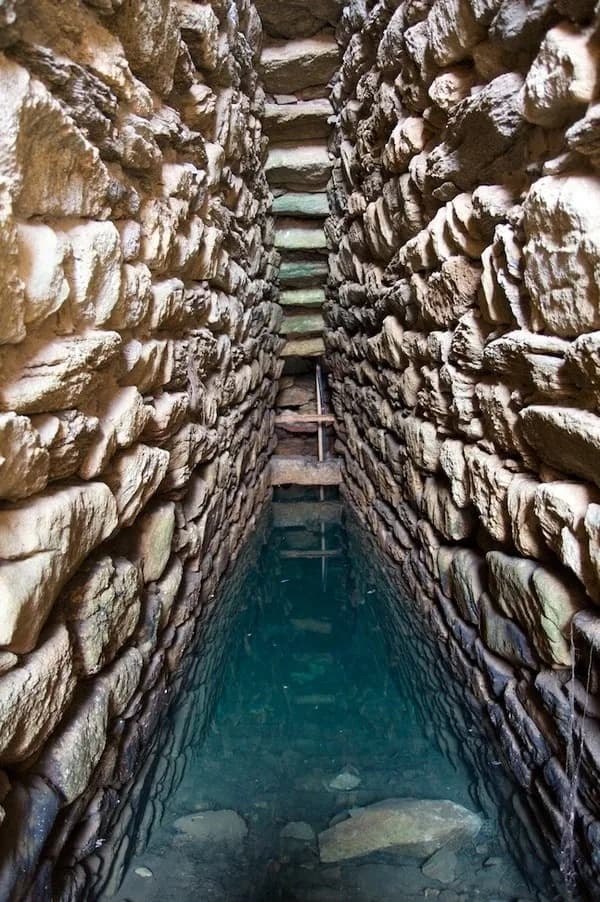

The Milis sacred well (Pozzo sacro Milis) is a Nuragic well temple in Golfo Aranci, on Sardinia's northeast coast. It is not out in the hills: it sits beside the railway station, close to the port, and you cannot simply walk in. This guide sets out what the well is, what is known about its age, and how visits work as of November 2026.
What is the Milis well?
Pozzo sacro Milis is one of the sacred wells built by the Nuragic civilization, in which a stone staircase leads down to a chamber over a spring. The Ministry of Culture's Idese catalog describes it as valuable evidence that the Golfo Aranci area was frequented in the Nuragic age. Sardegna Turismo also points to the "sacred Nuraghic well at Milis" as confirmation that the area has been populated since prehistoric times.
The well is built of finely worked blocks of schist and limestone. A staircase facing southeast leads down to the well chamber, which is closed by a tholos (false dome) roof. Inside, a limestone basin collects water from a spring that still flows. Of the 40 original steps, only 22 rise above the water today. The roof over the staircase is a series of stone lintels that step down in the opposite direction to the stairs, so from below it looks like an upside-down staircase. Sardegna Cultura, the regional heritage portal, gives the staircase as about 9.5 meters long and 1.5 meters wide, and the chamber roof as 9.29 meters high.
How old is it?
The official sources do not give the same date. Idese puts the well in the 8th to 7th century BC. Sardegna Cultura says the monument dates back to the end of the Middle Bronze Age and was used through the later Bronze Age and the Iron Age. Either way it is a Nuragic monument, far older than the town around it.
Discovery, the railway and the finds
The site was discovered in 1883. According to Sardegna Cultura, the monument was partly demolished in the 19th century when the railway station was built, and no trace remains of the vestibule that would once have stood in front of the staircase.
In 1884 the scholar Pietro Tamponi found a small gold ring weighing 10 grams in the surrounding area. In 1937, during excavations directed by Doro Levi, Francesco Soldati recorded three bronze objects: a small dagger, a cord bracelet and an Italic arched fibula. Idese notes that the well went on being used as a cistern until a few decades ago, to supply water to seafarers.
Where it is
Idese gives the location as the railway station area of Golfo Aranci, and the Monumenti Aperti program for May 2025 listed it at Viale Stazione 10, at the station. FAI, the Italian heritage trust, describes the site as lying between two sets of tracks on land owned by the railway company RFI, with the only access through a gated private property.
Sardegna Cultura's directions say to take the Pittulongu coast road (SP 82) from Olbia to the Golfo Aranci station, from where the well is about 300 meters along the railway line, behind a low concrete wall. Do not walk along the tracks or climb walls and gates to reach it. See it on an organized visit instead.
Can you visit?
As of November 2026 we could not find regular opening hours or a ticket office for the Milis well. What the sources confirm is this:
- In March 2025 the Comune di Golfo Aranci announced a public presentation of the first results of restoration work that had recently been completed, together with the heritage authority (Soprintendenza) and the local FAI delegation.
- The well was the focus of the FAI Spring Days of 22 and 23 March 2025, which the Comune described as a special opening.
- It was on the Monumenti Aperti program in Golfo Aranci on 17 and 18 May 2025, with guided visits led by local school pupils, the Pro Loco and an archaeologist. That program said the monument "will soon be open to visitors" after the restoration.
We could not confirm that regular opening has started since then. Before you plan around it, check with the Comune di Golfo Aranci and look at the Monumenti Aperti and FAI pages for the next open days.
Nearby in Golfo Aranci
The Capo Figari promontory rises on the other side of town. Its trails are usually started from the cove of Cala Moresca, and the old signal station at the top is where Guglielmo Marconi conducted radio experiments in 1932 (Sardegna Turismo). The well is a short stop, so it fits easily into the same day.
Respect and safety
- Do not climb on the stonework or drop anything into the water. The spring still feeds the well.
- The staircase is steep and ends in water. Keep children close on any visit.
- The site lies next to railway land. Stay off the tracks and behind the fences.
Sources: Idese (Ministero della Cultura), Pozzo sacro Milis · Sardegna Cultura, Golfo Aranci, Sacred Well of Milis · Sardegna Turismo, Golfo Aranci · Comune di Golfo Aranci, FAI Spring Days and the Pozzo Sacro di Milis · Monumenti Aperti, Nuragic sacred well "Milis" · FAI, Pozzo sacro Milis · Sardegna Turismo, Capo Figari and Figarolo island · Sardegna Turismo, Cala Moresca, Golfo Aranci. Links checked 10 November 2026.