
Last updated: November 26, 2026.
Palmavera is a Nuragic village and complex nuraghe in the territory of Alghero, on the slopes of Palmavera hill between the town and the Gulf of Porto Conte. The first buildings date to the 15th-14th century BC. What you see today includes a two-tower nuraghe, about fifty huts and the Meeting Hut, one of the most interesting rooms on the site. We visited with a guide, and it is one of the easiest and most rewarding archaeological stops in northern Sardinia.
Palmavera at a glance
Where: SS127bis, the road from Alghero to Porto Conte and Capo Caccia, about 10 minutes' drive from the town
What: a Bronze Age village built and expanded in several phases around a complex nuraghe
What to see: the two towers, the tholos roof, the Capanna delle Riunioni and the circular huts
Opening hours: in November and December, 10:00 to 14:00; longer hours from spring, up to 10:00 to 19:00 in May and September
Tickets: €7 full, €5 reduced; a combined visit with the Anghelu Ruju necropolis costs from €12
Run by: Cooperativa SILT, phone +39 329 4385947
Official channels: nuraghepalmavera.it, Facebook and Instagram
Hours and prices are from the official site and Alghero Turismo, checked in November 2026. Reduced tickets apply to ages 6 to 17, students up to 26 and Alghero residents; children under 6 enter free. Confirm before you go, especially in winter.
A village, not just a tower
Many people picture a nuraghe as a lone stone tower. Palmavera shows how much more there was. The site is the remains of a whole settlement, enlarged and reshaped over time until it became an organised community. About fifty huts can be seen today, but according to Wikipedia, the original village may have had around 200, of which only about a quarter is visible.
That changes how you walk round it. Where you now step between low walls, families, craftspeople and herders once lived. The village had spaces for daily life and places for collective gatherings. It is a small Bronze Age town more than a monument. The village was most likely destroyed by fire at the end of the 8th century BC.
The nuraghe and its tholos roof
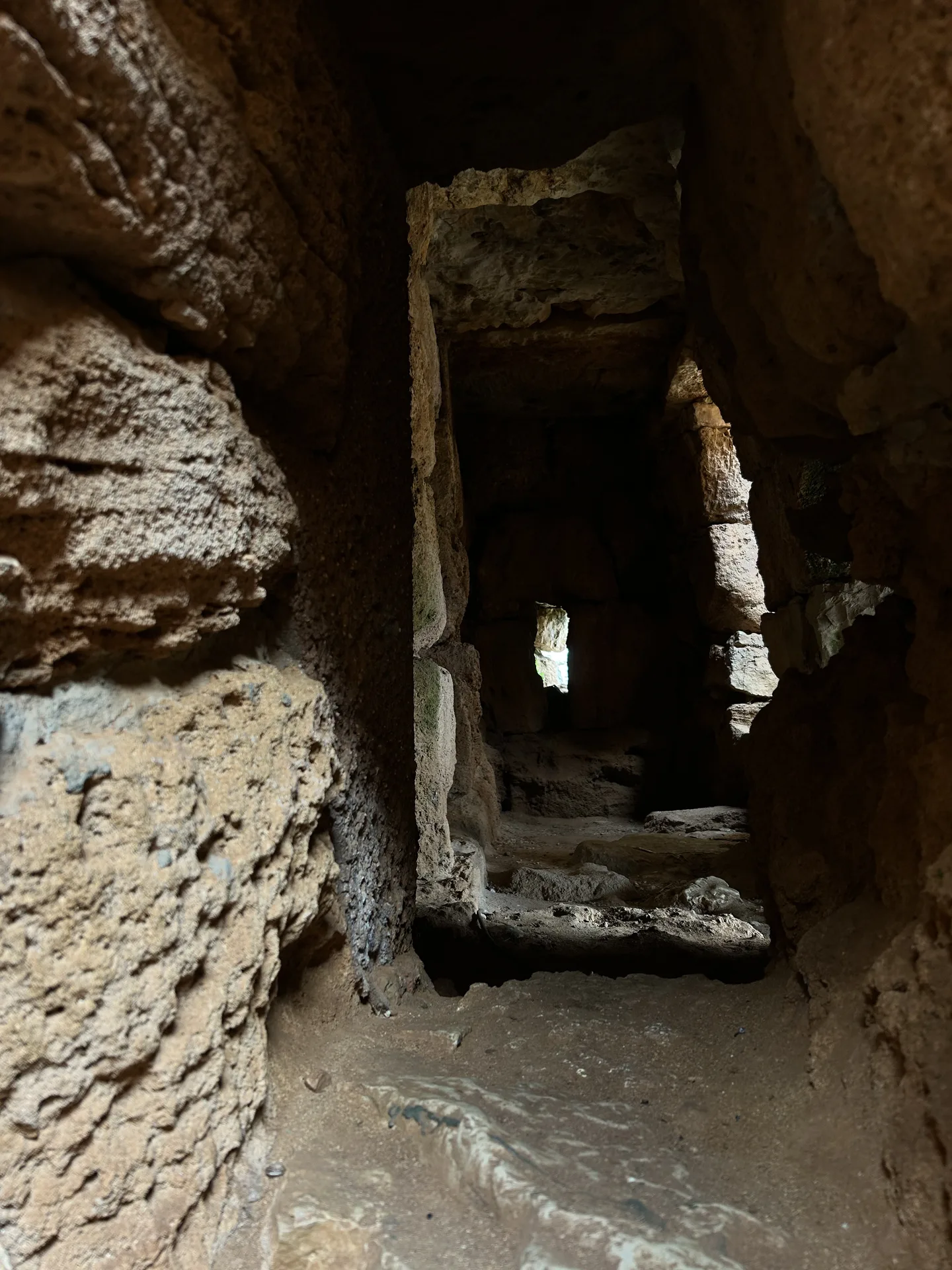
The centrepiece is a complex nuraghe: two towers built in different periods, joined by a courtyard and a corridor. The first tower, of limestone, dates to the 15th-14th century BC. In the 9th century BC a second tower was added and the older one was refaced in sandstone, so you can read the building phases in the colour and character of the stone. The site was first excavated by Antonio Taramelli in 1905, and later by Guglielmo Maetzke in the 1960s and Alberto Moravetti between the 1970s and 1990s.
Inside the main tower you can see the tholos roof, one of the defining techniques of Nuragic architecture. It is a false dome made by laying stones in progressively tighter rings, so the diameter narrows as the walls rise. There is no mortar, no crane and no machinery, only cut stone and a precise understanding of how to balance it. It is worth standing under it for a minute and looking up.
The Capanna delle Riunioni
If you stop at one room, make it the Meeting Hut, built in the 9th century BC. It is a large circular building with a stone bench running along the inner wall. Scholars think it served a public function and probably a ritual one as well, a place where the village's leading figures sat in a circle to talk and decide.
Inside are a stone basin, a round seat beside a niche, thought to be the chief's, and a central altar. On the altar stood a small sandstone model of a nuraghe, which shows how symbolically important these towers were. The original is kept at the Museo Nazionale Archeologico ed Etnografico G. A. Sanna in Sassari, and a copy stands on the site. If you are heading to Sassari afterwards, our Sassari city guide will help you plan the day.
Walking among the huts
The huts are mostly circular and built from stone blocks. Walking between them you can make out rooms, small spaces and the layout of household life: cooking, working, storing everyday objects. Finds from the site, including pottery and bone stamps, are on display in the archaeological museums of Sassari and Alghero.
Who were the Nuragic people?
The Nuragic civilisation developed in Sardinia during the Bronze Age and continued into the Iron Age. It was a structured society that built monumental stone architecture, worked metal, farmed, raised livestock and had contact with other Mediterranean peoples. The nuraghi are now among the best-known symbols of the island.
Many questions remain about exactly what the nuraghi were used for and how the communities that built them were organised. At Palmavera the stones say a lot, but not everything. To compare, see the rare four-lobed towers of Nuraghe San Pietro at Torpè or the Nuragic well temple of Milis in Golfo Aranci. Even older is the Copper Age fortress of Monte Baranta, also near Alghero.
Visiting with children
We recommend Palmavera for families, and you do not need to be an archaeology enthusiast to enjoy it. The site is compact and easy to walk. A good way to engage younger visitors is to ask them to imagine the village: where people slept, how they cooked, which tools they used. It can turn into a treasure hunt among the stones. For another family outing nearby, try the Butterfly House in Olmedo.
Adults benefit too, especially from a guided visit. Someone who knows the site well will point out details that are easy to walk past. The official site also offers a guided tour with an aperitivo and a combined visit with the Anghelu Ruju necropolis.
Making a day of it around Porto Conte
Palmavera sits in an area that also rewards a slower day. Nearby are Porto Conte, the beaches of Lazzaretto and Mugoni, and the scenery of the Capo Caccia headland. A simple plan is to visit the village in the morning, then head towards the sea for lunch or a walk along the coast. In winter, when the site closes at 14:00, a morning visit is the only option.
For the wider area, start with our Alghero travel guide.
If Capo Caccia is on your list, read about Neptune's Grotto, by boat or steps.
If you are building a longer itinerary, our Rental12 ecosystem can help with transport and stays.
Why it is worth the stop
Palmavera shows that long before Sardinia's towns and roads, organised communities were building, gathering and leaving lasting marks on the landscape. It also reminds you that the island is more than its beaches. A short stop here gives the coast around Alghero a deeper time frame.
Sources: Nuraghe Palmavera, official site; Alghero Turismo; Wikipedia, Complesso nuragico di Palmavera. Links checked 26 November 2026.