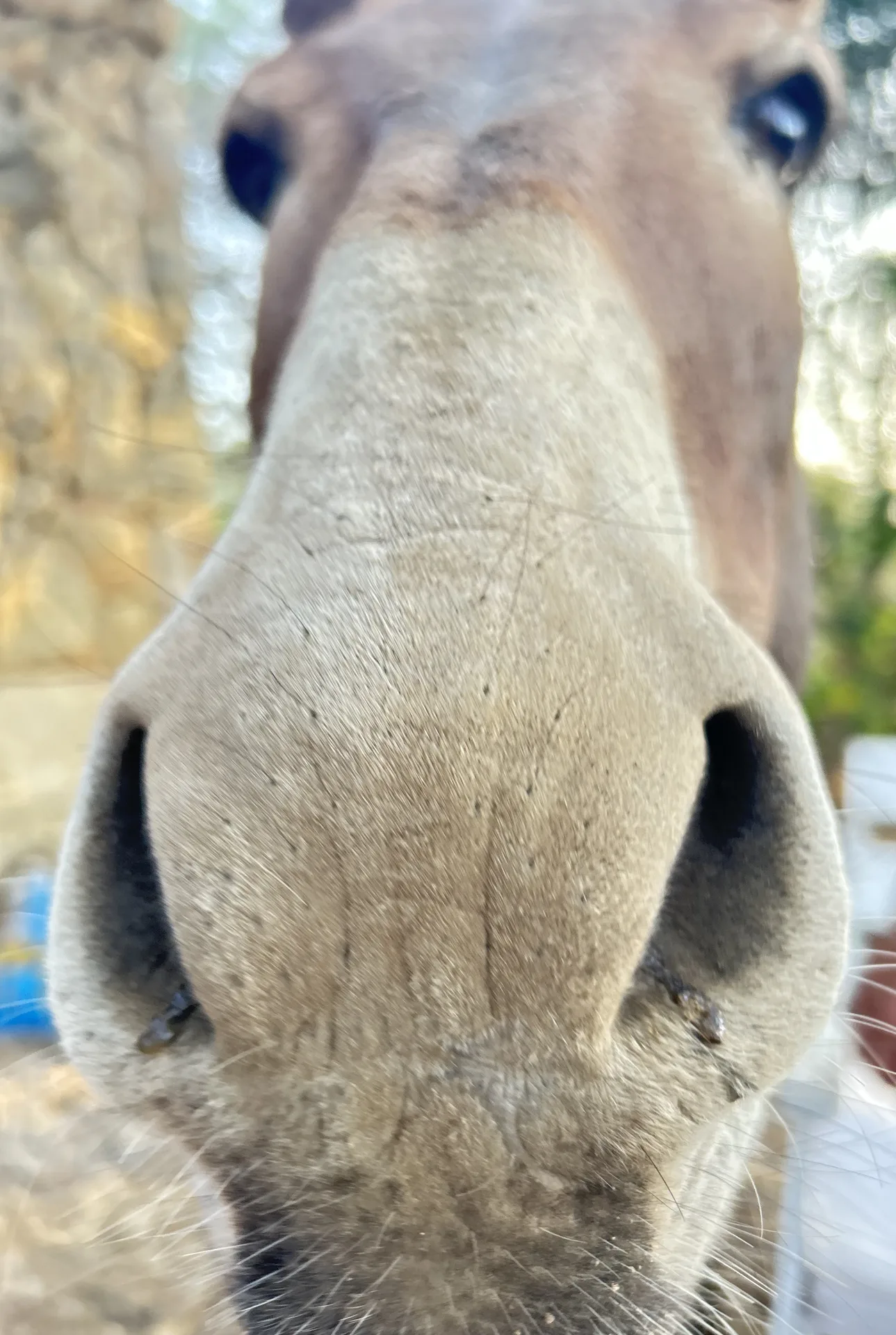

If you rent a house in the Sardinian countryside, you may find donkeys living next door, and some will walk up to your garden. The rules are short: let them come to you, ask the owners before offering any food (bread and kitchen scraps included), and keep your hands off an animal that looks uneasy. If you would like to go looking for donkeys instead of waiting for one at the door, the island has a small gray breed of its own, about 120 white ones on Asinara, and guides who will take you walking with one.
Why you might meet a donkey in the Sardinian countryside
Away from the coast, private land often borders fields where donkeys and other animals are kept. Sometimes a fence separates you. Sometimes, when the animals are used to people, they walk right up to the house.
The classic scene goes like this. You open the door with your morning coffee and a donkey is standing there, curious, apparently waiting for something. It is a surprise for a visitor and an ordinary morning for the people who live here.
There are more of them than most visitors expect. A 2024 report by the Centro Studi Agricoli counted 9,855 donkeys on 2,672 farms in Sardinia, which put the island third in Italy after Sicily and Lombardy.
The Sardinian donkey: small, gray, with a cross on its back
The island's own breed is the asino sardo. It is small even for a donkey. The regional biodiversity register gives a height of 80 to 115 cm at the withers, a mouse-gray coat with a pale belly, and a dark stripe along the back that meets another across the shoulders to form a cross.
For centuries it did the work a tractor does now. It carried water and firewood, pulled the plow and turned the millstone that ground the family's grain, walking in circles inside the house with its eyes covered. The most common Sardinian name for it, molente, comes from that job at the mill. In the south you will also hear burriku, and in Barbagia poleddu or ainu.
When farms mechanized, the numbers fell fast. The register classes the breed as threatened and lists a little over 3,400 animals in the national herd book. Today's donkeys are kept for trekking, for milk, for animal-assisted therapy and as company. A small herd of about twenty is kept by the regional agency at Foresta Burgos, in the hills of the Goceano.
The white donkeys of Asinara
The best-known donkeys in Sardinia are white. Asinara, the island national park off the northwest tip, has about 120 of them according to the park authority, which says recent counts are the highest in decades. They are albino: white coat, pink skin, pale eyes that struggle in bright light. An adult stands about 1 m tall.
Nobody is sure how they got there. One story has a Duke of Asinara importing white donkeys from Egypt. Another has them coming ashore from a ship wrecked on its way to France. The park considers a plainer explanation the most likely: they descend from the gray donkeys the islanders kept, and albinism took hold in a small, isolated herd. Whether the island's name has anything to do with donkeys is also less certain than it looks. The Romans called it Sinuaria, for its winding outline.
The White Donkey Trail
The park has a marked walk named after them, the Sentiero dell'Asino Bianco. It starts at the visitor center in Cala Reale, runs 7.8 km on almost flat ground and takes about three hours, by the park's own figures. It passes the old quarantine station, a former prison outpost and the coastal tower of Trabuccato, and it is on foot only. The park strongly discourages hiking in the summer months, when there is little shade and less water, and recommends spring and fall. For boats and the rest of the island, see our Asinara day trip itinerary.
White donkeys without the boat
You do not have to cross to Asinara. The park authority lists small groups of white donkeys elsewhere in Sardinia, among them Le Prigionette, the forest reserve inside the Porto Conte park near Alghero. The Porto Conte park describes Sardinian donkeys, Asinara donkeys and feral horses living there, with trails you can walk or cycle all year. Opening times change with the season and are posted on the park's site, along with ticket prices.
Walking with a donkey
Several guides on the island offer what Italians call trekking someggiato: you walk, the donkey carries the bags and sets the pace. Small children can usually ride for short stretches. Three we found, with details as each operator published them:
- Orgosolo, Supramonte. A full day sold by the consortium L'Altra Sardegna: about 8 km in a loop from the village, lunch with shepherds and a tour of the murals. €120 for adults and €70 for children aged 4 to 12, with a minimum of four people (page updated April 2026). Our guide to the Orgosolo murals covers the village.
- Cargeghe, near Sassari. About 5 km and three hours, past a Romanesque church, old water mills and a group of domus de janas, ending with an aperitivo. Listed by Escursì from €60 a person when we checked in November 2026.
- Santa Maria Navarrese, Ogliastra. About an hour and a half along the coast toward Pedra Longa, run by two brothers and booked through the Facebook page "Trekking Someggiato Santa Maria Navarrese". In summer it leaves at 17:30 to avoid the heat. We found no published price. The Golgo plateau is a short drive uphill from there.
We have not walked these ourselves, so treat them as leads and confirm dates and prices with the operator.
Etiquette: how to behave around donkeys
Do not feed them bread or kitchen scraps
Many donkeys seem to have worked out that people coming out of a kitchen might mean a snack. Owners sometimes ask friends to save leftover bread for them. That is the owner's call, not yours.
A donkey is built for poor, fibrous food. The Donkey Sanctuary, the British charity that publishes the most detailed feeding advice we know of, says the diet should be mostly straw with some hay or limited grazing, and that sugary extras can lead to obesity and laminitis, a painful hoof condition. Its list of safe treats allows a small handful a day at most, puts bread in the "only when there is a real need" column and rules out potatoes, onions, cabbage and anything sweet. It also asks people not to feed someone else's animals without permission.
- Ask the owners what the animals may eat before offering anything.
- Leave the feeding to them.
- Skip the improvised picnic.
Touching and stroking
A donkey looks so gentle that you want to stroke it, but not all of them like being touched. Some are used to people and relaxed. Others are shy, wary or simply not in the mood.
- Approach slowly, without sudden movements.
- Let the donkey decide whether it wants to meet you.
- Do not stand behind it.
- Do not bring your hands suddenly toward its head.
- Stop at once if it flattens its ears, swishes its tail or turns its back end toward you.
Even the sweetest donkey has its own strength and its own opinions. If trust builds up over a stay, it may start to know you, come over when it hears your voice and greet you with a small bray. It is not a serenade, but it has its charm.
Other animals, and a walk near Olbia
Donkeys are the polite visitors. In the same countryside you may also meet wild boar, mostly after dark, and the advice for them is stricter: see our notes on wild boars in Sardinia. If a morning with the donkeys puts you in the mood for a slow day inland, Lake Liscia and the ancient olive trees of Luras are an easy drive from Olbia, with quiet walks and picnic spots.
When you book a country house, it is worth asking the owner whether animals live on the land next door. Some guests want exactly that. Others have a dog, or small children, and would like to know first.
Thinking of taking a donkey home?
A donkey is not a garden ornament. It needs space, company, a vet, the right food and daily attention. Anyone considering one should learn what it needs and talk to people who keep them. For a visitor, the simplest approach is to enjoy the donkeys you meet, and leave them as you found them.
Sources: Laore Sardegna, regional biodiversity register, Asino sardo · Parco Nazionale dell'Asinara, terrestrial biodiversity and park trails · Parco di Porto Conte, Prigionette · The Donkey Sanctuary, safe treats for donkeys · Sardegna Agricoltura, Asino Sardo · Centro Studi Agricoli report on donkey farming, September 2024. Links checked 24 November 2026.
Rental12, a holiday-rental company in Olbia that shares an owner with Sardinia Blog, lets its own homes in Olbia and Golfo Aranci.